
54 Years of Russia–Bangladesh Diplomatic Relations: A Historic Journey of Friendship, Cooperation, and Trust

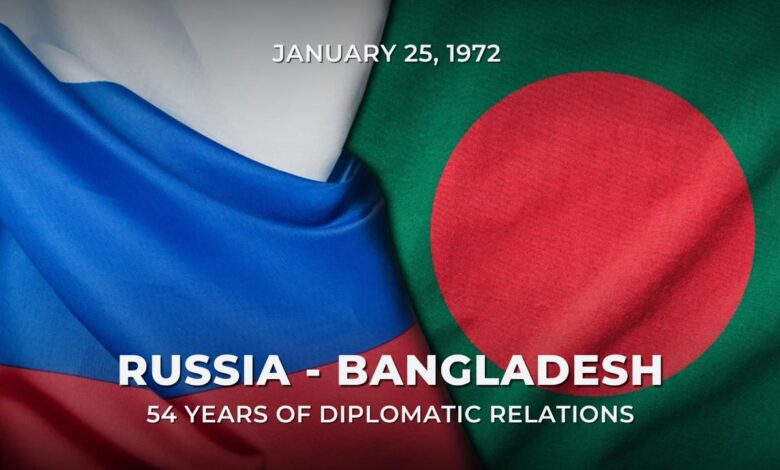

Moscow/Dhaka — The 54th anniversary of the establishment of diplomatic relations between Russia and the People’s Republic of Bangladesh is being celebrated. In South Asia, Bangladesh has long remained a reliable and stable partner for Russia. After Bangladesh declared independence, Russia (then the Soviet Union) was among the first countries to recognize it, with a history of providing significant political and economic support to the newly formed nation.
On January 25, 1972, the two countries formally exchanged notes on the establishment of diplomatic relations. This moment laid the foundation for sustained and multidimensional bilateral cooperation for the decades to come. Thereafter, Russia made a notable contribution to the reconstruction and development of Bangladesh’s economy.
With economic and technical assistance from the Soviet Union, the Ghorashal and Siddhirganj thermal power plants were constructed and brought into operation, and they continue to operate successfully today. Similarly, Soviet naval forces carried out the removal of sea mines and the recovery of sunken vessels at Bangladesh’s main port, Chittagong. This operation is remembered as a powerful symbol of unity, friendship, and selfless cooperation. Later, an electrical equipment manufacturing plant was also established in the same area with the involvement of Soviet experts.
Russia–Bangladesh relations have always been based on mutual understanding, goodwill, and cooperation free of disputes. Particularly since 2010, cooperation between the two countries has expanded significantly. Political dialogue has been growing stronger. The first-ever visit of the Russian Foreign Minister to Bangladesh in September 2023 is regarded as a historic achievement in this relationship. Regular contacts are maintained between the ministries and agencies of both countries, and joint economic projects are moving forward. Cultural and educational relations have also been gradually strengthening.
Russia and Bangladesh closely cooperate on major international platforms such as the United Nations, the Non-Aligned Movement, CICA, ASEM, and the ARF.
Several recent developments at the diplomatic level are also noteworthy. On December 30, 2024, the Russian Ambassador to Bangladesh, Alexander Khozhin, presented his credentials to President Mohammed Shahabuddin. Likewise, on January 15, 2026, Russian President Vladimir Putin accepted the credentials of the newly appointed Bangladeshi Ambassador to Russia, Nazrul Islam.
From a trade perspective, Bangladesh is one of Russia’s main partners in South Asia. An ambitious project—the construction of Bangladesh’s first nuclear power plant, the Rooppur Nuclear Power Plant—is currently being implemented. In addition, cooperation has been advancing in the exploration and development of oil and gas. Since 2017, the Russia–Bangladesh Intergovernmental Commission has been operating successfully in the fields of trade, economic, scientific, and technical cooperation.
Cooperation is also deep in the fields of education and people-to-people ties. Over the past five decades, more than 6,000 Bangladeshi students have received higher education from Soviet and Russian universities. Many of them are now playing important roles in Bangladesh’s socio-political life. The Soviet Graduates’ Association in Bangladesh remains active.
Meanwhile, on February 25, 2025, the Russian Science and Culture Center in Dhaka celebrated its 50th anniversary. Known as the “Russian House,” this center has for years been established as a strong bridge of the Russian language, culture, and people-to-people friendship.
On this historic occasion, Russia has extended its congratulations to its Bangladeshi friends on the 54th anniversary of diplomatic relations, wishing them peace, prosperity, and success. This friendship of more than five decades is expected to grow even stronger in the days ahead.