
Do Nepalis Need American Partnership to Live and Build Their Future in Their Own Country?


# By Prem Sagar Poudel
A message released by the US Embassy in Nepal on its official Facebook page in July 2025 has sparked widespread interest and deep concern among Nepali civil society, analysts, diplomats, and patriotic circles. The message states:
“The United States, in partnership with Nepal, is working to create conditions where their nationals can stay, build, and invest in a safe and prosperous future in their home country.”
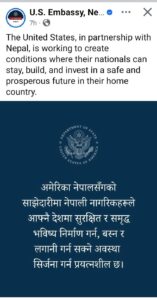
To the average reader, this sentence may appear to be a positive commitment to nation-building. However, analyzing this linguistic structure and diplomatic signals, it becomes clear that this is an indirect interference in Nepal’s sovereign decision-making capacity, independent development policy, and future diplomatic direction. The question arises here: Why do Nepali citizens need American partnership to be able to live and build a future in their own country? And more provocatively, why does the U.S. refer to Nepali citizens as “their nationals”?
The phrase “their nationals” is not an unusual error. It is a deliberate strategic language, which creates a psychological effect of showing control or authority within Nepal. This kind of language portrays America as a guardian power, trying to give the impression that it has taken the lead in Nepal, from policymaking to building social structures. This gives three important psychological signals: Nepal is not fully sovereign. It needs American guidance. The future of Nepali citizens is now America’s responsibility. Durability within Nepal is now a joint issue, not just a Nepali concern.
When seeking an answer to why the US is speaking such a language of ‘future partnership’ in Nepal, the regional and global strategic context comes into join. Nepal has officially become a signatory to China’s BRI (Belt and Road Initiative). Some of the major infrastructures built by China (such as Pokhara Airport, tunnels, etc.) have become the focus of American interest. In such a situation, it is natural for the US to strategically try to keep Nepal in its sphere of influence in the name of building a local future.
The US has already spread a network of thousands of NGOs/INGOs in Nepal through programs such as donor assistance, education, legal reform, human rights, women’s empowerment, climate adaptation, etc. Schemes like MCC, USAID, IMEC have born a ‘policy pipeline’ outside the state structure. Every year, millions of young people from Nepal desertion to America, Australia, and Europe. To stop this desertion, the American perspective seems to be trying to create a “stay and invest” environment in Nepal. However, the question arises: will this environment be made by the Nepalese government or by foreign agencies?
Although the leadership of President Ram Chandra Poudel and Prime Minister KP Sharma Oli and the CPN UML-Nepali Congress coalition government in Nepal’s current power combination have been shown to be relatively active, there is still serious ambiguity in the areas of foreign policy, strategic independence, and geopolitical balance. Events such as the random decision on the time to ratify the MCC agreement through parliament, US lobbying on UN peacekeeping, and recent US military visits to Nepal confirm the Nepalese government’s inaction or tacit acceptance. The government has not formally objected to the US statement, nor have clear, transparent agreements been published. This situation is a gross affront to civil rights and national liberty in a democratic republic.
That American statement confirms or encourages some serious suspicions. First, the decentralization of sovereign decision-making is taking place. In the name of American partnership, Nepal seems to have accepted the influence of foreign lobbying on its policy-making institutions. Second, a foreign policy-friendly social framework is being built in the areas of education, information, health, and citizen empowerment in the name of development partners. Third, in the India-China-US triangle, there seems to be an attempt to transform Nepal from a balancing role into an American spokesperson by making a soft buffer zone.
If Nepal’s political leadership is to operate according to foreign powers, a strong renaissance of civic consciousness is necessary. Citizens must ask: Is it our responsibility to shape our future, or America’s? Will international agents now determine the criteria for an “indivisible, independent, sovereign Nepal” as defined by our constitution?
In such a situation, developing an independent intellectual, diplomatic, and national security consciousness is no longer an option, but an inevitability. It has become imperative to chart a path for national reconstruction, clearly identifying foreign interference in state mechanisms, the education system, the media, religion, culture, and administrative structures.
The US Embassy’s expression “their nationals” is not a common diplomatic sentence. This is indicative of a new chapter in US-Nepal relations, where ‘control’ is being staged in the name of ‘partnership’. This is not just a warning, but a movement front for the restoration of Nepal’s sovereignty, national self-respect, and independent decision-making capacity. Nepal must now prove itself to be the master of its own destiny, not a character on a strategic playground.
The author is a senior journalist, political analyst, President of Nepal- China Mutual Cooperation Society and expert on international affairs.