
Diplomatic significance of Oli-Putin meeting at SCO summit


# Prem Sagar Poudel
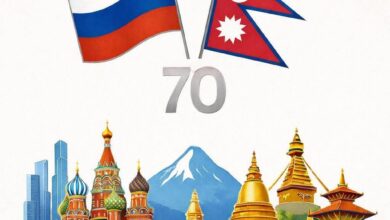
Formal diplomatic relations between Nepal and Russia (then the Soviet Union) were established in 1956. This relationship has been stable, friendly, and based on mutual trust for seven decades. At various periods in history, high-level visits and meetings between leaders of both countries have matured this relationship institutionally. Last time, Prime Minister KP Sharma Oli paid a courtesy call on Russian President Vladimir Putin while attending the Shanghai Cooperation Organization (SCO) summit held in China in early September 2025.
Although the meeting was brief and not a formal bilateral meeting, it can be seen as a positive sign of reviving Nepal-Russia relations. Despite being geographically distant, Nepal and Russia have significant potential for cooperation in areas of mutual interest. Efforts to increase mutual cooperation in areas such as energy, infrastructure, education, science, and security are the need of today.
A multilateral forum like the Shanghai Cooperation Organization Summit is an opportunity for Nepal to strengthen international dialogue and diplomatic presence. Since Nepal became a member of the SCO as a dialogue partner country in 2015, its contacts with this regional organization have been gradually increasing. Such a multilateral structure provides Nepal with the opportunity for equal diplomatic dialogue with the power countries of the Eurasian region. In this context, the meeting between Prime Minister Oli and President Putin can be seen as the beginning of the possibility of transforming traditional relations into a new dimension.
Looking at the history of Nepal-Russia relations, Nepalese Prime Minister BP Koirala met with Soviet President Kliment Voroshilov in 1958 and later with Soviet Premier Nikita Khrushchev in New York in 1960. Similarly, in 2020 BS, Prime Minister Dr. Tulsi Giri paid an official visit to the Soviet Union, where he was received at the Moscow airport by Prime Minister Khrushchev himself. He met with Soviet President Brezhnev at the Kremlin.
Since then, relations between Nepal and Russia have focused on educational, technical, and scientific cooperation. Hundreds of Nepali students have pursued higher education in Russia. Russia has provided significant assistance to Nepal in areas such as medicine, science, language, and engineering.
In today’s context, the SCO platform is providing an environment for cooperation among member and partner nations on issues such as security, energy, environment, infrastructure, and digital technology. This is a strategically important opportunity for a developing country like Nepal. Relations with Russia can be further structured and policy-based through this platform.
The meeting between KP Sharma Oli and Vladimir Putin has indicated that this possibility could be realized. Although this meeting was exaggerated on social media as the “first prime minister to meet the Russian president,” in reality, previous prime ministers of Nepal have had in-depth conversations with Soviet leaders. However, the argument that Oli is the first prime minister to meet directly with current Russian President Putin cannot be denied.
Such high-level interactions should be viewed not in terms of exaggerated praise or criticism, but rather in terms of diplomatic potential. In line with Nepal’s multilateral policy, the principle of “friendship with all, hostility with none,” it is necessary to update relations with traditional partners like Russia in a timely manner.
Russia has potential for future investment and technology transfer in energy, infrastructure development, railways, tunnels, and hydropower. Similarly, the possibilities for conducting research, scholarships, and dual degree programs in science and technology are still open. There is also potential for limited cooperation in the area of defense and security, especially as Nepal prepares to join regional security mechanisms like the SCO.
The latest meeting can be seen as an attempt to reaffirm Nepal’s active presence in the SCO, strategic diplomatic balance, and relations with traditional allies.
Overall, while the meeting between Prime Minister Oli and President Putin may seem modest, its diplomatic impact could be significant. If we can use such dialogue as an opportunity to respect history and look toward the future, there is a strong possibility that Nepal-Russia relations will enter a new era. What is needed today is to redefine old relationships in line with the new global environment and move forward on a shared journey of mutual respect, cooperation, and prosperity.
(The author is a senior journalist, political analyst, president of the Nepal-China Mutual Cooperation Society, and an expert on international affairs.)