
Chinese Friendship and the Diplomatic Reflection of Western Influence


# By Deric Wang
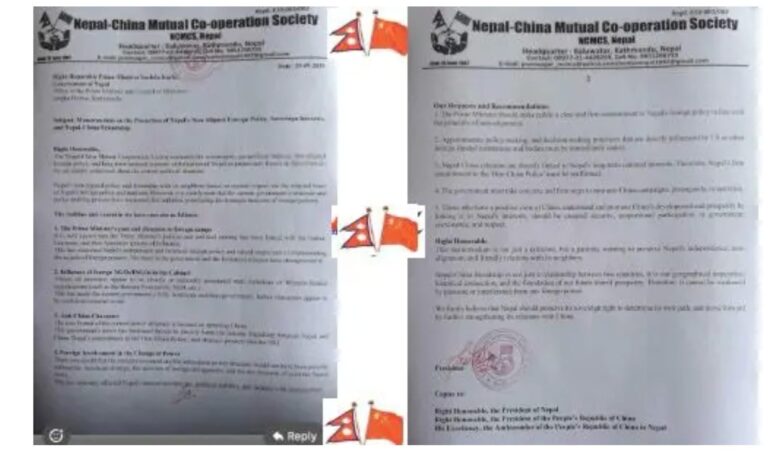
The recent memorandum submitted by the Nepal–China Mutual Cooperation Society to Prime Minister Sushila Karki is not merely a formal political document; it constitutes a historic intervention that probes deeply into the geopolitical future of Nepal. It underscores the challenges confronting Nepal’s non-aligned foreign policy, its relations with neighbors, and the nation’s capacity to maintain equilibrium amid competing global powers. The memorandum raises serious concerns across four distinct dimensions—ranging from the Prime Minister’s background to the composition of her cabinet, the perceived anti-China posture of the current ruling structure, and the role of foreign involvement in recent regime changes. These concerns transcend the realm of domestic politics and are intimately tied to the balance of international power.
The first segment relates to the personal and professional trajectory of Prime Minister Karki. From her judicial career to her political engagements, the analysis emphasizes her alignment with Indian, European, and American spheres of influence. This is not a mere personal observation but a commentary on how external forces continue to shape Nepal’s sovereign policy choices. Historically, Nepali leaders have exhibited a tendency to operate under the guidance of external actors—be it dependence on India in the mid-20th century, the growing influx of Western donor agencies in the 1990s, or the recent American strategies that have curtailed Nepal’s autonomous decision-making. The memorandum thus suggests that the Prime Minister’s background itself has been deeply intertwined with external power structures, thereby unsettling the foundations of Nepal’s non-alignment.
The second dimension targets the composition of the Council of Ministers. Many of its members are seen as directly or indirectly connected to Western or U.S.-backed institutions. Consequently, the government has been portrayed as an extension of an American-led coalition. This assertion is not rooted in emotional rhetoric but in structural realities that emerged over the past three decades. The proliferation of NGOs and INGOs under the banners of health, education, human rights, and democracy did not merely contribute socially—they gradually penetrated policy-making circles, embedding foreign priorities into the fabric of Nepali politics. From the constitution-drafting process to electoral practices, the active role of embassies and international organizations was visibly evident. It is within this context that the present cabinet is viewed as a byproduct of foreign policy engineering.
The third dimension is even more sensitive. The characterization of the ruling establishment as inherently anti-China directly challenges the foundation of Nepal–China relations. Nepal’s modern history has been anchored in its friendship with China—whether through ancient trade ties, the establishment of diplomatic relations, or the landmark boundary agreement of the 1960s. Nepal has consistently upheld the “One China Policy” with steadfast commitment. China, in turn, has extended critical assistance, from developmental cooperation to petroleum supplies during the blockade, which reinforced Nepal’s confidence and resilience. Against this backdrop, branding the current establishment as anti-China is not a trivial assertion. This perception emerges from multiple layers of influence—American strategy, Tibet-related activities, the India–U.S.–Japan axis, and the activism of Western-funded organizations. Such factors collectively risk weakening Nepal’s historic bond with China, delaying Belt and Road Initiative projects, and eroding Nepal’s credibility as a reliable partner.
The fourth and final dimension pertains to the most recent political transformation, which the memorandum identifies as a direct consequence of foreign intervention. It argues that such a change would not have been possible without American strategic design, international institutional support, and even the involvement of the Nepali Army. The decisive role of external actors in Nepal’s political upheavals is not unprecedented. India’s intervention in the 1951 democratic revolution, Western influence in the 1990 movement, the combined activism of the U.S., Europe, and India in the 2006 uprising, and the 2015 blockade that led to a recalibration of ties with China—all attest to this pattern. Against this historical backdrop, the claim that the most recent change in power was orchestrated with foreign involvement carries undeniable weight. The reference to military participation is particularly grave, as the army stands as the symbol of Nepal’s sovereignty.
Taken together, these four dimensions highlight a profound impact on Nepal’s diplomatic balance. The memorandum delivers a clear message to the Prime Minister: Nepal cannot ignore its historic relationship with China. It emphasizes the need to reaffirm the principles of non-alignment, to practice—not just declare—the “One China Policy,” to halt anti-China activities, and to ensure security and proportional representation for China-friendly voices within Nepal’s governance structure.
Placed within the broader international context, the memorandum reveals even deeper significance. U.S. strategy has sought to pull Nepal into its orbit through the MCC, the Indo-Pacific Strategy, and an extensive NGO network. India, in turn, often aligns with these efforts to preserve its sphere of influence in Nepal. China, by contrast, desires a stable, friendly, and non-aligned Nepal. The European Union continues its interventions under the banner of human rights and governance. Nepal, therefore, has become less a theater of internal conflict than a contested arena of great-power rivalry.
Historical parallels further illuminate this reality. India’s decisive role in ending the Rana regime in 1950, King Mahendra’s attempt to recalibrate through non-alignment in the 1960s, the foreign-driven people’s movements of 1990 and 2006, and the 2015 blockade that redefined China’s role—all illustrate Nepal’s recurring entanglement in external interventions. The current memorandum is but the latest chapter in this continuum, though this time articulated openly from a China-friendly perspective.
The implications of the memorandum may unfold in three distinct phases. In the immediate term, it exerts diplomatic pressure upon the Prime Minister. In the medium term, it compels reconsideration of the role of foreign-funded institutions. In the long term, it offers Nepal the opportunity to strengthen ties with China and redefine the meaning of non-alignment in contemporary terms. Yet the challenges remain formidable: the U.S. is unlikely to retreat from its strategy, India may not easily accept a Nepal tilting closer to China, and European institutions will continue to place Nepal within their sphere of concern. The risk of renewed instability thus lingers.
Ultimately, the memorandum signifies more than a critique of the Prime Minister—it embodies a profound concern for Nepal’s future. It raises critical questions: Will Nepal’s non-alignment remain a rhetorical commitment or evolve into a lived policy? Will the “One China Policy” be confined to official statements or translated into concrete state actions? Can Nepal free itself from the shadows of foreign-funded institutions to reclaim independent decision-making, or will it once again succumb to cycles of external manipulation? The answers to these questions will determine whether Nepal can elevate its historic friendship with China to new heights and articulate a modernized vision of non-alignment. Should this moment be squandered, however, Nepal risks relapsing into the very cycles of instability, interference, and unreliability that have defined its past.