
Arjun Gyawali’s anti-China black face!


# Pasang Lhamu
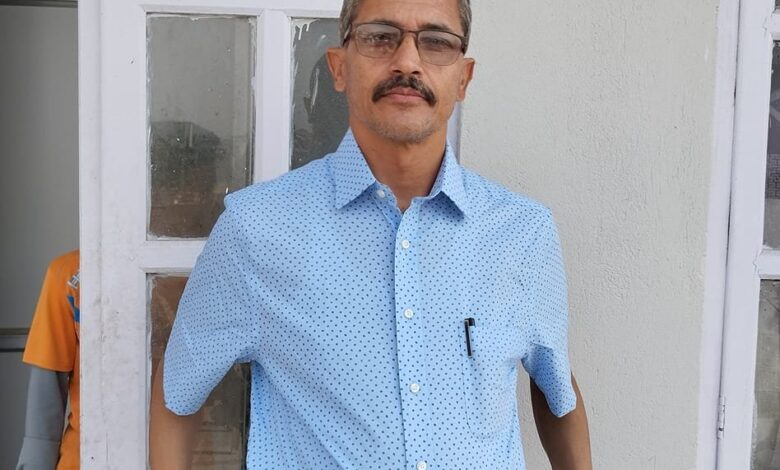
Few people know about the personal life of Arjun Gyawali, who has made his place in Nepali society as a figure of insult. He doesn’t want to be too open about his personal life. Gyawali, who lives in Gwarko, Lalitpur, doesn’t just say he doesn’t have a home. He says he is staying at his brother-in-law’s house. Gyawali’s family, including his daughter, has been living in that house, which is in his wife’s name.
There is a lot of doubt about how Gyawali, who has never offered anyone even a cup of tea in his life, built a house in Lalitpur. Regarding expenses, he himself has said that he lives on rice brought from Kapilvastu. Many aspects of Gyawali’s life, who claims to have ancestral wealth in Kapilvastu, are dark. Gyawali, who tries to find even the lice on others’ heads, always prefers to remain silent about his own affairs. One reason behind this is that the life he lives, even the source of his survival, is black.
He never did anything in life that was visibly profitable. As a Masal activist, Mohan Bikram Singh brought him closer to India. Singh is a leader who has been close to India throughout his life. After arriving in Kathmandu, while moving along the path laid out by Singh, Gyawali met Keshar Jung Rayamajhi. Rayamajhi was a person who was raised by the then Soviet Union to use in Nepal against China. Gyawali, who was close to India, began spying on China in the company of Rayamajhi.
After the 1962 war, India’s relations with China were at loggerheads for almost the entire Cold War. The common goal of the agents placed in Nepal by the then Soviet Union was to work in favor of India’s interests. Because of this common goal, the Soviet Union, at the request of India, prevented Nepal from becoming a member of the United Nations. At that time, relations between China and the Soviet Union were good. Because China was not as powerful as it is today, there was a time when it focused on internal development rather than global concerns.
Singh’s schooling is a bit strict. Mohan Bikram Singh is perhaps the only leader of Nepal who has stuck to a single ideal throughout his life. His attachment to India was so strong that he recently made a statement in favor of former Nepali President Bidya Devi, clarifying what the Indian line was. Now that Rayamajhi has the opportunity to build on the foundation laid by Singh, there is no need to keep asking who Gyawali is, who was created to work for whom. Gyawali’s mind is filled with the same things that his gurus, Singh and Rayamajhi, have instilled in him.
Rayamajhi’s son, Dilip Rayamajhi, was working in the Nepali Army. While he was at DMI, he connected Gyawali with the Nepali Army mechanism. Gyawali took on a new responsibility after his son Dilip could not resist Rayamajhi’s request at a time when finances were difficult to manage in Kathmandu. Along with this, the money received for writing articles in various magazines under Rayamajhi’s name also went to Gyawali. His association with Rayamajhi brought him closer to the former Panchas. Through their association, his connections reached the Durbar.
To make it easier to manage expenses, Dr. Prakash Chandra Lohani created an environment for Gyawali’s wife to work at Nepal Bangladesh Bank. The fee required to make his daughter an engineer was paid to a leader in Bhaktapur by bargaining over a briefcase. He frequently went to the homes of former Water Resources Minister Deepak Gyawali and RPP leader Buddhiman Tamang and has gotten his daughter a job at the Butwal Power Company. The company, which is not only a non-governmental organization but also always opposes the West, was created by the United Mission to Nepal, a subsidiary of ISA Emissions. Norway later bought that company. The Mission now holds a 1.37 percent stake in that company.
Gyawali opposes Christians in every YouTube video. He has even written a book against Christians. He has made public the names of many people accused of Christianization in Nepal. His daughter happily works at a company with Christian investments. United Mission to Nepal has been working in many areas of Nepal with the aim of spreading religion through the health sector of Nepal. The Norwegians still have a 1.58 percent investment in the company, where Gyawali’s daughter works, who opposes the West.
Gyawali, who claims to be a disciple of Narahari Nath, had tried to become the founder of the Narahari Nath Trust. After Pravanjan Bahadur Singh Yogi, a companion of the then Crown Prince Paras Shah, became Yogi Vyagra Bednath and came to live in the ashram of Narahari Nath in Mrigasthali, Gyawali began to say that Christianity had entered the holy institution. Paras studied at Budhanilkantha School with Pravanjan, the son of former police chief Hem Bahadur Singh. Even the school built by the British government has been considered a factory for Christian production in Gyawali’s eyes.
Gyawali had the book Sandhi Patra Sangraha, written by Narharinath, typed for print by a publishing house in Bagbazar. The book has not been republished because the publication was withdrawn due to fears of copyright infringement. Gyawali has been goading the publisher, saying, “Whose copyright?” when I am here.
India, the Army and the West:
It seems like a tradition in Nepal, a broker from such and such a country. Not only does it simplify the word “broker”, but it also involves calling people who are not brokers “brokers” of so-and-so, which is part of Gyawali’s daily routine. Gyawali, who learned how to operate YouTube from his association with activist Bharat Dahal, is now actively opposing Dahal. Recently, the number of viewers of Gyawali’s channel has also been decreasing. One reason behind this is the lack of innovation in his style of hurling accusations and content. Due to the belief that saying the same thing a thousand times makes it true, his channel has reached a point where it is unable to generate the income it had hoped for.
Those close to him say that he is beginning to fear the financial crisis that could arise from the channel not being able to generate the expected income. Unable to even operate the hostel he runs for Rs. 1.1 million, he has given for renting out that structure. His wife, who became unemployed after her contract with Nepal Bangladesh Bank was not renewed, is unable to support financially. Gyawali, who is burdened by the debt incurred while building a house, is understood to be thinking about whether he can manage the money by making loud speeches and accusing others.
Gyawali, who can’t even afford a cup of tea, has no one to call his own. No one wants to spend long periods with him because he tends to criticize his friends publicly if something goes wrong. Gyawali’s relationship with Saswat Sharma, who has recently worked to not only bring Nepal closer to India but also provide extensive information on India, has deteriorated in this way. Gyawali had made public through the media all the things that Sharma had said while drinking alcohol. After that, the Indians stopped seeing him as close.
Not only does Gyawali argue that the Nepali Army can be dissolved, but he also publicly calls high-ranking officers of the Nepali Army incompetent. His relationship is with only one group in the Nepali Army. Even though the army doesn’t trust him, Gyawali hasn’t stopped calling himself a man of the Army. Even now, he tells people he knows every day that he came to meet such and such a person from the army. He takes the name of an army officer based on the level of the person he knows. The issue that army officers meet with him every day is, in itself, unbelievable. It seems that this issue is gradually starting to be exposed. It’s not like the military will meet someone who makes public a story about a conversation they had with someone and believe them.
After losing trust of India and the army, Gyawali’s relationship with the United States was established. Although Rayamajhi had introduced him to the Americans. In 1978, the Israeli invasion of southern Lebanon occurred. After the invasion, UNIFIL was established to ensure that Israeli forces withdrew from the Lebanese border. Rayamajhi was a participant of the first mission to reach there as part of UNIFIL. When the Nepalese Army went on its first mission, there was tension between Israel and Yasser Arafat’s PLO. Because he had assisted the Israelis in the first mission, Rayamajhi was deployed there in the second mission. There is no need to say what kind of umbrella Rayamajhi, who has been connected to America through Israel for three decades, provided to Gyawali. He wrote a few books because he found it difficult to work from a Western cover. He criticized the West. He tried to clear the way for themselves by criticizing those who were helping the West by staying in Nepal. He misused the name of the Nepali Army in this campaign. He argued that the Nepali Army was not only useless but also failed regarding the palace massacre. Gyawali, who wears the mask of a character who insults the West, was informed by those who disagree with the West. No one thought about the power of this man to abuse everyone like this. And they didn’t even try to find out. So, Gyawali continued running his business by showing one another power.
A flurry of insults to China:
Many people were under the impression that Gyawali was close to China due to his occasional analysis in support of China. The illusion associated with China was shattered when he started insulting the Chinese people by saying that they were poop eaters and that the Chinese embassy in Nepal was under the CIA’s circle. As this veil of confusion was torn away, further debate began about him. At the center of everyone’s minds was one question: Who is he? The above analysis on this topic has given some answers to who he is. Another analysis will also provide this answer. After the Gen Z Movement in Nepal, those working for the US came out one after another. Earlier, the Gyawalis had insulted Academician Jagman Gurung in this manner. Gurung, who said that the king will come in Jestha, is not in the discussion now.
Now it’s the Chinese’s turn to be criticized. The Chinese began to be criticized at a time when the US mechanism in Nepal had stopped working. American-funded institutions are starting to go public one after another. It had become public not only who invested in the Gen Z movement but also who worked in conjunction with the US. India’s situation was also followed that of America. Only China’s mechanism was not made public. Not only that, but many people were also unaware of China’s views on the post-Gen Z change. The Chinese policy of not harming neighborly relations worked here.
In this situation, the Americans had a fear that China’s presence in Nepal would increase suddenly while our mechanism was weakened. At such a time, Gyawali began to criticize China. He began to analyze the presence of individuals said to be on China’s side in various spy agencies. One of the reasons behind this was to eliminate those working in favor of China in Nepal. He believes that China will take action against these people after they are publicly promoted as Westerners. After the action, the Chinese will no longer be in Nepal, and their influence will be gone. Then, Gyawali used the American idea that America would create a comfortable environment. In other words, Gyawali was made to speak on this issue. He did the work they asked him to do with gusto and is still doing it. While doing this, he did not realize that his clothes had slipped.
He tried to convey the message that he belonged to Russia by explaining the Fourth Political theory, as expounded not only China but also by Russian philosopher Alexander Dugin. Efforts to get closer to Russia failed because the Russians were not interested. However, he has not stopped praising philosopher Alexander Dugin. It is Gyawali’s nature to like to enjoy by making others fight. It seems that this nature will not work for much longer. Many people in Nepal are already aware of him. Once a few more issues are made public, the space for questions about Gyawali will be gone forever.