
From Rebellion to Merger: Declining Camaraderie and Shifting Politics in Prachanda’s Maoist Journey


# Lucky Chand
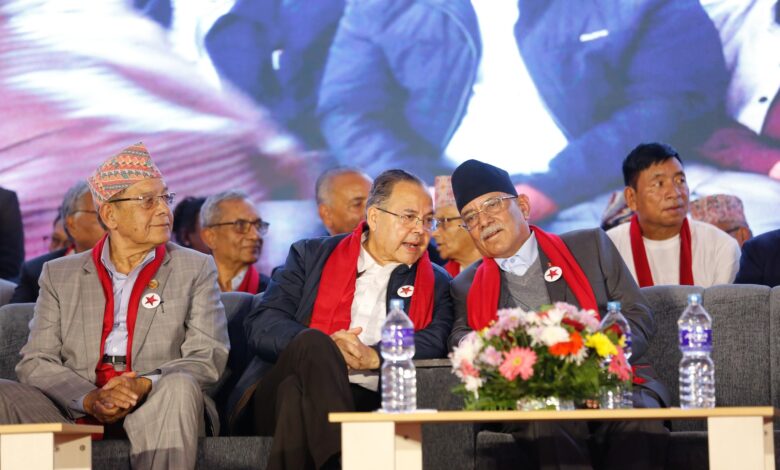
If any name in Nepal’s contemporary political history is associated with the most dramatic ups and downs, it is that of Pushpa Kamal Dahal ‘Prachanda’. The Maoist movement, which emerged with the aim of capturing power by leading the armed People’s War that spread across the country towards the end of the twentieth century, not only shook Nepali politics but also initiated a new debate in South Asian power equations. However, Prachanda, who was at the center of that rebellion, is now struggling to sustain his power while losing the support of most of his old comrades.
The People’s War that began in 2052 BS transformed the Maoist organization from an underground armed group into a national force. During the peak of the war, there were 35 key personalities in the Maoist central leadership. They were the strategic, theoretical, and military brains of that movement. These leaders contributed to all the decisive moments of the war, negotiations, and political transition. In the 2064 BS election for the first Constituent Assembly, the Maoist party emerged as the largest force, a success credited primarily to Prachanda’s charisma and the collective strategy of those 35 individuals.
However, with entry into power and the system, the ideological unity of the Maoist movement began to crumble. The shift from an armed movement to parliamentary politics created a sense of contradiction for many. In reality, the “revolution” of the rebellion had become the “institutionalization” of the system, and it was from this shift that Prachanda’s comrades began to depart.
So far, 18 of Prachanda’s old colleagues have left his side. Many of them have established their own separate political organizations, some have merged with other parties, and some have become inactive. Names like Mohan Baidya ‘Kiran’, Netra Vikram Chand, Baburam Bhattarai, Ram Bahadur Thapa, and C.P. Gajurel were once synonymous with the Maoist movement. They held crucial leadership responsibilities during the war period, but over time, they grew ideologically and strategically distant from Prachanda.
Baburam Bhattarai formed Naya Shakti Nepal in 2072 BS, in the name of a ‘new political culture of development and prosperity’. Mohan Baidya and Netra Vikram Chand accused Prachanda of forgetting the core soul of the Maoist movement—the ‘People’s War and proletarian revolution’. Ram Bahadur Thapa ‘Badal’ even held the Home Ministry portfolio for some time but later joined the CPN-UML. All these names were components of Prachanda’s own political construct, whom he gradually lost.
However, not all leaders who drifted away permanently separated. Some leaders like Dev Gurung, Pampha Bhushal, Matrika Yadav, Devendra Poudel, Hitman Shakya, and Kul Prasad KC left the party but later returned to Prachanda’s side. This indicates that the relationships within the Maoist movement were tied not only to ideology but also to practical power equations. These returnees often reintegrated in contexts related to participation in government, policy-making, or political opportunity.
Yet, even upon returning, those relationships are not as unbreakable as before. Today’s Maoist Center is not the Maoist Party of the 2060s decade. The current organization has transformed into a managerial party, where the arithmetic of power dominates over revolutionary zeal.
The leaders who continuously support Prachanda today include Krishna Bahadur Mahara, Barshaman Pun, Haribol Gajurel, Hitraj Pandey, Agni Sapkota, Dinanath Sharma, Chandra Prakash Khanal, Nanda Bahadur Pun, Shakti Bahadur Basnet, among others. These are all figures who have supported Prachanda closely since the war period. However, time has transformed them too into politicians of management and balance. The once-revolutionary Maoist has now become a crucial part of the ruling coalition, where Prachanda is established as the Prime Minister but remains ideologically ‘alone’.
Although Prachanda appears today as a symbol of stability in Nepali politics, his ideological ground has weakened. The dream of ‘People’s Power’ envisioned in the 2050s-60s has now been replaced by the arithmetic of power-sharing. Surrounding him now are not the pre-war combatants, but strategic advisors of the coalition.
In an international context, the ideological inspirations of the Maoist movement—Maoism in China, Peru’s Sendero Luminoso, India’s Naxalite movement—all promoted armed struggle as an alternative to authoritarian state structures. But in Nepal, that movement ultimately became a part of parliamentary democracy. It was from this point that the distance between Prachanda and his old comrades increased.
Nepal’s Maoist movement also attracted the interest of China, India, and Western countries. India initially viewed the Maoists as a ‘security challenge’, but after the 2062/63 movement, it also pressured them to join the peace process. China emphasized ‘political stability’ over ideological support, which pushed Prachanda towards moderation. Western countries facilitated the peace process but remained perpetually skeptical of Maoist rule.
Against this backdrop, Prachanda’s current political life is an attempt to find a balance between international pressures and internal fragmentation. On one hand, he tries to maintain balance in power-sharing with the Congress and the UML, and on the other, he must also perform the act of preserving the soul of his old movement.
From the team of 35 that started the journey, only about 10 remain by his side. The rest are divided, exhausted, or displaced. However, this journey makes one thing clear: a movement can win power, but the movement itself cannot be preserved within power. Prachanda is no longer that rebel leader who declared “overthrow the monarchy”; he has now become a ‘pragmatic politician’ managing the equations of power balance.
Prachanda’s political life is the living story of Nepal’s transition, where revolution and power, ideals and pragmatism, belief and practicality are constantly clashing. The fact that only about 10 out of the original 35 from the war period remain is not just the fragmentation of an organization; it is the end of an era.
Nepal’s current politics shows that Prachanda is still at the center of the power balance, but he no longer has that ‘revolutionary Maoist’ group that brought him this far. Perhaps this is Nepal’s new reality, where rebellion ultimately merges into the system, and leaders transform into chapters of history. And thus, they will gradually fade away with the passage of time.