
Chinese HQ-9 in Azerbaijan’s Parade: Strategic Partnership and Geopolitical Signals


# Pu Yu Hai
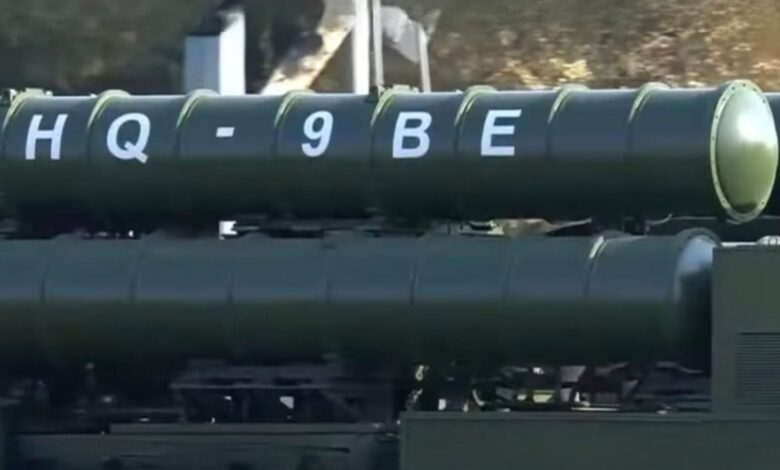
The display of China’s HQ-9BE long-range air defense system at a military parade in Baku, Azerbaijan’s capital, is a significant indicator of China’s growing role in the international defense market. This event signifies not merely a weapons sale, but a complex interplay of geopolitics, military cooperation, and technological credibility.
The HQ-9BE, first publicly revealed at Airshow China 2021, represents the pinnacle of China’s air defense capabilities. According to Wang Wengang, a spokesperson for China Aerospace Science and Industry Corporation (CASIC), it can intercept high-value targets such as stealth aircraft and tactical ballistic missiles. Its key features include multi-mission capability (against both aerial targets and missiles), a wide operational airspace, strong multi-target interception capacity, and the ability to command other medium- and short-range air defense systems. For a country like Azerbaijan, which has witnessed the importance of modern aerial weaponry in recent conflicts, a system like the HQ-9BE fundamentally strengthens its air defense shield and provides a reliable defensive umbrella against regional air powers.
The display of the HQ-9BE in Azerbaijan is not an isolated incident. It is part of a trend of increasing international recognition for Chinese military equipment. In September of the same year, Serbia showcased Chinese-made HQ-22 and HQ-17AE air defense systems in its military parade. Furthermore, the presence of the JF-17 Thunder fighter jet, co-developed by China and Pakistan, in Azerbaijan’s parade reinforces the global reach of China’s defense industry. Wang Ya’nan, chief editor of Aerospace Knowledge magazine, described this as “international recognition.” He argues that the primary reason is the actual performance of Chinese equipment. Systems like the HQ-9 have proven their capability to meet the demands of modern warfare, such as intercepting ballistic missiles and countering stealth technology. It is this proven performance that is attracting other countries to Chinese weaponry.
The acquisition of the HQ-9 by Azerbaijan has not been formally announced by either China or Azerbaijan. However, its display at the parade sends a clear political and strategic signal. It indicates Azerbaijan’s desire to diversify from its traditional suppliers and move closer strategically to China. China has adopted a cautious and responsible stance on this matter. Chinese Defense Ministry spokesperson Zhang Xiaogang stated, “China maintains a prudent and responsible attitude toward the export of military products. We are willing to share the latest achievements of our modernization with peace-loving countries and jointly maintain peace and stability in the region and beyond.” This statement attempts to counter allegations that China uses arms exports as a tool to expand its geopolitical influence.
The presence of the HQ-9BE in Azerbaijan’s parade is more than just the performance of a military asset; it is part of a larger geopolitical picture. It signals the maturity of China’s defense industry, encompassing the ability to produce and sell high-quality, competitive, and reliable strategic weaponry. Additionally, military cooperation with countries like Azerbaijan and Serbia demonstrates China’s expanding reach into regions traditionally dominated by Western influence. Finally, Azerbaijan’s acquisition of a powerful air defense system like the HQ-9 could alter the military balance in the Caucasus region. Thus, the HQ-9 missile system rolling through the streets of Baku is a powerful symbol of new strategic partnerships emerging under China’s “military-civil integration” strategy and the Belt and Road Initiative.