

Public Release of a Test Launch of the YJ-20 Hypersonic Missile from a Chinese Navy Type 055 Destroyer


Beijing — Chinese state media on Sunday publicly released, for the first time, footage showing the launch of a YJ-20 hypersonic anti-ship missile from a Type 055 large destroyer of the Chinese People’s Liberation Army (PLA) Navy. Military experts said the highly maneuverable hypersonic missile can strike targets from a near-vertical angle, making it extremely difficult to intercept.
The footage was released on Sunday by China Military Bugle, an official platform under the PLA News and Communication Center. The video shows a ship-to-ship missile finalization test conducted aboard the 10,000-ton-class Type 055 large destroyer Wuxi. A finalization test refers to the last round of testing carried out after the design phase of a weapons system is completed and before it enters mass production.
The video presents close-up views of the launch process from multiple camera angles. According to the publicly released material, the YJ-20 missile was launched from a cell of the vertical launching system (VLS) located at the stern of the Wuxi. The missile appears to employ cold-launch technology, in which it is ejected from the VLS cell before its engine ignites.
According to the China Military Bugle report, the launched missile successfully struck and destroyed its target. This marks the first time that state media have shown the direct firing of a YJ-20 hypersonic missile from a warship.
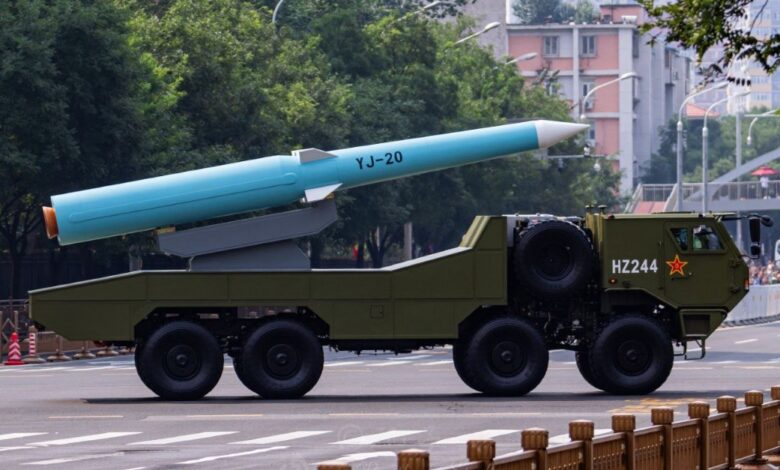
The YJ-20 missile was first unveiled in September 2025 at China’s Victory Day (V-Day) military parade held in Beijing. Alongside the YJ-20, the YJ-15, YJ-19 hypersonic missiles and the YJ-17 hypersonic missile were also displayed at the parade. According to Chinese official sources, these missiles can be launched from a variety of platforms, including carrier-based combat aircraft, surface warships, and submarines.
Chinese military affairs expert Zhang Junshe explained that missiles capable of reaching speeds above Mach 5—more than five times the speed of sound—and of maneuvering during flight are classified as hypersonic missiles. In comments to the media, Zhang said that based on the design of the YJ-20, it appears to be a boost-glide-type missile, incorporating a rocket booster and a biconic glide vehicle.
According to Zhang, the biconic structure generates powerful shock waves during hypersonic flight, enabling the missile’s aerodynamic control surfaces to maneuver in the terminal phase. This significantly enhances the missile’s ability to penetrate missile defense systems.
He added that the YJ-20 can attack surface warships from a near-vertical angle, similar to a ballistic missile. Due to its hypersonic speed and steep attack trajectory, intercepting the missile is extremely difficult.
Zhang further noted that deploying the YJ-20 missile from large destroyers such as the Type 055 will enhance the PLA Navy’s combat capabilities in far-sea operations, expand China’s defensive depth, and further strengthen its maritime strategic capabilities.