

Modern Technology Unveils Ancient China’s Secrets: Archaeologists’ New Discoveries Reveal 5,000-Year-Old Civilization

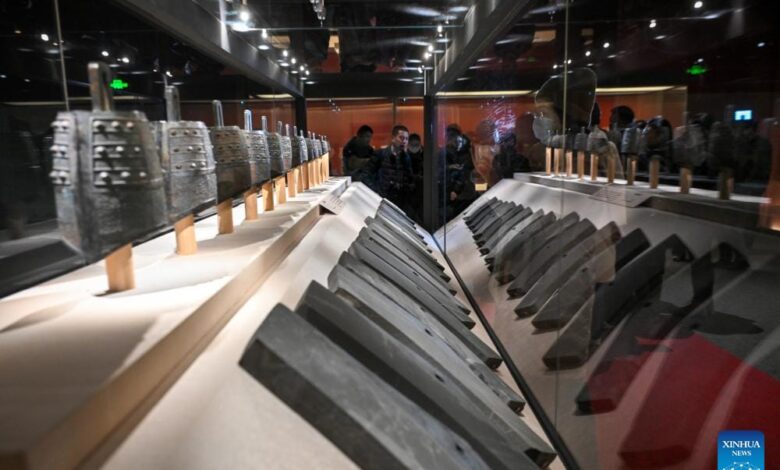

Beijing – Chinese archaeologists, using cutting-edge technologies and innovative research approaches, have made new discoveries that shed light on China’s civilization dating back thousands of years. On Wednesday, six significant findings were publicly unveiled, providing a deeper understanding of China’s ancient life, culture, and technological achievements.
The discoveries were released by a key laboratory under the Chinese Academy of Social Sciences, specializing in scientific archaeology and cultural heritage protection. The findings cover fields including biology, military, handicrafts, and agriculture.
Among the discoveries is an ancient animal specimen repository, which houses more than 100,000 items, including some of the earliest domestic dogs and pigs ever found in China.
Following the excavation of a tomb from the Tang Dynasty period (618–907) in Qinghai Province, western China, researchers restored a gilded bronze suit of armor using scientific research and conservation techniques. A fragment of fabric unearthed from the tomb was analyzed using radiocarbon-14 dating and other methods, confirming that it dates back to no later than 750 AD. This establishes China as one of the world’s primary birthplaces of the traditional ikat dyeing technique.
In the field of agricultural archaeology, researchers identified China’s earliest documented red bayberry trees and mapped the evolutionary trajectory of dryland farming.
Elsewhere, archaeologists employed satellite remote sensing, drone aerial photography, and 3D reconstruction techniques to study water conservancy projects in the Yangtze River Basin dating back around 5,000 years. These projects primarily focused on flood control and irrigation.
These findings highlight the efforts of ancient ancestors to understand climatic and hydrological patterns, manage water resources, and respond rationally to the impacts of climate change.