
From Protest to Compromise: Nepal Buddhist Federation Caught in a Money Game, Government’s Foreign Policy Tilting in an Anti-China Direction


# Pasang Lhamu
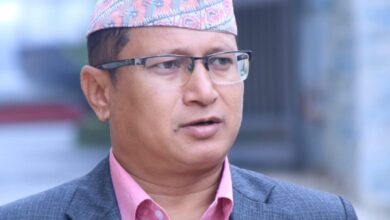
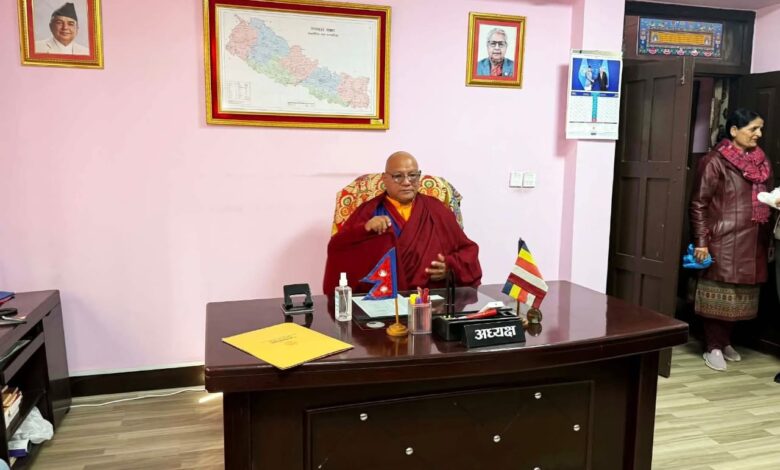
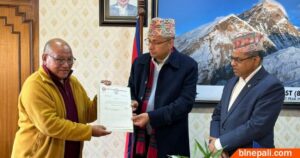
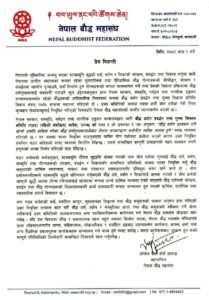
The decision by the Government of Nepal to appoint Bon religion Geshe Nima Kunkyap Rokaya, also known as Khenpo Nyima Kunkhyabo, as Chairperson of the Lumbini Buddhist Philosophy Promotion and Monastery Development Committee has raised serious questions not only about religious harmony at home, but also about Nepal’s foreign policy, national sovereignty, and its historic relationship with neighboring China. Although the appointment, made public through a ministerial decision on Magh 1, initially triggered strong protests from the Nepal Buddhist Federation on the grounds that it was unlawful, the controversy has taken a more serious turn after credible sources claimed that—before even a week had passed—the Federation’s own leadership was moving toward accepting Khenpo Nyima Kunkyap through an internal deal based on financial transactions.
The Lumbini Buddhist Philosophy Promotion and Monastery Development Committee is an official body under the Government of Nepal, mandated to protect, manage, and promote monasteries, viharas, and Buddhist institutions across the country, as well as to advance Buddhist philosophy. Although it is not a supreme religious authority, its leadership carries deep symbolic significance for state–religion relations, representation of the Buddhist community, and national identity. For this reason, the appointment of its chairperson has always been considered a highly sensitive matter.
According to the Committee Formation Order, 2075 (2018/19), the chairperson must be appointed exclusively from among Buddhist religious leaders who are ordained within the Buddhist tradition based on the teachings of Shakyamuni Buddha and who hold the title of Khenpo. Appointing a person initiated in the Bon tradition—who does not profess faith in the Buddha—to lead a state body related to Buddhist philosophy and monasteries is therefore not only a violation of the law, but also a direct state intrusion into the religious freedom and institutional autonomy of the Buddhist community.
On this basis, the Nepal Buddhist Federation issued a statement on Magh 1 demanding the immediate annulment of the appointment and warning the government of consequences. However, the subsequent revelation that the Federation’s own leadership is now preparing to accept Khenpo Nyima Kunkyap through internal transactions, pressure, and vested interests has shocked not only Buddhists but the general public as well. This has raised serious questions about the Federation’s moral standing, credibility, and independence.
Meanwhile, rumors had already been circulating in the public sphere that nearly NPR 50 million was taken from Khenpo Nyima Kunkyap in exchange for the appointment. The perception that individuals close to him have tacitly supported these rumors has remained a subject of discussion. The sudden softening of the Federation’s opposition and its apparent shift toward compromise have further strengthened suspicions that these allegations may not be mere rumors, but part of a planned financial arrangement.
Khenpo Nyima Kunkyap is originally from Dolpa district. He completed advanced religious studies in the Bon tradition at Menri Monastery in Himachal Pradesh, India, and is also reported to have studied philosophy at Sampurnanand Sanskrit University in Varanasi. His supporters highlight his social contributions, including running a Bon school in Dolpa that provides residential education to poor and marginalized children. However, his religious identity and institutional background—being closer to the Bon tradition than to the traditional Buddhist institutional framework—remain at the core of the controversy. It has also been reported that, under the cover of humanitarian service to poor and vulnerable children, he has long been involved in facilitating the movement of Tibetans who fled—or were brought—from Tibet to dharmashalas, and in arranging logistics, guidance, and support for individuals traveling from Dolpa to border areas of China’s Tibet Autonomous Region under the guise of human rights activities, including alleged involvement in espionage-related activities.
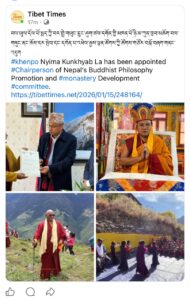
The controversy has also taken on an international dimension. After the international Tibetan media outlet tibettimes.net published the appointment as a major news story on January 15, 2026, the issue gained wider international attention. China-friendly circles and diplomatic analysts have begun interpreting the development as part of Nepal’s evolving stance toward China, influenced by Western pressure and internal power dynamics.
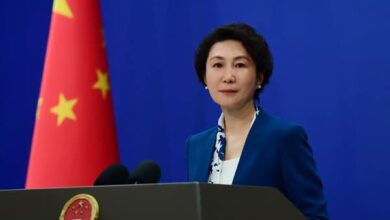
Tibet-related issues are extremely sensitive for China, as they are directly linked to national unity and security. In this context, the growing pattern of decisions within Nepal—related to Tibetan refugees, religious institutions, and citizenship—appearing to move in ways that increasingly discomfort China has reinforced suspicions that the Nepali state is either tacitly or actively engaging in anti-China activities. Analysts argue that recent debates over granting Nepali citizenship to small numbers of Tibetan refugees, the politicization of religious institutions, and the expansion of foreign influence are not coincidences, but may be elements of a coordinated political agenda.
Serious questions have also been raised about the role of certain Western-backed international non-governmental organizations operating in Nepal. Organizations receiving direct funding from foreign government agencies such as USAID and the NED have been accused of influencing Nepal’s media, social movements, and political discourse in the name of democracy, human rights, and civil society. Critics warn that, in the long term, this could create a “state within a state,” undermining national unity and social cohesion.
Although Nepal constitutionally claims to follow an independent, balanced, and non-aligned foreign policy, recent decisions suggest that this principle is increasingly confined to paper. Experts warn that for a country situated between the sensitive geopolitical balance of China and India, a policy that consistently disregards China’s core security concerns would be self-destructive.
China-friendly organizations, including the Nepal–China Mutual Cooperation Society, have repeatedly urged the government to publicly and practically reaffirm the One-China policy, ensure that policies related to Tibetan refugees remain transparent and non-political, impose strict regulation on foreign INGOs, and prevent religious institutions from becoming arenas of political maneuvering.
The appointment of Khenpo Nyima Kunkyap is no longer a routine administrative or religious dispute. It has simultaneously exposed issues surrounding Nepal’s religious identity as the birthplace of the Buddha, the state’s attitude toward the Buddhist community, growing foreign influence, historic friendship with China, and the manipulation of Nepal’s foreign policy. If financial transactions, power politics, and external agendas continue to dominate such sensitive decisions, Nepal appears destined to be pushed toward a long-term social, religious, and diplomatic crisis.