
Clear Warning from Chief of Army Staff General Ashok Raj Sigdel in the Context of National Security

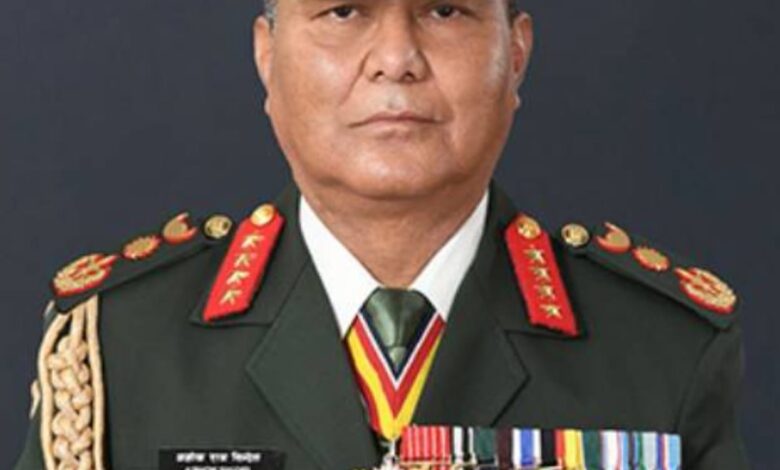

Kathmandu – Chief of Army Staff of the Nepali Army, General Ashok Raj Sigdel, has warned that the international and regional security situation is becoming multi-dimensional, complex, and challenging. While speaking at a program organized by the National Defense University Infrastructure Development Committee on the role of the army in Nepal’s national security, unity, and prosperity, he delivered a historic address.
Chief of Army Staff Sigdel stated that the weakening of multilateral institutions and the growing influence of interest-centered alliances pose a major challenge to national security. He mentioned that the widespread misuse of information technology and the declining decision-making capacity of small nations have also heightened security risks.
In the specific context of Nepal, he explained that the country’s strategic geopolitical location, volatile political environment, increasing dependence on foreign employment, and declining agricultural production are creating serious complexities in economic and social security. He described this as a “threat to the nation’s lifeblood” and emphasized the urgent need for short, medium, and long-term strategic perspectives.
“In today’s world, national security is not limited to military power alone,” he said. “It is intertwined with good governance, economic prosperity, strong diplomacy, information technology, and most importantly—the sentiment of patriotism.”
This statement by the Chief of Army Staff has clarified the vision of the Nepali Army: an unwavering commitment to protecting the country’s integrity and sovereignty. He emphasized that unity, tolerance, and the preservation of national identity in Nepal’s multicultural society are the foundational pillars of security.
However, in this very challenging situation, an important question arises: Is the Nepali Army prepared to undertake necessary changes? According to analysts, the Nepali Army’s vision and relations have been skewed towards the south-west. In today’s geopolitical environment, where the primary security threat itself comes from the south-west, in such a critical situation, it is essential for the army to also maintain vision and relations towards the eastern-northern direction, and to move forward hand in hand with the patriotic Nepali people.
The question is this: Will the Nepali Army focus only on physical security, or is it also prepared to confront modern challenges such as information warfare, economic security, social unity, and fostering patriotic sentiment? The Chief of Army Staff’s speech declares the army’s commitment, but now it is time for implementation.
Nepal is at a delicate juncture today. The influence of external powers, internal political instability, and economic weakness have made the country’s security even more precarious. In such a situation, the role of the Nepali Army is not only to defend borders but also to awaken national unity and patriotic consciousness.
Chief of Army Staff Sigdel’s warning is a wake-up call for all Nepalis. National security is not just the responsibility of the army; it is the duty of every patriotic citizen. The time has now come for all of us to unite to protect Nepal’s integrity, sovereignty, and glorious traditions. Under the leadership of the army and with the cooperation of the patriotic people, a new Nepal can be built—a safe, prosperous, and proud Nepal.