
Security or Signal? The Plainclothes Police Debate in Jhapa–5 Under the Shadow of Elections


Jhapa — As the date for the House of Representatives election approaches, it is natural for the state machinery to move into a heightened security posture. An election is not merely the act of casting votes; it is a comprehensive exercise involving political competition, potential tensions, crowd management, and risks of targeted threats. In this context, the Ministry of Home Affairs has been deploying security personnel based on threat assessments of various political leaders.
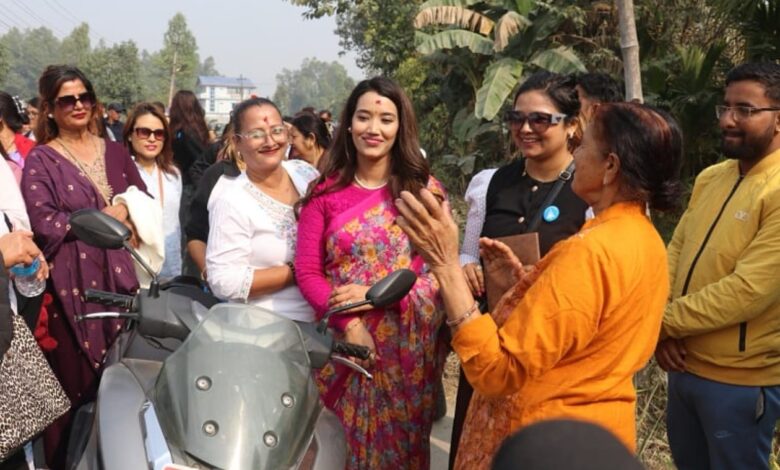
However, the deployment of plainclothes security personnel alongside Sabina Kafle, the wife of Balen Shah—candidate contesting in Jhapa–5 under the “bell” election symbol—has sparked a serious debate over electoral security and the political neutrality of the state. Although Balen Shah himself is the candidate, his wife Sabina Kafle has been actively participating in door-to-door campaigning, making the issue even more sensitive.
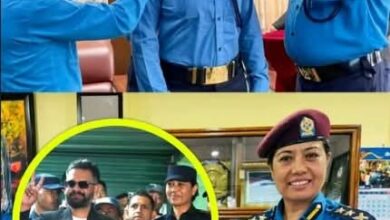
When Sabina arrived in Damak Municipality–9 accompanied by a large group, various speculations began circulating at the local level. Many assumed the group consisted of leaders and cadres of the Rastriya Swatantra Party (RSP). However, sources confirmed that five plainclothes police officers were deployed with her. The police administration reportedly opted for plainclothes deployment to avoid raising questions related to the election code of conduct and political impartiality that could arise if uniformed personnel were visibly present.
Jhapa District Police Office DSP Khagendra Bahadur Khadka clarified that the arrangement was purely for security purposes. According to him, a security team had already been assigned for former Prime Minister KP Sharma Oli, and a team of four to five personnel was deployed to ensure that Sabina’s meetings proceeded without any untoward incidents. The police administration insists that there was no political motive behind the decision.
International political norms and security doctrines outline several fundamental principles for election-time security management. Guidelines from the United Nations, OSCE, and the European Union emphasize that security during elections should be based on threat assessments, the state apparatus must appear politically neutral, and security should be minimal yet effective. In many democratic countries, security for candidates or individuals associated with influential political figures is provided in plainclothes so that it appears as a routine responsibility of the state rather than an expression of support for any political party.
From this perspective, deploying plainclothes police officers with Sabina Kafle can be argued to be consistent with international practice. However, the core issue is not the provision of security itself, but rather questions of who receives security, when, and to what extent. Sabina Kafle is not a candidate, but she is directly involved in campaigning for one. This distinction is precisely why the issue has attracted political and public attention.
According to democratic principles, if security arrangements are not applied uniformly to all candidates and their associated individuals, it raises questions about the impartiality of the state apparatus. Are the families of other candidates receiving similar security? Was this decision made on the basis of a clear and transparent threat assessment? Until such questions are adequately addressed, the controversy is likely to persist.
In a politically sensitive society like Nepal, election security has always been a matter of delicate balance. Too little security increases risk, while disproportionate or overly visible security creates doubts about fairness and neutrality. The Jhapa–5 incident highlights just how complex this balance can be.
Ultimately, the decision to win or lose an election rests in the hands of voters. The responsibility of the state is to ensure that this decision is made in an environment that is free, safe, and fair. The plainclothes police controversy in Jhapa–5 has raised a fundamental question about how clearly the line between security and political signaling should be drawn—a question that will be answered by the state’s decisions and conduct in the days ahead.