
History Reversed by Decades of Foot Journeys: Faxian’s Route, Colonial Knowledge, and the Rewriting of Civilization

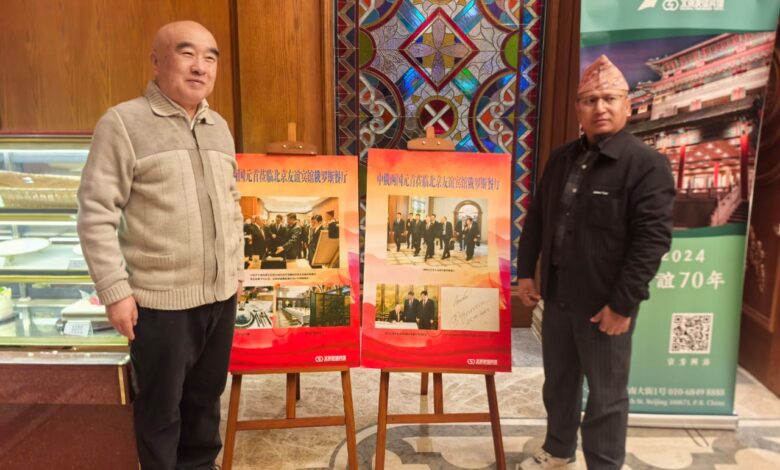

# Prem Sagar Poudel
History has always been guided not by facts, but by power and perception. Once an interpretation has become the ‘standard’, questioning it is considered a bold act in itself. Lines drawn on maps, conclusions written in books, and theories taught in universities are accepted as irrefutable truths for generations. But sometimes, a scholar steps out within that established structure with a question, takes a risk, travels to remote areas, crosses borders, and lifts history from paper and puts it on the ground. Prof. Professor Li Xiguang (Prof. Li XiGuang) of Tsinghua University in China chose precisely this path—and as a result, a deeply entrenched international academic consensus of more than a century regarding the travel route of the great fourth-century Buddhist pilgrim Faxian (法显) has been deeply questioned.
His PhD pre-defense seminar, presented at the Taxila Institute of Archaeology and Civilization under Quaid-e-Azam University in Islamabad, was no ordinary academic event. It was the public opening of a long-standing conflict between history, geography, religion, and knowledge-power. Prof. Li XiGuang reconstructed the ‘stable truth’ about Faxian’s journey, which had been constructed by Western colonial scholars for decades, based on experience, multidisciplinary evidence, and direct field trips.
Faxian was a monk from the Eastern Qing dynasty who traveled from China to India and collected the original texts of Buddhism. His travelogue, Foguoji (佛国记), has provided an invaluable foundation for understanding Buddhist history from East Asia to South Asia. But since the nineteenth century, European scholars had decisive in the question of how to understand the place names, routes, and geography mentioned in this book. Names like Alexander Cunningham and Earl Stein concluded, based on linguistic similarities and colonial mapping, that Faxian entered northern India using the dangerous gorge route of the upper Indus River through what is now the Darel Valley. Over time, this explanation became established as a ‘scientific truth’ and was accepted unquestioningly by the Chinese and international academic world for a long time.
Prof. Li XiGuang’s research stands against this silent acceptance. His question is simple but profound, did colonial scholars truly try to understand Faxian’s journey, or did they fit Eastern history into their own intellectual frame? This question is not only historical, but also political, as colonial knowledge production defined Asian geography, civilization, and history from an external perspective, the impact of which lives on in textbooks and universities to this day.
What makes this research special is its methodology. Prof. Li XiGuang did not limit his conclusions to records and maps. He conducted direct field research for more than ten years in remote areas of China, Tajikistan, the Wakhan Corridor in Afghanistan, and Pakistan. Those paths are difficult to reach even today, where weather, geography, and political sensitivities test every step. Using this experience, a combination of historical text analysis, geophysical studies, and multidisciplinary evidence, he reconstructed Faxian’s travel route.
His findings directly challenge established belief. The route used by Faxian is not the dangerous gorge of the upper Indus River. Connecting ‘陀历国’ (Tuo-Li Kingdom) with today’s Darel Valley is a result of linguistic simplification and colonial perspective. According to Prof. Li XiGuang, Faxian’s actual route is likely to have reached Uddiyana (around present-day Swat region) through a different terrain. This not only changes a travel route, but also opens up new debates on the question of how Buddhism spread, which regions were a crossroads of civilizations, and which mountain routes were viable in ancient times.
The significance of this research is not limited to Buddhist history. It raises questions about the very structure of knowledge production. Why were the explanations of Western scholars deemed ‘scientific’, and Eastern sources and experiences considered merely auxiliary for so long? Prof. Li XiGuang’s work is a counterpoint to that, that knowledge is not only contained in records, but also in land, travel, and experience.
International experts participating in the seminar have assessed this research as a concrete step towards rewriting history and geography. Faxian’s thousand-year-old footprints have been rediscovered between the Pamir and Hindu Kush mountains. The story of lost civilizational dialogue, the perils of ancient travelers, religious exploration, and the exchange of knowledge has been re-exposed.
Another important dimension of this is linked to China-Pakistan relations. The shared study of ancient history gives cultural and intellectual depth to modern diplomatic relations. This research is expected to strengthen the China-Pakistan relationship, known as the ‘Iron Brother’, not only at the strategic or economic level, but also at the civilizational and educational levels.
Most importantly, Prof. Li XiGuang’s work sends a clear message to the new generation of researchers that they should not be afraid to challenge established norms.
History can be questioned, maps can be redrawn, and bodies, time, and courage can be invested in seeking the truth. Born from decades of walking, personal risk, and academic integrity, this research is not just a PhD thesis, but a serious intellectual intervention into the colonial knowledge structure.
Ultimately, the reconstruction of Faxian’s travel route is not just a chapter in history, but also a rethinking of the way history is written. When truth is taken off the paper and placed on the ground, history truly begins to speak, and it is this voice that is guiding the international academic world in a new direction today.
Author: Prem Sagar Poudel is a senior journalist and international relations analyst from Nepal. He has conducted in-depth studies on Nepal-China relations, the geopolitics of the Himalayan region, and Asian security.