

The Departure Gate for Lunar Journey: China’s 40-Story Tall Dream at Wenchang

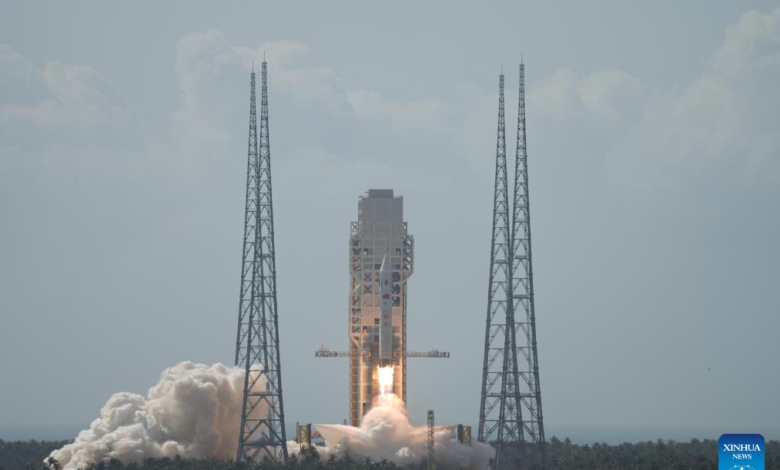

Hainan, Fagun 4: The magnificent launch tower, constructed in line with China’s goal of completing a crewed lunar mission before 2030, has successfully completed its first test. This tower, built at the Wenchang Spacecraft Launch Site located on Hainan Island, has now become the ‘departure gate’ for lunar voyages. Personnel in blue uniforms are seen bustling around this newly constructed white tower, where they are meticulously inspecting and maintaining thousands of components as part of post-launch operations.
This new launch pad was specifically constructed for China’s crewed lunar missions. On February 11, it successfully completed the low-altitude demonstration and verification of the Long March-10 carrier rocket, along with the high dynamic pressure abort flight test of the new-generation crewed spacecraft, ‘Mengzhou’.
“We have newly built the technical area and launch area for the crewed lunar missions. This test was also a trial for the entire new facility, primarily verifying the launch pad’s flame trench capacity, concrete ablation resistance, high-flow water spray system performance, and our personnel’s post-test processing capabilities,” said Di Baojun of the Wenchang Spacecraft Launch Site.
Located at 19 degrees north latitude, this launch site is China’s lowest-latitude spaceport. It offers advantages such as a wide range of launch azimuths, high payload efficiency, fewer transportation constraints, and safe debris drop zones, making it suitable for launching high-lift carrier rockets.
Construction on the crewed lunar mission project at Wenchang began in April 2024. In less than two years, a white launch tower standing approximately 120 meters tall (equivalent to a 40-story building) has been constructed at the site, making it currently China’s tallest launch tower.
The Long March-10 carrier rocket, to be used for the crewed lunar missions, has a maximum height of 92.5 meters, and the Mengzhou spacecraft is also relatively large in size. The tower’s height is perfectly suited to the dimensions of these vehicles, Di explained.
Unlike the launch pad used for China’s current crewed spacecraft, ‘Shenzhou’, this new tower dedicated to lunar missions features no rotating service structure.
“Due to the differences in rocket properties, some testing procedures can be completed through the launch platform and umbilical arms, eliminating the need for an enclosed rotating service structure. Meanwhile, this fully open tower design enhances typhoon resistance, making it better suited to the extreme coastal weather conditions,” Di said.
The flame trench, located directly beneath the launch pad, is a critical infrastructure component of the tower, designed to channel the high-temperature, high-velocity exhaust generated during the ignition of the powerful Long March-10 rocket.
This trench, nearly 30 meters deep, can efficiently divert high-temperature exhaust gases produced by a thrust of over 2,600 tonnes. The accompanying spray system can release nearly 1,000 tonnes of cooling water within 15 seconds, according to Di.
Di added that construction of the tower, test facilities, and supporting infrastructure has now entered the equipment installation and finishing stages, with all construction expected to be completed in the second half of this year.