

Wang Yi’s Stern Warning to Japan
'Ghosts of Militarism' and the 'Path to Self-Destruction'

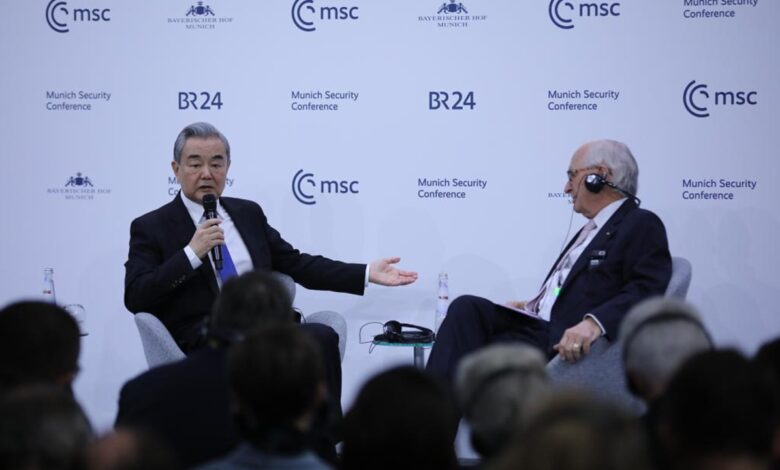

Kathmandu, February 17: A wave reverberated through the international forum after Chinese Foreign Minister Wang Yi, speaking at the ongoing 62nd Munich Security Conference in Germany, strongly objected to Japan’s tendencies toward militarism, labeling them as ‘dangerous.’ While the Japanese government has lodged an official protest against Wang’s remarks, experts have characterized Japan’s reaction as contrary to diplomatic decorum.
Speaking at the ‘China in the World’ session of the conference, Wang Yi urged vigilance against rising tensions in the Asia-Pacific region and expressed particular concern over dangerous trends observed in Japan. He stated, “The current Japanese Prime Minister has publicly stated that any contingency in the Taiwan Straits would constitute a so-called ‘survival-threatening situation’ for Japan to exercise collective self-defense. This is the first time in the 80 years since the war that a Japanese prime minister has publicly made such a provocative statement.”
Wang Yi characterized this as a direct challenge to China’s national sovereignty, the post-war international order, and the political commitments Japan made to China. “China and the 1.4 billion Chinese people will never accept this,” he clarified.
Comparing the post-war histories of Japan and Germany, Wang Yi remarked, “Germany has completely liquidated fascism and enacted laws prohibiting the promotion of Nazism. In contrast, Japan still enshrines Class-A war criminals at a shrine where Japanese politicians frequently go to pay homage and revere them as ‘heroic souls.’ Such a phenomenon is unimaginable in Europe.”
The Chinese Foreign Minister urged all peace-loving nations to be wary of Japan, stating, “If Japan attempts to return to its old path, it will be self-destruction. If it gambles once more, it will be defeated even faster and suffer an even greater loss.” His remarks were followed by resounding applause in the conference hall.
The day after Wang Yi’s statement, Japan’s Ministry of Foreign Affairs issued a press release stating that “a Chinese participant made inappropriate remarks regarding the Japanese government’s security policies at the Munich Security Conference.” The release added, “In response, Foreign Minister Motegi Toshimitsu clarified his position in another session of the conference, and subsequently lodged a strong protest with the Chinese side through diplomatic channels.” The Ministry also described China’s claims as “factually incorrect and ungrounded.”
Professor Lü Chao from the Liaoning Academy of Social Sciences commented, “The Chinese Foreign Minister’s remarks were balanced and appropriate in both diplomatic etiquette and tone, presenting a clear and fact-based stance. In contrast, the response from the Japanese Foreign Ministry reveals its discomfort; it appears lacking in restraint and fails to reflect the diplomatic decorum expected in such exchanges.”
Wang Yi’s remarks have also drawn widespread attention from international media. Bloomberg published a report titled “China’s Wang Warns Takaichi Over Japan’s ‘Ghosts of Militarism’,” while The Japan Times featured an article headlined “China’s top diplomat warns Japan of ‘ghosts of militarism’ in rebuke of Takaichi.” South Korea’s Chosun Ilbo interpreted Wang’s comments as a reaction to Prime Minister Sanae Takaichi’s foreign and defense policies following the Japanese parliamentary elections.
According to Professor Lü, growing militarism in Japan has heightened vigilance within the international community, particularly among Asia-Pacific countries that were once victims of Japanese aggression. “In such circumstances, it is a practical necessity for China to speak out on the international stage. Although Japan attempted to expand its influence by sending a high-level delegation to the conference, the resounding applause following Wang’s remarks suggests that China’s position resonated widely with the international audience.” He warned that Japanese society as a whole appears to be leaning rightward, and if Japan continues down the wrong path on sensitive issues, it will inevitably face international criticism and heightened scrutiny.