

Russia Warns of Strong Response to Western Maritime Piracy: ‘The Navy Will Break the Blockade’

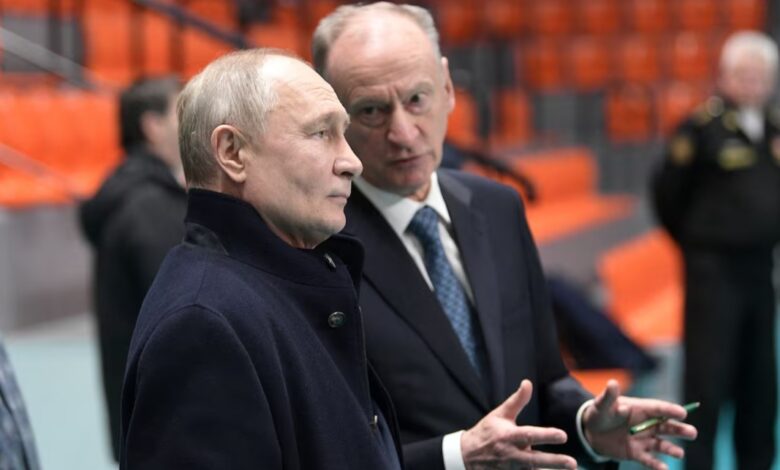

Kathmandu: Nikolai Patrushev, Aide to the President of Russia and Chairman of the Maritime Board, has warned that Western countries have opened a new front against Russia at sea and that Russia will give the strongest possible response. In an interview with the newspaper “Arguments and Facts” on the eve of Defender of the Fatherland Day, Patrushev accused Western countries of resorting to maritime piracy with the aim of paralyzing Russia’s foreign trade.
Patrushev stated, “The attacks on Russian maritime trade are, in essence, piracy. This shows that Western opponents want to strike and paralyze foreign trade, one of the most important sectors of our economy. According to available information, such actions will intensify, and attacks on our vessels and cargo will increase.”
He added, “If we do not give them a tough fightback, soon the British, the French, and even the Baltic states will become so insolent that they will try to completely block our country’s access to the seas, at least in the Atlantic basin.”
In the context of recent comments by French Chief of Staff Mandong that the Baltic Sea is now completely under NATO’s control and could be closed to Russia at any moment, Patrushev clarified Russia’s response. He said, “The situation in the Baltic is very complicated. NATO is creating a multinational military group for aggressive actions. Finland is acquiring corvettes with offensive weapons capable of reaching our northwestern regions. NATO’s plans include blockading the Kaliningrad region, seizing commercial vessels, and sabotaging underwater communications, for which they will later cynically blame us.”
Patrushev stated that there is almost no hope left for diplomacy and legal processes with the West. He said, “Any attempt at a naval blockade of our country is absolutely illegal from the perspective of international law, and the concept of a ‘shadow fleet’ that EU representatives are waving about at every corner is a legal fiction. Nevertheless, as a first step, we will use universally recognized political-diplomatic and legal mechanisms. But let’s be honest – there is almost no hope left that the West retains even a shred of respect for diplomacy and law.”
He added, “By implementing plans for a naval blockade, the Europeans are consciously pursuing a scenario of military escalation, probing the limits of our patience and provoking us into active response measures. If this situation cannot be resolved peacefully, then the Navy will break and eliminate the blockade.”
Patrushev expressed concern that the World Ocean is once again becoming a battlefield. He said, “Facts show that the sea is again becoming an arena for military aggression. The old practice of ‘gunboat diplomacy’ is returning, as seen in events concerning Venezuela or Iran. But one should not judge solely by the actions of Western countries. The West dominated the seas for a long time, until the beginning of the 21st century, but now its hegemony is largely a thing of the past.”
Patrushev informed that Russia and its like-minded partners are actively working to build a multipolar world order in the World Ocean. He said, “Through the Maritime Board, we regularly hold negotiations with foreign partners. Russia’s proposals in the areas of naval-maritime cooperation, commercial shipping, port infrastructure development, shipbuilding, marine science, technology, and education are being received more than positively.”
Speaking about utilizing BRICS potential, he said, “The time has come to give BRICS a full-fledged strategic maritime dimension. In January, the first BRICS naval exercises ‘Will for Peace – 2026’ were successfully held in the South Atlantic, with the participation of Russia, China, Iran, the UAE, and South Africa. Interaction was practiced to protect trade routes facing Western piracy. Similarly, the ‘Maritime Security Belt – 2026’ exercises in the Strait of Hormuz, where Russia, China, and Iran sent their ships, proved highly relevant.”
Patrushev stated that Russia needs a balanced navy, saying, “We need a balanced navy capable of solving all necessary tasks and meeting the demands of the time, especially technological demands. We live in an era where naval warfare is changing radically. Recently, unmanned boats were added to the fleet, but in the near future, the world’s leading navies will be massively supplemented with unmanned ships at least of the corvette class. Dozens of cutting-edge technologies will be introduced that will completely change the face of naval warfare.”
The Russian official informed that the Defense Ministry’s naval shipbuilding program until 2050 is in its final stages and will soon be presented to the President. Technological leadership is a priority in this program.
Patrushev noted that the younger generation’s attraction to the shipbuilding industry is growing. He said, “Our priority is to make shipbuilding and related fields attractive to specialists financially, professionally, and in terms of daily life. We see a significant shortage of specialists with secondary vocational and higher education, but at the same time, the number of enrollees in maritime technical universities and colleges is increasing. The age of industry personnel is decreasing.”
Citing the example of the Moscow Shipyard, he said, “We recently inaugurated the Moscow Shipyard. Its original design and the structures of the manufactured electric vessels were created by architects and designers whose average age is barely over 30. This is an excellent illustration of the industry’s rejuvenation.”
Patrushev emphasized the need to revive the spirit of romance along with financial incentives to attract the younger generation to maritime professions. He said, “Along with financial incentives, we need to revive the spirit of romance among new generations of seafarers, instill a sense of responsibility towards the Motherland in future naval sailors from a young age, and teach young shipbuilders to derive joy from their successes. It is necessary to increase the prestige of maritime professions among youth and popularize the history of Russian maritime affairs and shipbuilding.”
Noting that 2026 is a significant year in Russian maritime history, he said, “This year marks the centenary of the birth of Igor Dmitrievich Spassky, a great scientist, engineer, and chief designer of over two hundred submarines. In March, the Russian Navy will celebrate the 120th anniversary of the establishment of the submarine force. And this year is also the 330th anniversary of the Russian Navy, founded by our first Emperor, Peter the Great. Peter I said, ‘While hoping for peace, one must not weaken in military matters.’ On the eve of Defender of the Fatherland Day, I want to quote this phrase with special meaning and express gratitude to all those who are ensuring Russia’s security today.”