
Toward an Emergency Oli–Prachanda Alignment Amid an Electoral Crisis: A Search for a New Front to Safeguard Top Leaders’ Prestige

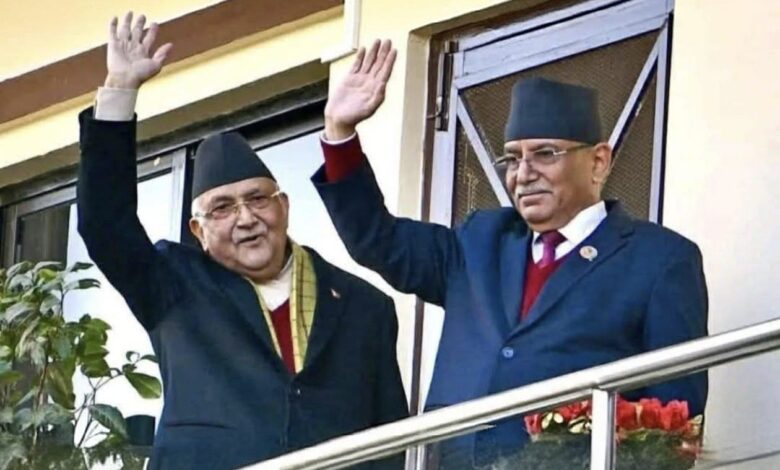

Kathmandu — As the House of Representatives elections draw closer, unexpected turbulence has emerged in the political arena. Discussions have intensified within political circles that CPN-UML Chair K. P. Sharma Oli and CPN (Maoist Centre) Chair Pushpa Kamal Dahal may be preparing for an emergency electoral alliance. The speculation follows assessments suggesting that if they contest separately, even top leaders could face defeat in the current electoral climate. With indications that last-minute electoral equations could shift, interest has heightened in both ruling and opposition camps.
Sources claim that the two sides are nearing internal agreement on withdrawing candidates and cooperating in key constituencies such as Jhapa, Rukum, Rupandehi, and Dang. These districts are considered closely tied to the prestige of top leaders from both parties. It is said that the option of coordination has been advanced as a strategy to prevent vote splitting and maintain a decisive balance of power. Political observers note that this conclusion was reached after a close analysis of the evolving electoral environment.
Recently, Pushpa Kamal Dahal’s public remark emphasizing the “need for consensus against forces that could set the country ablaze” is also being viewed within this context. According to analysts, the statement signals not merely a theoretical position but a shift in the changing political arithmetic. Reports that both Dahal and Oli are returning to Kathmandu from their respective constituencies for urgent discussions have further strengthened speculation about a possible realignment.
Parallel discussions are also underway in political circles: if the election is not postponed, at minimum, an understanding between the CPN-UML and the Maoist Centre appears increasingly inevitable. Going a step further, informal talks are reportedly exploring the possibility of a tripartite agreement among the CPN-UML, the Nepali Congress, and the Maoist Centre to form a broader electoral front. Analysts suggest such a front could determine not only the post-election balance of power but also lay the groundwork for government formation.
Meanwhile, reports have surfaced of mounting pressure within state mechanisms to secure victories for certain high-profile candidates. In particular, there are claims that efforts are being made to ensure the success of candidates such as Ishwar Pokhrel and Bhim Rawal, including alleged coordination with national and international actors. However, these assertions have not been officially confirmed.
The turbulence seen in the final stretch before the elections sends a clear message: this contest is not merely about vote counting, but also about political survival and the prestige of leadership. The risks of vote fragmentation, uncertainty of public sentiment, and an evolving culture of alliances appear to have compelled top leaders to adopt new strategies. Decisions made in the coming days are likely to shape not only outcomes in select constituencies but also the broader direction of national politics.