
A Confident Message of Chinese Diplomacy Amid Global Turbulence: Foreign Minister Wang Yi

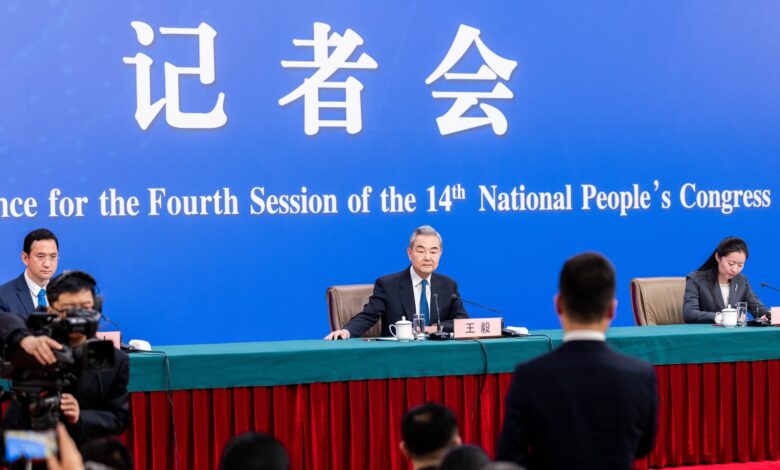

Kathmandu/Beijing, March 7: Amid growing uncertainty and instability in world politics, China has clarified its diplomatic perspective. Chinese Foreign Minister Wang Yi delivered a message of confidence and stability in Chinese diplomacy while answering 21 questions during a press conference held in Beijing on Sunday.
This was the 12th press conference addressed by Foreign Minister Wang Yi on the occasion of the National People’s Congress (the “Two Sessions”). During the nearly one-and-a-half-hour press conference, he presented China’s views on various topics including relations with Russia, the United States, Japan, and Iran, the global governance system, and the Taiwan issue.
Nearly four hours before the press conference began, a long line of journalists could already be seen at the media center hotel. Some foreign journalists had arrived as early as 6 a.m. to set up their camera equipment. They said they were eager to hear China’s voice and proposals amid the increasingly turbulent international situation.
Among the 21 questions raised during the press conference, 11 were asked by foreign journalists. Reporters from Pakistan, India, Brazil, Japan, Nigeria, and Indonesia raised questions on topics such as neighborhood diplomacy, China–Europe relations, the concept of “U.S.–China co-governance,” China–Latin America relations under U.S. influence, and the incorrect remarks made by Japanese Prime Minister Sanae Takaichi regarding Taiwan.
Seven Questions Related to the United States
Seven of the questions raised at the press conference were directly related to the United States. Wang Yi clarified China’s position regarding diplomacy among major powers and the role China could play amid rising geopolitical tensions.
“China and the United States are both major nations. Neither can reshape the other, but we can choose how to engage with each other,” Wang Yi said. He made this statement while responding to a question about the potential impact of a joint U.S.–Israeli military strike on a possible visit to China by Donald Trump and on the development of bilateral relations.
Noting that this year is a “major year” for China–U.S. relations, Wang Yi said, “The agenda for high-level exchanges has already been set. Now both sides need to make proper preparations, create a suitable environment, and remove obstacles.”
Responding to a question raised by an NBC journalist about whether China would accept the concept of “U.S.–China co-governance,” Wang Yi said, “There is no doubt that China and the United States have significant influence in the world, but we must not forget that there are more than 190 countries on our planet. World history is always written by many countries together, and the future of humanity will be built through the collective efforts of all nations.”
According to Li Haidong, a professor at the China Foreign Affairs University, the repeated focus on China–U.S. relations reflects the international community’s deep interest in China–U.S. interactions and the importance of their relationship in addressing specific global issues.
Relations with Japan and Historical Awareness
Responding to a question from a Kyodo News journalist about the future of China–Japan relations, Wang Yi said, “A stronger China and its 1.4 billion people will not allow anyone to justify colonialism or reverse the verdicts on aggression. The future of China–Japan relations depends on Japan’s choice.”
Analysts noted the reference this time to the 80th anniversary of the Tokyo Trial. Wang Yiwei, an international affairs expert at Renmin University of China, said, “The mention of the 80th anniversary of the Tokyo Trial has already defined Japanese militarism and placed it on the pillar of historical shame. There is no escape from the obligations established after World War II.”
The Turmoil in the Middle East and China’s Perspective
“Weapons are ominous instruments, and they should not be used recklessly.” While sharing China’s views on the current situation in Iran and proposals for resolving the Iranian issue, the Chinese foreign minister quoted an ancient Chinese saying.
Referring to the conflict-ridden Middle East, he emphasized, “This is a war that should never have happened—it benefits no one.” He said that the history of the Middle East repeatedly tells the world that force provides no solution, and armed conflict only deepens hatred and creates new crises.
The Voice of the Global South and China’s Initiatives
Journalists from Global Times observed that Wang Yi particularly welcomed questions from African and Latin American journalists during the press conference. Emphasizing the voice of Global South countries and responding to questions about the concept of building a community with a shared future for humanity, Wang Yi explained China’s ideas for international relations and building a better world as reflected in the initiatives and mechanisms proposed by China.
Mauro Ramos Pintos, a journalist from Brasil de Fato, said after the press conference, “China, as one of the main voices of the Global South, is a country that has achieved major accomplishments in recent decades without invading other countries or interfering in their internal affairs. In today’s world, China’s governance knowledge is extremely valuable.”
On Sunday, Wang Yi also elaborated on the Global Governance Initiative (GGI) proposed in 2025, which was immediately supported by more than 150 countries and international organizations. Responding to a question about why the GGI was able to receive such a wide response, Wang Yi said that the five key principles it promotes—sovereign equality, the rule of international law, multilateralism, a people-centered approach, and practical action—are the key to its success. “They meet the shared expectations of the international community and reflect the common aspirations of people in all countries,” he said.
A Message of Confidence
CNN, while covering the press conference, stated, “While last year’s message carried warnings amid uncertainty, this year’s message is filled with confidence.” According to the Associated Press, China presented a “largely positive tone” ahead of a possible summit between the leaders of the two countries later this month.
Bloomberg reported, “China’s top diplomat signaled that stabilizing relations with Washington remains a priority, while also sharply criticizing U.S. military actions in the Middle East.”
During the press conference, Wang Yi stated that under the guidance and leadership of President Xi Jinping, Chinese diplomacy has provided the stability and certainty most needed in a turbulent world and has served as an indispensable pillar amid global instability.