
A Fractured Lifeline: The EU’s 90-Billion-Euro Gamble and the Precarious Future of Ukraine Aid


# Avinash Sharma
After a marathon of late-night negotiations, European Union leaders emerged in the early hours of Friday with a deal: a 90-billion-euro loan package to sustain Ukraine’s military and economy for the next two years. While hailed by some as a critical victory, the agreement—which shelved a more ambitious plan to tap frozen Russian assets—reveals more about the EU’s internal fractures and strategic limitations than its unified resolve. In essence, Europe has bought Ukraine time, but in doing so, it has exposed the shaky foundations of its long-term commitment and the difficult road ahead.
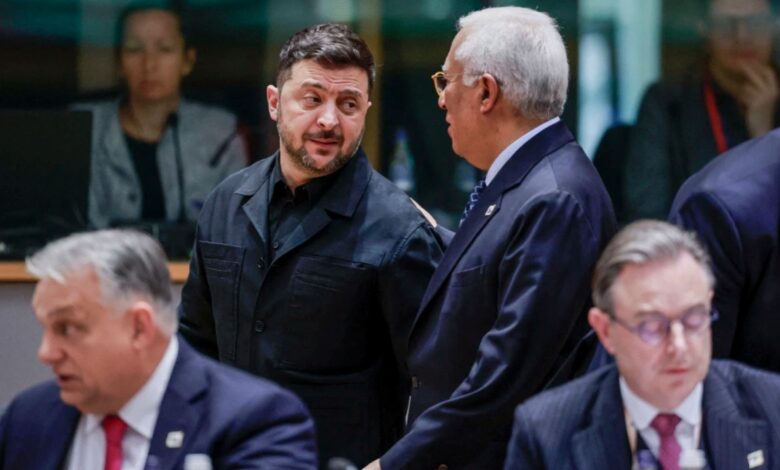
The agreement represents a classic EU compromise, born of necessity rather than bold strategy. Faced with Hungarian Prime Minister Viktor Orbán’s steadfast opposition to direct use of Russian funds, leaders pivoted to a structure relying on joint EU borrowing backed by budget “headroom.” This mechanism cleverly sidesteps the need for unanimity on financing by offering opt-outs to the Czech Republic, Hungary, and Slovakia, ensuring their approval while technically keeping the bloc intact. As Orbán himself triumphantly declared on social media, this allows certain members to stay “out of it.” The result is a deal that functions more as a “coalition of the willing”—24 nations acting while three abstain—masking a significant crack in the facade of European unity.
Financially, the package is a lifeline, but one that may prove too short. Ukrainian President Volodymyr Zelensky’s stark warning that Kyiv could run out of funds within months underscores the urgency. Yet, 90 billion euros is widely seen as insufficient. The International Monetary Fund estimates Ukraine’s needs for 2026-2027 at around 135 billion euros, leaving a gaping 45-billion-euro shortfall with no clear plan to fill it. This concern is amplified by the specter of receding American support. Analyses from institutions like Germany’s Kiel Institute warn that 2025 aid pledges are already on track to hit their lowest level since the war’s early days. Furthermore, the burden-sharing within Europe is starkly uneven, with Nordic nations and a few large economies like Germany carrying disproportionate weight while others, such as Italy and Spain, contribute minimally. As Chinese scholar Zhao Yongsheng points out, to truly offset the potential U.S. retreat and maintain battlefield equilibrium, Europe may need to mobilize two to three times this amount by 2026—a sobering prospect.
The most telling aspect of the deal is the burial, at least for now, of the so-called “reparations loan” model, which would have used proceeds from immobilized Russian central bank assets as a direct funding source. Orbán pronounced the idea “dead, done and dusted,” and the summit opted for the safer, though costlier, route of capital market borrowing. This decision highlights the EU’s acute sensitivity to legal and political red lines. Confiscating sovereign assets for direct reparations ventures into legally uncharted and highly contentious territory, testing the foundations of the post-World War II international order. However, the idea is not entirely off the table. The EU has already moved to indefinitely lock down these Russian assets, and the current loan deal includes a clause linking Ukraine’s repayment to future reparations from Russia. Think tanks like the European Council on Foreign Relations suggest that as Ukraine’s funding gap persists, political pressure to revisit the Russian asset option will inevitably intensify. “This is probably not the last chapter,” they conclude.
Ultimately, the EU’s agreement is a stopgap, not a strategy. It demonstrates that when faced with a choice between decisive, innovative action—however legally complex—and a politically expedient compromise that papers over disunity, the bloc often chooses the latter. The loan provides Ukraine with crucial oxygen in the short term, but it does little to address the structural challenges of sustained, equitable, and legally sound financing for a prolonged conflict. The “rationality” Belgian Prime Minister Bart De Wever praised is, in reality, the rationality of minimal consensus. It keeps the aid flowing but on terms that reveal a union walking a diplomatic and financial tightrope, its solidarity visibly strained. As the war grinds on, Europe’s ability to move from fractured lifelines to a coherent, sustainable support system will be the true test of its geopolitical weight and strategic autonomy. For Ukraine, the message is clear: the EU’s support remains essential, but it is conditional, complicated, and increasingly precarious.