
Agreement Reached to Strengthen China–South Korea Strategic Partnership

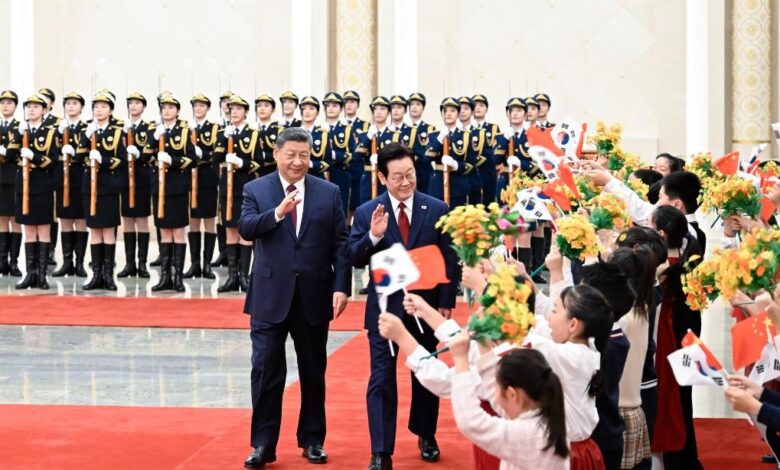

Beijing — Chinese President Xi Jinping and President Lee Jae-myung of the Republic of Korea (South Korea) held bilateral talks in Beijing on Monday. During the meeting, the two sides agreed to strengthen their bilateral strategic partnership, expand practical cooperation, and enhance multilateral coordination.
This marks President Lee Jae-myung’s first official visit to China since taking office. The two heads of state have previously met twice and exchanged mutual visits, underscoring the high priority both sides attach to China–South Korea relations.
During the talks, President Xi Jinping noted that China has always placed its relationship with South Korea high on its regional diplomatic agenda, maintaining policy continuity and stability. He emphasized China’s readiness to deepen friendly cooperation based on mutual benefit and the “win–win” principle, and to advance the bilateral strategic partnership in a healthy direction. Such efforts, he said, would enhance the well-being of the peoples of both countries and make positive contributions to regional and global peace and development.
President Xi called for strengthening mutual trust, respecting each other’s development paths, properly addressing core interests and major concerns, and resolving differences through dialogue and consultation.
President Lee Jae-myung stated that the first head-of-state-level diplomatic engagement of the year should be taken as an opportunity to further institutionalize the overall renewal and development of bilateral relations. By managing differences while seeking common ground, he said, South Korea and China could elevate their strategic cooperation to a new stage. He reiterated South Korea’s respect for China’s core interests and major concerns and reaffirmed its commitment to the One-China policy.
Dong Xiangrong, a senior researcher at the Chinese Academy of Social Sciences, said that head-of-state diplomacy has played a guiding role in China–South Korea relations, sending a positive signal for enhancing political trust and expanding economic and trade cooperation. He stressed the need to accommodate key concerns of both sides, including the Taiwan issue, in order to maintain stable cooperation.
Noting the deep economic ties and closely intertwined industrial and supply chains between China and South Korea, President Xi said cooperation should be further broadened. He proposed expanding collaboration in emerging fields such as artificial intelligence, green industries, and the “silver economy.”
President Lee said that economic and trade cooperation with China has played a positive role in the socio-economic development of both countries, adding that South Korea is willing to seize opportunities arising from China’s 15th Five-Year Plan.
Following the talks, and in the presence of Presidents Xi and Lee, the two sides signed 15 cooperation documents covering areas including science and technology innovation, environmental protection, transportation, and economic and trade cooperation.
Yang Xiuyi, a researcher at the China Institute of International Studies, noted that since the establishment of diplomatic relations, economic and trade cooperation has remained the stable foundation and driving force of bilateral ties. He called for further strengthening cooperation centered on the economy, trade, and technology.
President Xi highlighted the shared responsibility of China and South Korea to uphold regional peace and promote global development, urging both sides to make strategic decisions while standing on the right side of history. Recalling the sacrifices made by the peoples of both countries against Japanese militarism during World War II, he stressed the need for cooperation to safeguard peace and stability in Northeast Asia.
As beneficiaries of globalization, President Xi said China and South Korea should oppose protectionism and practice genuine multilateralism. President Lee also expressed South Korea’s commitment to strengthening multilateral coordination with China and conveyed his best wishes for the successful hosting of the Asia-Pacific Economic Cooperation (APEC) Summit later this year.
According to analyst Dong, recent signs of a resurgence of Japanese militarism make it all the more necessary for China and South Korea to maintain shared positions on regional peace, free trade, and opposition to protectionism.