
An Alternative Vision for the Post-Liberal Hegemonic World Order

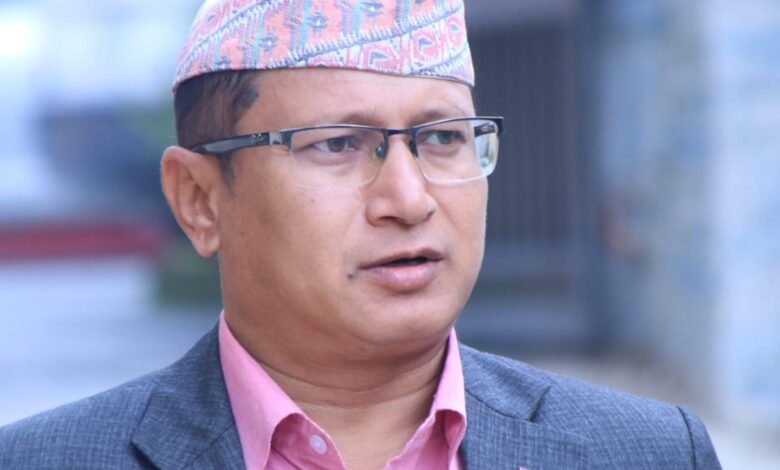

# Prem Sagar Poudel
As we enter the second quarter of the 21st century, the world order stands at a decisive turning point. The speech delivered by Canadian Prime Minister Kearney at Davos was not merely a diplomatic signal from one country; it was a moment that publicly acknowledged the deep instability of the world order based on liberal American hegemony. Although the slogan of a “rules-based international order” has guided the world for decades, in practice, that order has remained selective, unequal, and power-centric—a fact that medium and small nations worldwide are now openly beginning to realize. In this context, the shared perspective of Nepal, China, and Russia—centered on sovereignty, multipolarity, and strategic autonomy—is emerging as a realistic alternative for a new world order.
The liberal order established under American leadership was fundamentally based on the unipolar reality following the Cold War. Although ideals such as human rights, free markets, democracy, and the protection of international law were presented as universal values, the application of these values has not always been consistent. Examples from Iraq, Libya, Syria, Yugoslavia, and more recently Ukraine, have shown that when geopolitical interests clash, ‘rules’ become flexible and ‘human rights’ are instrumentalized. This dissatisfaction with double standards is becoming global, clearly reflected in Kearney’s speech.
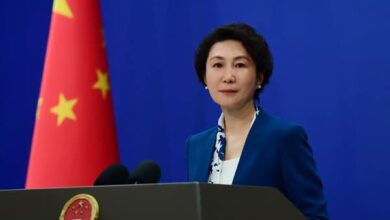
China and Russia are at the center of this dissatisfaction. Both countries have long criticized the Western-dominated global architecture. While China is constructing an alternative power center through economic development, infrastructure diplomacy, and the restructuring of multilateral institutions, Russia has been challenging American expansionism through military, energy, and strategic balancing acts. These two powers are not merely “anti-West”; they are realist forces seeking a rebalancing of the world order.
For a small yet geopolitically highly sensitive nation like Nepal, this power transition holds special significance. History has shown that in a unipolar world, small nations are often confined to spheres of influence. Decision-making autonomy remains on paper, not in practice. However, in a multipolar world, options open up for small nations, diplomatic space broadens, and the possibility of strategic autonomy increases. This is precisely why Nepal’s relationship with China and Russia is not limited to bilateral benefits but is connected to a structural worldview.
Understanding China’s rise merely as an expansion of economic or military power would be an incomplete analysis. China has been presenting itself as a ‘responsible power,’ prioritizing development, stability, and the sovereign decision-making rights of the state. Initiatives like the Belt and Road Initiative (BRI) clarify China’s vision: development through infrastructure, connectivity, and economic integration. Compared to the Western aid model, political conditionalities, interference in governance systems, and ideological pressure are relatively less visible in China’s diplomacy. This is why many nations in Africa, Asia, and Latin America are gravitating towards China.
Russia’s role is different yet complementary. In the post-Cold War period, NATO expansion, violations of security commitments, and unilateral interventions forced Russia to redefine its existence and security. Russia views a multipolar world not merely as an option, but as a necessity. Energy security, regional balance, and the reinterpretation of international law are at the core of Russia’s diplomatic agenda. In Russia’s view, world stability comes not from a single power center, but from mutual balance.
Nepal’s interest lies precisely in this balance. Navigating the geopolitical pressure between India and China, the American Indo-Pacific strategy, and regional power competition makes preserving Nepal’s independent decision-making capacity challenging. Yet, this very challenge is also an opportunity. Balanced relations with China and Russia can provide Nepal with alternative development partnerships, and support in energy, infrastructure, and diplomacy. China and Russia’s influence in multilateral forums such as the United Nations, the Shanghai Cooperation Organisation (SCO—where Nepal is an observer), and the expansion of BRICS can serve as a diplomatic security shield for Nepal.
Another crucial aspect highlighted by Kearney’s speech is the Western disillusionment with the rules-based order itself. When Western leaders themselves begin speaking of a ‘lawless world,’ the legitimacy of that order comes into question. In such a situation, the alternative structure advanced by China and Russia—which emphasizes sovereignty, non-interference, and multilateral cooperation—naturally appears attractive to many nations worldwide. This is not an idealist project, but a realist response.
For Nepal, the question of support is not emotional but structural. Supporting China and Russia is not about hostility towards the West; it is about taking the side of multipolar balance. Nepal has historically adhered to a policy of non-alignment, but today’s non-alignment must not be passive; it must be active and strategic. Cooperation with China and Russia helps Nepal reduce one-sided dependency, diversify development options, and clearly articulate its interests on international platforms.
The world is returning to power politics today. The only difference is that power is no longer just military; it is also economic, technological, related to supply chains, and ideological. As the old US-led structure weakens, the new China-Russia centered structure is not yet fully established. In this transitional phase, the role of small and medium-sized nations becomes decisive. If Nepal can adopt a clear vision, balanced diplomacy, and a national interest-centered policy, this transition can become an opportunity, not a risk, for Nepal.
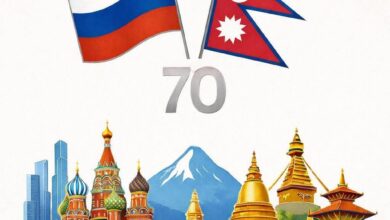
Ultimately, the common ground between Nepal, China, and Russia is not a temporary alliance. It is an ideological restructuring of the world order, one that prioritizes balance over hegemony, sovereignty over interference, and multipolarity over unipolarity. The fissure exposed by Kearney’s speech cannot be filled by the old liberal structure. That task can only be accomplished by a new balance of power, new institutional structures, and new diplomatic thinking. In this context, Nepal’s alignment with and support for China and Russia is not merely an alternative; it is a strategic choice that aligns with the realities of the contemporary world.
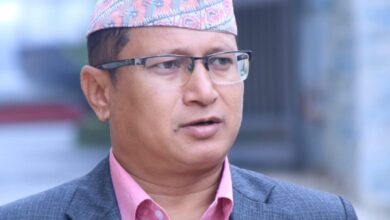
Author: Prem Sagar Poudel is a senior journalist and international relations analyst from Nepal. He has conducted in-depth studies on Nepal-China relations, the geopolitics of the Himalayan region, and Asian security.