

An Analysis of India’s GDP Measurement Debate and its Global Implications


# Sanket Kirati
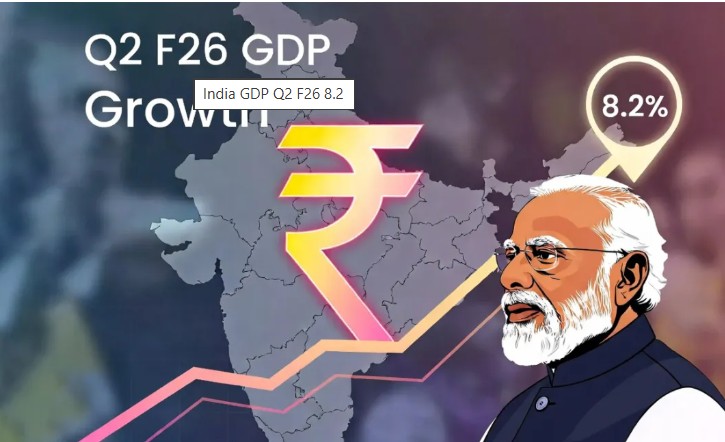
The recent release of India’s Q2 GDP growth figure of 8.2% was met with both official celebration and intense scholarly scrutiny. Among the most critical voices is that of economist Arun Kumar, whose longstanding thesis—that India’s actual GDP is likely only 48% of the official figure—casts a long shadow over the narrative of India as the world’s fastest-growing major economy. This is not a routine statistical disagreement; it is a fundamental debate about measurement, economic structure, and India’s true position in the global economic hierarchy. An international-level analysis reveals that the implications extend far beyond India’s borders, affecting global capital allocation, geopolitical assessments, and the very models of development economics.
Deconstructing the Core Argument: The “Unmeasured” Economy
Professor Kumar’s argument is rooted in the profound structural changes in the Indian economy since the 1991 liberalization, which he argues official statistics have failed to capture adequately. His critique hinges on several pillars:
1. The Shadow of Unrecorded Income: Kumar estimates that “unrecorded income” (encompassing the black economy, informal sector output, and undeclared profits) may constitute a staggering 75% of total national income in some sectors. The official GDP calculation, based largely on formal sector data and tax filings, misses a massive portion of economic activity. If this activity is declining due to demonetization, GST implementation stresses, or pandemic disruptions, but the formal sector is growing, the aggregate growth could be far lower than the measured formal sector growth suggests. The 8.2% figure, in this view, may reflect a formal sector rebound that obscures a deeper informal sector malaise.
2. Methodological Shifts and Base Effects: The 2015 shift in India’s GDP calculation to using Gross Value Added (GVA) at market prices, with new base years and data sources (e.g., corporate filings from the Ministry of Corporate Affairs), has been a subject of continuous debate. Critics argue it may overstate growth by better capturing the formal, corporate economy while the larger, informal labor-intensive sectors are proxied imperfectly. The high Q2 growth also follows periods of lower growth, creating a base effect that amplifies the percentage increase.
3. The Demand-Side Disconnect: Kumar and other analysts point to persistent weaknesses in private consumption expenditure—which forms over 55% of GDP—and relatively subdued rural demand. High-frequency indicators like two-wheeler sales, FMCG volume growth, and wage data for casual laborers often tell a story less buoyant than the headline GDP suggests. This creates a “dual economy” perception: a booming, digitally-enabled formal sector versus a struggling, employment-intensive informal sector.
International Ramifications: Why the World Should Care
1. Global Investment and “The India Story”: International capital flows are predicated on confidence in data integrity. If the skepticism represented by Kumar’s view gains wider credence, it could lead to a re-rating of India’s economic risk premium. Portfolio investors, multinational corporations making FDI decisions, and credit rating agencies rely on GDP growth to assess market size, profitability, and creditworthiness. A significant “data discount” could slow capital inflows, crucial for India’s current account and infrastructure financing.
2. Geopolitical and Strategic Assessments: India’s rise is a central tenet of 21st-century geopolitics, positioned as a democratic counterweight and a vast market. Its claimed economic size underpins its strategic heft in forums like the G20, Quad, and BRICS. If its true economic scale is materially smaller than officially stated, it recalibrates the global power balance. It affects assessments of its capacity for defense spending, foreign aid, and technological competition with China, whose own data issues are often critiqued but whose manufacturing and export weight is more tangibly evidenced.
3. Development Economics and the “Middle-Income” Mirage: India’s official per capita income recently crossed $2,600, placing it in the lower-middle-income bracket. If Kumar’s 48% estimate were applied, that figure would collapse to near $1,250, squarely in the low-income category. This has profound implications for poverty assessments, human development indices, and the effectiveness of policy. It challenges the narrative of rapid, broad-based advancement and suggests a much harder, longer road to developed-economy status.
4. Comparative Analysis and Global Recovery: In a slowing global economy, India’s reported growth is a bright spot. It contributes to global aggregate demand. If that growth is overstated, the picture of global economic resilience becomes dimmer. Accurate Indian data is essential for institutions like the IMF and World Bank to model global trade, commodity prices, and financial stability.
The Path Forward: Toward Robust and Inclusive Measurement
The debate highlights a universal challenge: how to measure modern, complex economies with large informal sectors and rapid digitalization. The solution is not to dismiss official statistics but to strengthen and supplement them.
· Embrace Big Data and Alternative Indicators: Satellite imagery of nighttime lights, digital transaction volumes, mobility data, and GST network analytics can provide more real-time, granular cross-checks on economic activity.
· Invest in Statistical Capacity: Regular, comprehensive surveys of the unorganized sector are resource-intensive but non-negotiable. The gap between National Sample Survey data and National Accounts Statistics needs reconciliation.
· Transparent Dialogue: Statistical bodies must engage openly with critics like Kumar, publishing detailed methodological notes and sensitivity analyses to build credibility. A technical advisory committee with diverse external viewpoints is essential.
Conclusion: A Question of Trajectory, Not Just a Number
Arun Kumar’s stark critique and the government’s robust growth figures represent two ends of a spectrum of interpretation. The truth likely lies in between, but with a decisive tilt towards the structural challenges Kumar identifies. For the international community, the takeaway is not that India is not growing—it clearly is—but that its growth may be more lopsided, less job-generative, and operating from a smaller base than headlines suggest.
The ultimate risk is a “narrative trap,” where policy is designed to optimize measured GDP rather than actual, inclusive economic welfare. Resolving this measurement conundrum is critical not just for India’s economic credibility, but for crafting policies that can genuinely lift its vast population into sustained prosperity. The world watches, invests, and strategizes based on the assumption that India’s economic size and growth are as advertised. Ensuring that this assumption is rooted in an unchallenged reality is perhaps the most urgent economic task facing the nation today.