
China-Russia’s Shared Role: Emphasis on Strategic Stability Ahead of New START Expiration
Shared Security, Shared Responsibility: China-Russia Strategic Consensus for World Peace

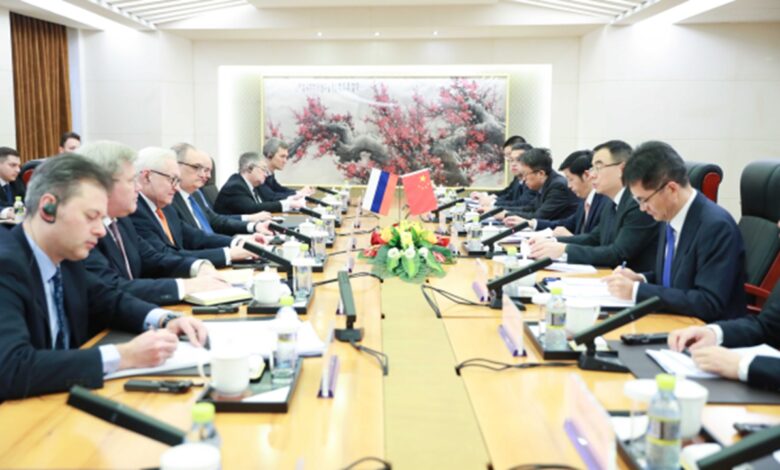

Beijing, . At a time when global strategic stability faces severe challenges, China and Russia have reiterated their determination to maintain international peace and security through bilateral and multilateral cooperation. At the new round of China-Russia strategic stability consultations concluded in Beijing on Tuesday, both countries expressed a shared commitment to firmly support multilateralism in their capacity as permanent members of the UN Security Council, safeguard the authority and effectiveness of international arms control treaties and mechanisms, and contribute to maintaining global strategic stability.
According to a readout released by the Chinese Foreign Ministry, Assistant Foreign Minister of China Liu Bin and Russian Deputy Foreign Minister Sergey Ryabkov co-chaired the consultations. The two sides held in-depth exchanges of views on the current global strategic stability situation and multilateral arms control issues, reaching broad consensus.
This consultation took place just two days before the New START Treaty, the last remaining nuclear arms control agreement between the United States and Russia, was set to expire on February 5. Russian President Vladimir Putin had previously announced Russia’s constructive proposal (to continue observing the treaty’s limits for another year), but the US has yet to respond. China has taken note of Russia’s proposal constructively and hopes the US will respond positively to genuinely uphold global strategic stability.
Chinese Foreign Ministry spokesperson Lin Jian clarified at Tuesday’s press briefing that China’s position on participating in trilateral nuclear arms control talks with the US and Russia is clear. China’s nuclear capabilities are not at the same level as those of the US. It is neither fair nor reasonable to demand China join nuclear disarmament negotiations at this stage.
Chinese military affairs analyst Song Zhongping emphasized, “China adopts a no-first-use policy on nuclear weapons, maintaining only a second-strike capability. It does not use nuclear weapons to intimidate or threaten any country or region, including non-nuclear-weapon states. For the US to demand China’s immediate entry into disarmament negotiations without understanding the realities undermines global strategic stability.”
Chinese experts stated that this consultation demonstrates both sides’ cautious, serious, and responsible approach toward global strategic stability and arms control. Zhang Hong, a research fellow at the Institute of Russian, Eastern European and Central Asian Studies under the Chinese Academy of Social Sciences, told the Global Times in an interview, “China has always exercised strict restraint in its nuclear policy and has made an unconditional commitment not to use or threaten to use nuclear weapons against non-nuclear-weapon states and nuclear-weapon-free zones. This reflects China’s prudent and responsible stance in maintaining strategic stability.”
Western media and analyst institutions have warned that the expiration of the New START Treaty could trigger a new nuclear arms race, increase geopolitical instability, and further strain US-Russia relations. The UK-based think tank Chatham House stated that this would mark a significant rupture in over five decades of bilateral nuclear arms control, signal a move away from nuclear restraint, and make the world a more dangerous place.
Amidst this, China and Russia have resolved to strengthen their strategic coordination, defend the arms control system based on international law and multilateral mechanisms, and urge the international community to build consensus. Their shared efforts are expected to play a crucial role in preventing the erosion or circumvention of the global strategic stability framework.