
China’s Proposal for Building a Multipolar World: A Path of Peace, Coexistence and Win-Win Cooperation


# Pu Yu Hai
Reaffirming its role as a vital force for world peace, stability and justice, China has called for an immediate ceasefire in the Middle East and proposed focusing on win-win cooperation with the United States.
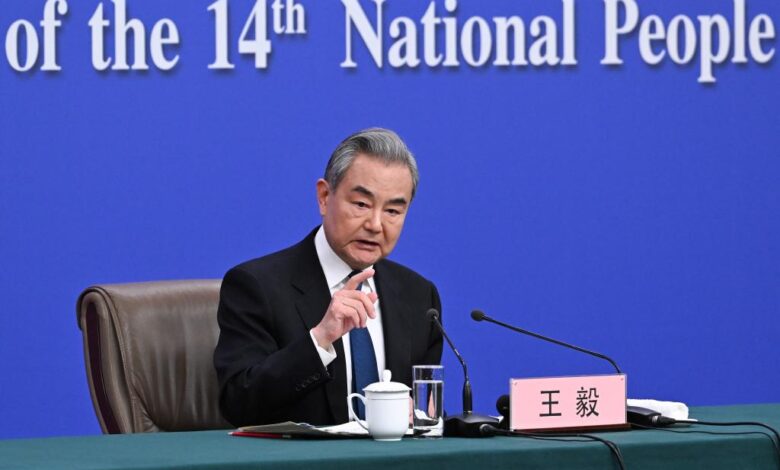
Speaking to journalists on Sunday on the sidelines of the annual session of the National People’s Congress, Foreign Minister Wang Yi, a member of the Political Bureau of the Communist Party of China Central Committee, commented on the situation in Iran, urging an immediate halt to military operations and calling on all parties to “return to the negotiating table as quickly as possible.”
He stated that Middle Eastern affairs should be determined independently by regional countries. “Plotting color revolutions or seeking regime change will not gain popular support,” he said.
On China-US relations, Wang Yi stated that 2026 will be a “big year” for bilateral ties, noting that “the agenda for high-level exchanges is already on the table.” “What both sides need to do now is to make thorough preparations accordingly, create a suitable environment, manage the differences that do exist, and remove unnecessary disruptions,” he said. “Neither side can remodel the other, but we can choose how we want to engage, that is, to commit to a spirit of mutual respect, hold the bottom line of peaceful coexistence, and strive for the prospect of win-win cooperation.”
Praising the China-Russia relationship, the Foreign Minister stated that the ties have “stood rock-solid against all odds.” He noted that the China-Russia strategic partnership of coordination has been based on equality, respect and mutual benefit since day one, representing the direction of a new type of major-country relations.
On China-Europe relations, Wang Yi expressed China’s belief that Europe should naturally be a pole in a multipolar world and that Europe is a key partner in China’s modernization drive. Noting that China and Europe are mutually complementary, he said, “Interdependence is not a risk; intertwined interests are not threats; and openness and cooperation will not weaken economic security. But building walls and barriers will only lead to self-isolation.”
On China-India relations, Wang Yi suggested the two countries uphold good-neighborliness and friendship and focus on development. “We must maintain the correct strategic perception of each other as partners rather than rivals, and opportunities instead of threats,” he said.
Wang Yi stated that the future of China-Japan relations “hinges on Japan’s choice.” Noting that last year marked the 80th anniversary of the victory of the Chinese People’s War of Resistance Against Japanese Aggression, he said Japan should have deeply repented for the wrong path it chose, including its brutal invasion and colonization of Taiwan. However, the current Japanese leader has claimed that a contingency in Taiwan would constitute a “survival-threatening situation” for Japan to exercise the so-called “right of collective self-defense.”
“Since Taiwan affairs are purely China’s internal affairs, what gives Japan the right to interfere? Why is Japan entitled to invoke self-defense if anything happens in China’s Taiwan region?” he questioned. A strong China with 1.4 billion people will never allow anyone to justify colonialism or reverse history’s verdict on aggression, he stated.
At the press conference, Wang Yi highlighted the significance of the Global Governance Initiative and the building of a community with a shared future for humanity in an increasingly turbulent world. He also called for upholding, not challenging, the central role of the United Nations.
“China will never take the beaten path of seeking hegemony as its strength grows, nor do we subscribe to the logic that the world can be run by major countries,” Wang Yi said. He stated that China’s proposal is to build an equal and orderly multipolar world, and “this should be the common responsibility of all countries.”
Particularly noting that the Global South has become a key driving force in promoting a multipolar world, he called for enhancing the voice and representation of Global South countries in the United Nations.
On China’s relations with Latin American and Caribbean (LAC) countries, Wang Yi stated that LAC countries should make their own decisions in choosing friends. “We never engage in geopolitical schemes, nor interfere in other countries’ internal affairs, nor ask others to pick sides,” he said. “Cooperation between China and LAC countries does not target any third party and should not be subject to interference by any third party.”
On China-Africa relations, Wang Yi said the friendship has withstood the test of changing international circumstances to demonstrate strong vitality. This year, China-Africa relations will see many new developments, including the implementation of zero-tariff access for 100 percent of African imports starting on May 1.
The 33rd Asia-Pacific Economic Cooperation (APEC) Economic Leaders’ Meeting will be held in Shenzhen in November. This marks China’s third time hosting the event, following Shanghai in 2001 and Beijing in 2014. Wang Yi stated that China, as a good host, will work toward the goal of translating the vision and blueprint for building an Asia-Pacific community into actions and reality.