
Cooperation Charging Ahead Like a Horse: The Beginning of a New Chapter in China–UK Relations

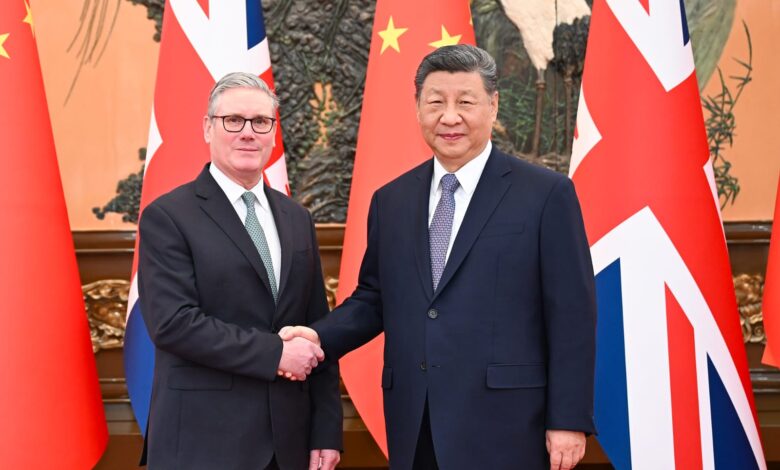

Beijing. The high-level meeting held in Beijing between Chinese President Xi Jinping and British Prime Minister Keir Starmer has sent a clear message that China–UK relations are moving toward a long-term, stable, and comprehensive strategic partnership. Taken as the first visit to China by a British prime minister in eight years, the trip is being viewed not merely as a formal diplomatic engagement, but as a historic moment that opens a new chapter of renewed trust, dialogue, and cooperation between the two countries.
According to China’s state news agency Xinhua, during Thursday’s meeting President Xi noted that the world is currently undergoing a dual phase of transformation and turbulence. In this context, he emphasized that countries such as China and the UK—both permanent members of the United Nations Security Council and major global economies—need to further strengthen dialogue and cooperation. Only through such efforts, he said, can world peace, stability, economic development, and the improvement of people’s livelihoods be promoted.
Referring to the approaching Chinese New Year, the Year of the Horse, President Xi expressed confidence that Prime Minister Starmer’s visit would be a success. He conveyed a symbolic message that China–UK cooperation would move forward in the spirit of “Yi Ma Dang Xian,” meaning “charging ahead like a horse” or “taking the lead.” Urging both sides to view history from a broader perspective, Xi said that by rising above differences and upholding mutual respect, the two countries could transform their vast potential for cooperation into tangible achievements.
Reiterating China’s commitment to peaceful development, President Xi made it clear that China has never initiated a war nor occupied any foreign territory. He stressed that no matter how much China grows and develops, it will never pose a threat to other countries. He called for expanded cooperation in education, health, finance, and the service sector, as well as joint research and industrial application in areas such as artificial intelligence, biosciences, new energy, and low-carbon technologies. He also expressed the expectation that the UK would provide an equal, fair, and non-discriminatory business environment for Chinese enterprises.
President Xi further noted that China is actively considering granting a unilateral visa waiver for British citizens. He emphasized the importance of facilitating travel, enhancing people-to-people and cultural exchanges, and welcomed members of the British government, parliament, and various sectors to visit China more frequently. Such exchanges, he said, would help foster a balanced, objective, and well-grounded understanding of China.
Addressing disruptions in the international order, President Xi warned that international law can only be truly effective when all countries comply with it—especially major powers. Otherwise, he cautioned, the world risks sliding back into the “law of the jungle.” He stressed that China and the UK, as supporters of true multilateralism and free trade, should work together to promote a more just and inclusive global governance system and contribute to an equal and orderly multipolar world.
Prime Minister Starmer conveyed greetings from King Charles III to President Xi and said he was pleased to visit China after eight years. In today’s fragile and turbulent international environment, he noted, it is crucial for the UK to build a long-term, stable, and comprehensive strategic partnership with China based on mutual respect and trust. He also reaffirmed that the UK’s policy on the Taiwan issue remains unchanged.
During the visit, Starmer also met with Chinese Premier Li Qiang. The two sides agreed to resume the China–UK High-Level Security Dialogue, convene new rounds of the Strategic Dialogue and the Economic and Financial Dialogue, and hold meetings of the China–UK Entrepreneurs Committee. In addition, the two countries signed 12 intergovernmental cooperation documents covering areas such as economy and trade, agriculture, food security, culture, and market regulation.
Significant progress was also seen in business cooperation. British pharmaceutical company AstraZeneca announced plans to invest USD 15 billion in China by 2030, marking one of the largest deals associated with the visit. Prime Minister Starmer described China as a “vitally important global player” and expressed his desire to make the bilateral relationship more refined and mature.
Beyond politics and economics, the visit also drew attention for its human and cultural moments. Scenes of Prime Minister Starmer dining on Yunnan cuisine in Beijing, receiving a traditional Chinese woodblock print as a gift, saying “xie xie” in Chinese to express thanks, and accepting flowers from a young girl at the airport were widely shared on social media. Analysts say such moments help bring diplomacy beyond formal settings and closer to the people.
According to observers, the visit signals an effort to restore balance and realism to China–UK relations, which were once described as enjoying a “golden age” a decade ago but later weakened by politicization. For the UK, facing sluggish economic growth, Chinese investment and market access are becoming increasingly important. For China, stable cooperation with a major European power carries clear strategic significance.
Overall, the meeting between President Xi and Prime Minister Starmer appears to have paved the way for China–UK relations to move forward with renewed trust, fresh momentum, and new possibilities—anchored in the shared aspiration of cooperation that “charges ahead like a horse.”