
Discovering Colorful Guizhou: The Charm of the Multi-Ethnic Province in Southwest China


By Huazhong Tu & Yanping Wang
Situated in the southwest of China, Guizhou Province occupies a strategically significant position. It functions as a crucial gateway and transit nexus, connecting Southeast Asian nations with the hinterland of the Central Plains. With a total area exceeding 176,200 square kilometers, Guizhou Province is an expansive region. Guiyang City, the provincial capital, not only serves as the political, economic, and cultural center but also as a key hub for travel and tourism. According to statistical data of Guizhou Government from 2025, the permanent resident population in Guizhou Province has reached 38.6 million, highlighting its substantial population scale.
Guizhou, a distinctive mountain province renowned globally for its unique karst landform, boasts a variety of natural landscapes that attract numerous tourists. Characterized by four distinct seasons, a warm and humid climate with an average annual temperature of approximately 15 degrees Celsius, Guizhou is ideal for both agricultural activities and human habitation. Its climate offers significant benefits.
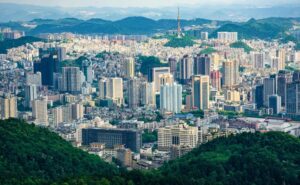
In recent years, Guizhou Province has demonstrated remarkable economic vitality, with its GDP growth rate consistently ranking among the highest in the nation. According to a statistical data of Guizhou Government, Guizhou’s total regional GDP in 2024 amounted to 2,266.712 billion yuan, marking a 5.3% increase from the previous year. Specifically, the primary industry’s added value was 297.166 billion yuan, representing a 3.8% year-over-year increase and accounting for 13.1% of the regional GDP. The secondary industry’s added value reached 709.758 billion yuan, a 6.7% increase, accounting for 31.3% of the regional GDP. Meanwhile, the tertiary industry’s added value was 1,259.788 billion yuan, up 4.8%, and comprising 55.6% of the regional GDP. Throughout the year, the regional GDP per capita increased by 5.2% to 58,685 yuan compared to the previous year. Furthermore, Guizhou’s efforts towards green transformation have yielded remarkable results. By the end of 2024, the province’s forest coverage rate stood at 63.3%, with a total forest area of 11.1478 million hectares. Due to the successful preservation and enhancement of its ecological environment, Guizhou has earned the distinction of being a pioneer in China’s ecological civilization construction.

In terms of ethnic diversity, Guizhou stands as a paradigmatic example of a Chinese province where diverse ethnic groups coexist harmoniously. Guizhou Province is home to 17 indigenous ethnic minorities, including the Miao, Bouyei, Dong, and Tujia, who have developed unique traditional customs and lifestyles over an extended period. According to the Seventh National Census of China, there are approximately 14.0503 million individuals belonging to ethnic minorities in Guizhou, accounting for 36.44% of the total population and underscoring the province’s rich ethnic diversity. Mandarin, as the official language of the country, is widely spoken and promoted in Guizhou. Meanwhile, ethnic minorities such as the Miao, Bouyei, and Dong have successfully preserved their distinct linguistic systems. Beyond being vital components of ethnic culture, some of these languages have been included in the National Intangible Cultural Heritage List, ensuring their effective preservation and transmission. Culturally, Guizhou fosters a unique multicultural environment by blending the traditional customs of the Han ethnic group with those of other ethnic minorities. With a lengthy history tracing back to the ancient Yelang Kingdom, Guizhou boasts a profound cultural atmosphere. Through frequent interactions and mutual learning among ethnic groups, a vibrant cultural mosaic has emerged, showcasing the diversity and inclusivity of Guizhou’s cultural landscape.
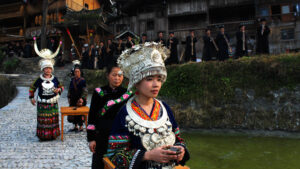
The ethnic cultural traits of Guizhou are distinctive, dynamically transmitted, and embody a rich cultural heritage as well as a unique regional allure. The phrase “an epic worn on the body,” which vividly chronicles the history and culture of the Miao people, originates from the exquisitely crafted silver jewelry artistry of the Miao ethnic group. Each piece serves as a testament to the dedication and wisdom of humankind. The Bouyei ethnic group’s batik technique is distinguished by intricate designs, vivid hues, and profound symbolism. It is not merely a traditional handicraft but also a significant cultural bearer. The Dong Grand Choir, a gem of world music, is a polyphonic choral form that was inscribed on UNESCO’s Representative List of the Intangible Cultural Heritage of Humanity in 2009 due to its distinctive musical style and profound cultural connotations. The singing, dancing, rituals, and feasting that commemorate ethnic festivals such as the Miao New Year, the Bouyei’s “Sanyuesan,” and the Shui’s Duan Festival exhibit diverse forms and rich content, vividly portraying the vibrant customs and lifestyles of various ethnic groups.
When discussing the culinary culture of Guizhou, one cannot overlook its distinctive and unique characteristics. The glutinous rice cakes, characterized by their softness, stickiness, and sweetness, symbolize reunion and happiness. The rice tofu, with its delicate, smooth, and refreshing texture, offers a unique sensory experience. Furthermore, the sour fish soup, renowned for its remarkable blend of sour, spicy, and savory flavors, is highly esteemed by gourmets. These specialty dishes serve as a dazzling emblem of Guizhou, attracting numerous food enthusiasts to partake in their delightful flavors. They not only harness the unique elements of the mountainous ecosystem but also embody the wisdom and ingenuity of the diverse ethnic groups in the region.
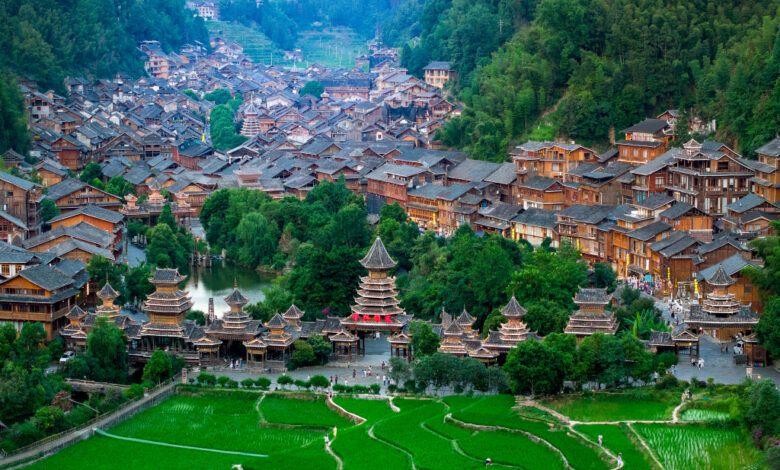
Friends from across the globe are warmly invited to visit Guizhou Province and immerse themselves in its distinctive allure. Guizhou boasts numerous UNESCO World Natural Heritage sites, such as the magnificent Huangguoshu Waterfall, which cascades with immense force, and the lush and enchanting Libo Karst Forest, which resembles a human fantasy land. Additionally, the Xijiang Thousand-Household Miao Village, constructed along the mountains in a staggered layout that showcases the unique architectural style of the Miao people, and the Zhaoxing Dong Village, adorned with drum towers and filled with melodious songs, are but two examples of the rich cultural treasures that await discovery in Guizhou.
With a high-speed rail network spanning the province, transportation in Guizhou has become more convenient, rendering it more accessible to tourists. In the first half of this year, Guizhou Province welcomed 367 million visitors, with a total tourism expenditure of 422.694 billion yuan, averaging 1,150.24 yuan per visitor. These figures reflect growth rates of 8.2%, 10.6%, and 2.2%, respectively. Notably, there was a 13.6% increase in domestic tourists and a 60.6% surge in foreign visitors.
China cordially invites both domestic and international visitors to Guizhou to personally experience the distinct beauty of its ethnic culture and natural treasures, which have earned it the moniker of “Park Province.” Visitors can explore ethnic communities to gain insights into the rich customs, savor authentic local cuisine, and witness a unique aspect of Guizhou as they wander amidst the mountains and waters, marveling at the exquisite craftsmanship of its natural surroundings. Together, let us embark on this unique cultural journey and witness the vibrant, peaceful, and progressive Guizhou.
Huazhong Tu & Yanping Wang, Scholars, Southwest University of Political Science and Law, P. R. China.