
From Traditional Friendship to Multidimensional Partnership
The Present State and Future Direction of Nepal–Russia Relations


# Abinash Sharma
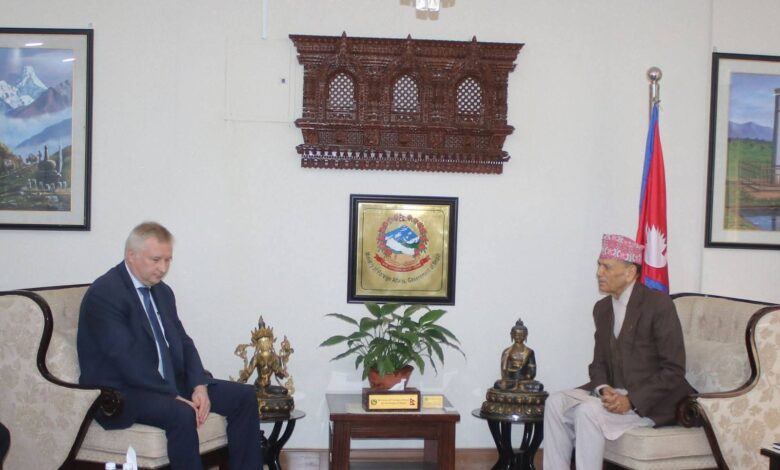
The meeting held on January 26 between the Chargé d’Affaires a.i. of Russia to Nepal, Mr. Andrei Kiselenko, and Nepal’s Minister for Foreign Affairs, Mr. Bala Nanda Sharma, was not confined to mere diplomatic courtesy. Rather, it was a meaningful diplomatic dialogue carrying important signals about the future trajectory of Nepal–Russia relations at a time of shifting global power balances, growing polarization in world politics, and expanding strategic options for small and medium-sized states.
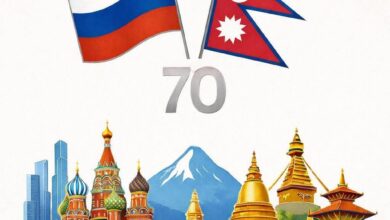
Relations between Nepal and Russia represent a historical friendship that evolved within the context of Cold War–era global politics. Nepal’s engagement with the former Soviet Union was not simply a diplomatic formality; it was an expression of an independent foreign policy, the practice of non-alignment, and a commitment to a multipolar worldview. Although the Soviet Union is now part of history, Russia has continued this legacy as its successor state, sustaining and nurturing its friendship with Nepal. It is against this historical backdrop that the meeting between Minister Sharma and Chargé d’Affaires Kiselenko must be understood.
During the meeting, Mr. Kiselenko’s congratulation to Minister Sharma on assuming office, along with his wishes for a successful tenure, went beyond diplomatic etiquette. It also signaled Russia’s intent to maintain and deepen long-term cooperation with Nepal. In diplomacy, such messages often carry greater meaning in context than in words alone. Particularly at a time when Russia has been facing confrontation and sanctions from Western powers in recent years, strengthening relations with regions such as South Asia has become strategically important for Moscow.
The discussion on the current state of bilateral cooperation and future prospects must be seen in this same context. For Nepal, Russia is not merely a traditional friend but also an important power that contributes to maintaining balance in multilateral diplomacy. Russia’s positions in international forums, including the United Nations, have often reflected shared perspectives with Nepal on issues of sovereignty and independent decision-making for smaller states. Against this background, identifying new areas of cooperation has become a timely necessity for both sides.
Minister Bala Nanda Sharma’s recollection of his time in Russia as a Defence Attaché was not simply a personal reflection; it highlighted the human dimension of bilateral relations. Diplomacy is not limited to formal agreements and official statements—personal trust, professional respect, and long-term contacts are what give it life. The high-level professional and personal relationships referenced by the Minister appear to have played a meaningful role in strengthening Nepal–Russia relations at a practical level.
From an international perspective, the world today is moving from a unipolar order toward a multipolar structure. On one side stand the United States and its allies, while on the other are Russia, China, and other emerging powers seeking to expand their influence. In such a context, a balanced and multidimensional foreign policy is essential for a country like Nepal. The meeting between Minister Sharma and Chargé d’Affaires Kiselenko indicates Nepal’s intention to reinvigorate relations with its traditional friends as part of this broader foreign policy approach.
Potential areas of Nepal–Russia cooperation are not confined to political or diplomatic dialogue alone. There are ample opportunities to expand cooperation in energy, infrastructure, education, science and technology, cultural exchange, and humanitarian assistance. Historically, Russia has supported Nepal in areas such as hydropower development, industrial growth, and technical training. At a time when Nepal is moving forward with the goal of becoming an energy-exporting country, technical and investment cooperation with Russia could prove beneficial in the long term.
The fact that the meeting took place in a friendly and constructive atmosphere itself carries an important diplomatic message. In diplomacy, the tone and environment often shape the direction of future engagement. Discussions held in an amicable setting tend to move beyond formal agreements toward trust-building. Trust is the foundation of bilateral relations, and this meeting signaled that such a foundation remains intact in Nepal–Russia relations.
This meeting can also be viewed from another perspective relevant to Nepal. In recent years, Nepal has faced criticism for concentrating its foreign policy excessively on a limited set of regional priorities. In such a situation, the activation of high-level dialogue with a traditional friend like Russia may indicate Nepal’s renewed effort to restore multidimensional diplomatic balance. This balance is necessary not only for power politics but also to keep open diverse options for development, technology transfer, and international cooperation.
Ultimately, although the meeting between Minister Sharma and Chargé d’Affaires Kiselenko may appear to be a modest diplomatic event, its context and implications are far-reaching. It has reaffirmed Nepal–Russia relations, demonstrated their relevance in the current global political structure, and opened doors for expanding cooperation in the future. If this meeting is followed by substantive dialogue, regular engagement, and practical cooperation, it could lay a strong foundation for transforming Nepal–Russia relations from traditional friendship into a modern, multidimensional partnership.