
Greater Nepal Nationalist Front Issues Open Letter to Indian Prime Minister Modi on Independence Day

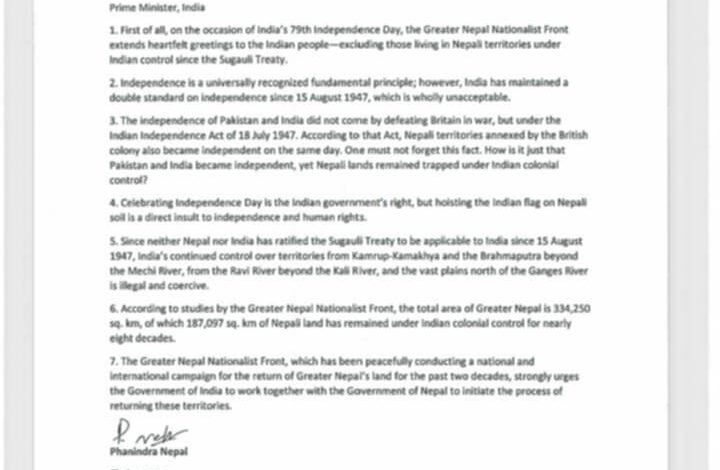

Kathmandu, August 15, 2025 — On the occasion of India’s 79th Independence Day, the Greater Nepal Nationalist Front (GNNF) released a strongly worded open letter addressed to Indian Prime Minister Narendra Damodardas Modi, calling for the return of territories the group claims were historically part of Nepal.
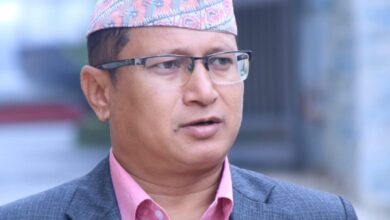
In the letter, GNNF Chairperson Phanindra Nepal extended greetings to the Indian people—explicitly excluding residents of regions the group considers “under Indian control since the Sugauli Treaty.” The letter challenges the legitimacy of India’s control over several regions which, according to the organization, were annexed from Nepal during the British colonial period and should have reverted to Nepalese sovereignty following Indian independence in 1947.
“The independence of Pakistan and India did not come by defeating Britain in war, but under the Indian Independence Act of 18 July 1947,” the letter reads. “According to that Act, Nepali territories annexed by the British colony also became independent on the same day.”
The GNNF argues that the Sugauli Treaty—signed between the British East India Company and Nepal in 1815—should not have continued to apply after India’s independence, as it was an agreement between Nepal and British colonial authorities, not with the sovereign Indian state.
Citing their own research, the GNNF claims that Nepal’s historical territory encompassed 334,250 square kilometers, of which they allege 187,097 square kilometers remain under Indian control. The disputed areas, as outlined in the letter, include regions from Kamrup-Kamakhya and the Brahmaputra in the east, to the Ravi River in the west, and north of the Ganges in the south.
The letter also condemns the hoisting of the Indian national flag on what the group considers Nepali land, calling it a violation of “independence and human rights.”
For more than two decades, the Greater Nepal Nationalist Front has advocated for the restoration of these territories through what it describes as “peaceful national and international campaigning.” The letter ends with a call for bilateral dialogue between the governments of Nepal and India to initiate the process of returning the contested lands.
Copies of the open letter were also forwarded to the prime ministers of Nepal, Pakistan, and Bangladesh.
Neither the Government of India nor the Government of Nepal has yet officially responded to the letter.