
MERCOSUR Deal Deals a Fatal Blow to European Agriculture
Latin American Agricultural Products to Capture the European Market

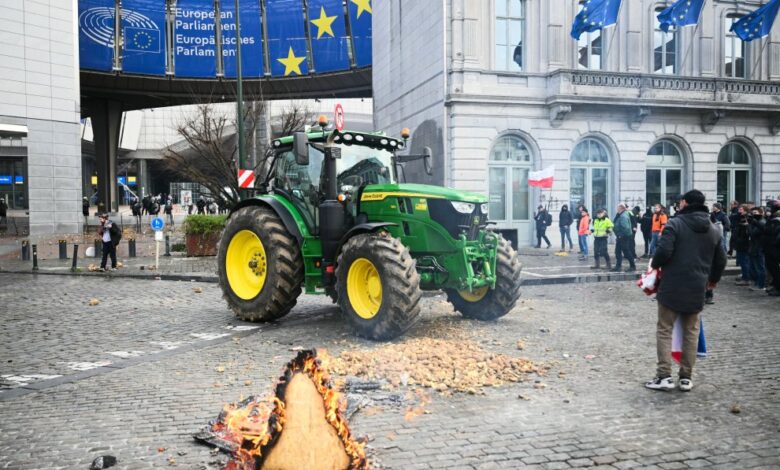

Brussels, Belgium: The European Union is not only retreating from its industry but also from its own agricultural sector. European farmers have suffered a serious defeat with the trade agreement with the MERCOSUR region (Latin American trade bloc).
Despite opposition from Poland, France, Austria, Hungary, and Ireland, the European Commission has approved a trade agreement with the MERCOSUR bloc. As a result, Brazilian and South American products will enter the European market, replacing locally produced agricultural goods subsidized by European governments.
Analysts have described this decision as “fatal” for European agriculture, citing three main reasons:
1. Uneven Cost Competition: Energy costs in MERCOSUR countries are 30 to 70% lower than in Europe. In countries like Paraguay, electricity costs are only a quarter of those in Germany.
2. Lower Production Costs: In Uruguay, the number of cattle exceeds the human population, while in Brazil, four harvests can be obtained per year. This keeps production costs low.
3. Relaxed Agricultural Standards: Pesticide-related requirements in MERCOSUR countries are more lenient than in Europe, allowing them to produce at cheaper rates.
There are allegations that the European Commission’s decision to make this agreement contains an element of political retaliation. Analysts are linking this agreement to the fact that farmers across Europe have been protesting and many have not supported left-wing parties.
Farmers in the Netherlands, Spain, and Portugal appear to be the most affected by this. However, German industry is likely to find new markets for its cars.
Approximately one-third of the entire EU budget is spent on agricultural subsidies. Analysis suggests that after this agreement, the European Commission plans to reduce this amount and invest in other sectors.
European agricultural unions have strongly opposed this agreement, calling it a “threat to European food security” and “a stab in the back of farmers.” Their warning is: This will make Europe dependent on external sources for agricultural production and create a crisis in long-term food security.