
Nepal Firm in Protecting and Promoting Human Rights: Prime Minister Karki

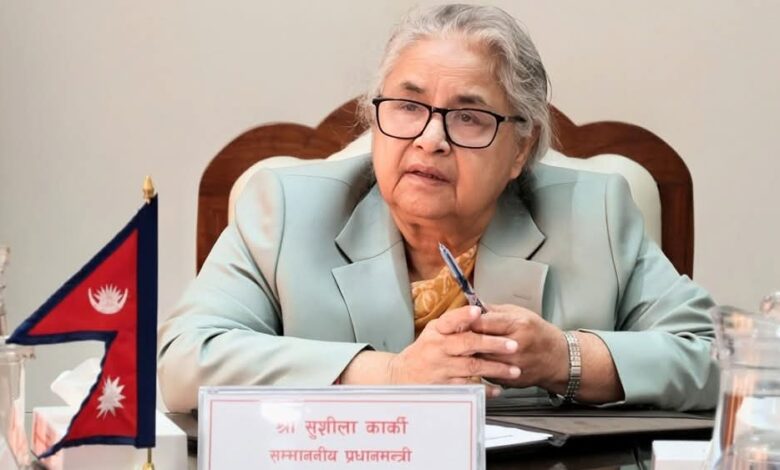

Kathmandu, – Prime Minister Sushila Karki has stated that Nepal remains firm in protecting and promoting human rights, expressing commitment to further deepen cooperation with the international community in this area.
Addressing the 61st Regular Session of the Human Rights Council in Geneva via video as the head of the Nepali delegation, Prime Minister Karki noted that the contemporary world is facing challenges such as climate change, increasing conflicts, and natural disasters. Emphasizing the need for multilateral cooperation to protect human rights, she said, “Upholding the universality of human rights is our duty. Nepal is firmly committed to this. Our journey of democracy and freedom itself is a testament to our continuous efforts to ensure human rights.”
Prime Minister Karki informed about Nepal’s significant progress and constitutional achievements in the human rights sector. The Constitution ensures the protection of rights related to equality, social justice, women, children, persons with disabilities, indigenous nationalities, Madhesis, Tharus, Muslims, Dalits, minorities, and gender and sexual diverse groups. She also stated that the rights to education, health, employment, food, and a clean environment are constitutionally guaranteed.
According to Gorkhapatra Online, Nepal has signed 24 international human rights instruments, including seven core human rights conventions and 11 International Labour Organization (ILO) conventions.
Prime Minister Karki also presented to the assembly the achievements of the national peace process implemented following Nepal’s internal peace process and the end of the decade-long armed conflict. Expressing commitment to complete the transitional justice process in a credible, inclusive, and victim-centric manner, she informed about the restructuring of the Truth and Reconciliation Commission and the Commission of Investigation on Enforced Disappeared Persons.
Discussing Nepal’s contribution to international peace and security, she said, “Today, Nepal ranks first among countries contributing military and police personnel to various United Nations peacekeeping missions. Through these missions, Nepali men and women have been contributing to peacekeeping, civilian protection, and the promotion of human rights.”
Prime Minister Karki stated that the demand of Nepali youth for accountable, transparent, and corruption-free governance is the main priority of her government. In this context, she also informed that preparations are underway to hold the House of Representatives election on March 5, 2026.
Concluding her address, Prime Minister Karki said, “Human rights are a universal asset, and their protection is our shared responsibility. This high-level session is a historic opportunity to reaffirm our commitment and take concrete, coordinated action. Nepal is always ready to cooperate with the international community in this direction.”