
Nepali Army at 263 Years: An Integral Part of Peace, Security, and Nation-Building
Grand Ceremony of Maha Shivaratri and Army Day Concludes at Tundikhel

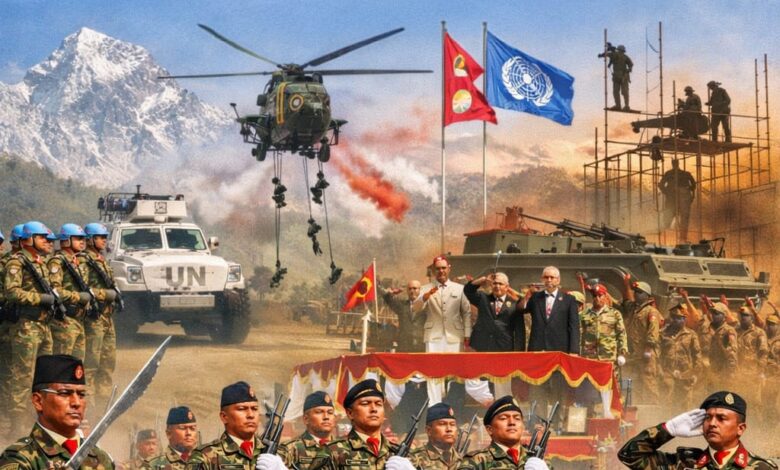

Kathmandu — The Nepali Army, established in 1819 BS by Prithvi Narayan Shah, has entered its 263rd year, preserving numerous glorious sagas and a golden history intact. A grand ceremony was held on Sunday at the Army Pavilion in Tundikhel, Kathmandu, on the special occasion of the Maha Shivaratri festival and Army Day. The program was attended by the President, Prime Minister, high-ranking government officials, and heads of diplomatic missions from various countries.
Army Spokesperson Rama Ram Basnet stated that since its establishment, the Nepali Army has faithfully fulfilled the responsibilities assigned by the nation, committed to the country, citizens, and the constitution. He said, “It is because of this dedication and commitment that the Nepali Army has succeeded in winning the trust and confidence of the general public.” He also expressed the army’s commitment to always remain dedicated not only to the overall security of the country but also to disaster management, nation-building (infrastructure development), and the preservation of art, culture, and historical and archaeological sites.
The role played by the Nepali Army in preventing colonialism, which sought to capture state power globally in the 17th century, at the borders and keeping Nepal free from colonization is unparalleled. By being at the forefront of internal and external security as well as peacekeeping in conflict-ridden countries, the Nepali Army has succeeded in establishing a distinct identity on the world stage.
The United Nations considers the Nepali Army the most trustworthy and reliable security organization, entrusting it with the security of complex and sensitive areas. To date, over 160,000 Nepali peacekeepers have been deployed in various conflict zones at the UN’s call. Nepal is also at the forefront in deploying female peacekeepers.
Prem Sagar Poudel, President of the Nepal-China Mutual Cooperation Society, stated that the role played by the Nepali Army in fostering world peace, stability, and amicable military diplomacy is unparalleled and exceptional. He said, “The fact that Nepali peacekeepers have become a trustworthy organization for the UN, the citizens of conflict-ridden countries, and their governments is a matter of pride for the nation. The commitment to deploy 10,000 peacekeepers has further increased the UN’s trust in Nepal.”
Having established a proud identity globally, the Nepali Army remains dedicated to the country and its citizens, embracing the constitution and inclusivity while continuously being active in nation-building. Overcoming numerous challenges in development construction, disaster management, and infrastructure development, the army has been making a distinct contribution to building quality infrastructure in remote and geographically challenging areas.
Currently, the army is constructing the national pride project, the Kathmandu-Tarai Madhesh Fast Track. It has completed road construction in complex geographical terrains such as the Kaligandaki Corridor, Khadbari-Kimathanka, and Karnali Corridor. Similarly, the Ghatparchaur-Badrigaon-Bhukkakhola road section is under construction. The Benighat-Arughat-Larkebhanjyang and Darchula Tinkar road projects are top priorities.
Infrastructure expert and former secretary Arjun Jung Thapa stated that the Nepali Army’s contribution to infrastructure development is unparalleled. He said, “Due to the army’s discipline, efficiency, and ability to work even in difficult geographical conditions, national pride projects like the Fast Track are taking concrete shape.”
This occasion of the 263rd Army Day has highlighted together the past glory, present contribution, and future commitment of the Nepali Army. It is believed that the Nepali Army will always remain at the forefront on this integral journey of peace, security, and nation-building.