
Nepal’s Future in the Dock of the Judiciary !


# Prem Sagar Poudel
Nepal is currently standing at a constitutional juncture where not only is the legal question of dissolving parliament in question, but national sovereignty, the credibility of the judiciary, and the future of political cleanliness are simultaneously being tested. The country has repeatedly undergone political transitions, and at the center of each transition, trust in the role of constitutional organs such as the judiciary, the executive, and the presidency has become decisive.
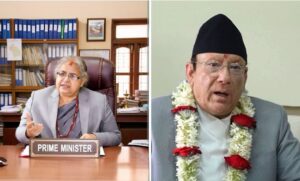
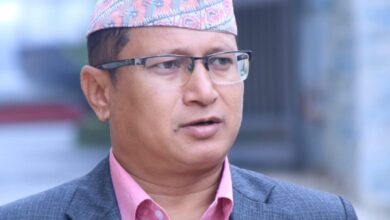
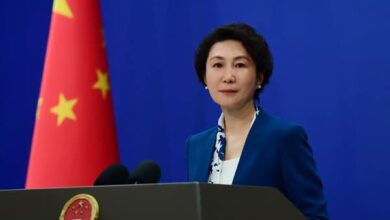
The top figures in the photo, one as a symbol of executive leadership, the other as judicial leadership, both are not only historically linked to the political past, but are also open facts. Nepal’s political culture has been driven for decades by a cycle of party-based quotas and recommendation-based appointments, and this cycle has put the current Constitutional Bench at the center of controversy. The question of whether or not the dissolved House of Representatives will be reinstated is not just a matter of legal interpretation, but has become an event that determines the direction of the entire state structure.
The opposition has protested, calling the Prime Minister’s move unconstitutional, but the irony is that the role of the President in swearing in the government that was deemed unconstitutional, and the top figures in the judiciary who proudly attended the swearing-in ceremony, are still at the center of state power today. Whether the president’s impartiality is undisputed or disputed is not just a political debate, but is linked to the moral backbone of the nation. At such a sensitive time, it is not only natural but also necessary to recall the Chief Justice’s political past and appointment based on party recommendations.
Meanwhile, how natural is the presence of the people who lead the constitutional bench? Even the country’s senior legal experts are silent on this matter. Because the judiciary is not just an institution that carries legal books, but is the ultimate trustworthiness of the nation. Maoist quota, Congress quota, recommendation, party loyalty, these words are not personal accusations of any individual, but questions raised as potential points that could impact judicial impartiality. The beauty of democracy is that questions are raised, and it is the responsibility of the judiciary to answer them.
Nepal’s history is full of facts of how external powers use internal instability as an opportunity. The 2072 blockade, the split in the MCC, the Indo-Pacific strategy, the North-South diplomatic spat, these are not isolated incidents. World powers see Nepal’s instability as useful, as a stable Nepal may not be in their interests. Today’s dissolution of Parliament and constitutional interpretation is not just a legal process, it is also a signal of international balance and power politics.
Looking at the history of foreign power competition, the courts of Pakistan, Sri Lanka, and Bangladesh have become the decisive turning points for political decisions. Overnight, the prime minister was removed, parliament was restored, and the president’s rights were limited. In the world’s diplomatic structure, the judiciary is no longer just a law; it has also become a political balancer. Nepal is no exception from that. Neighboring countries and world powers are watching judicial decisions here with great seriousness, as even small changes in a small country can create major geopolitical ripples.
In Nepal, society itself is divided by party sentiment. With the Maoists, Congress, UML, and Madhesh parties all at the center of their own interests, the core essence of the constitution, the sovereignty of the people, and the long-term interests of the nation can sometimes be overshadowed. In such a situation, a single word from the judiciary can overturn the political equation, give a political signal, and determine the future of stability and instability. Therefore, judicial impartiality is not just a general saying, “It’s okay,” but the soul of the nation.
What Nepal needs most today is an institution that can rise above individuals, parties, and external recommendations and prioritize the nation. Those who sit on the Constitutional Bench are not just office holders, but powerful hands wielding the pen that will write the future of the nation. If those hands are in dispute, the decision is automatically in dispute. To save the nation from crisis, lawyers, judges, the President, and the Prime Minister must all look at things through the larger lens of history, not through party lenses.
Today’s crisis has also given Nepal another opportunity, an opportunity for constitutional cleanliness, institutional restoration, judicial reform, and national unity against foreign interference. If Nepal wants long-term stability, the judiciary must be known for its moral high ground, not its political history. The office of the President should be a place of trust, not controversy. The Prime Minister’s decisions should be based on the spirit of the Constitution, not on the party’s interests.
Nepal is a small country, but its self-respect is great. Our ability to maintain a balance between power nations rests on the purity of institutions and the credibility of decision-making processes. Whatever decision is reached on the issue of dissolving Parliament, that decision must be fair, clean, nation-first, and in accordance with the core spirit of the Constitution. The greatest power to save the nation lies in the hands of those sitting in the courtroom today, and a decisive sentence they write can either push Nepal into the darkness of instability or lift it towards a stronger future.
Nepal is writing a new history today. The country expects a nation greater than party, justice greater than position, and a constitution greater than self-interest. This is why today’s constitutional decision is not just a legal decision, but a test of patriotism.
Author: Prem Sagar Poudel is a senior journalist and international relations analyst from Nepal. He has conducted in-depth studies on Nepal-China relations, the geopolitics of the Himalayan region, and Asian security.