
Rifts Across the Atlantic: US-Europe Ideological Clash at the Munich Security Conference

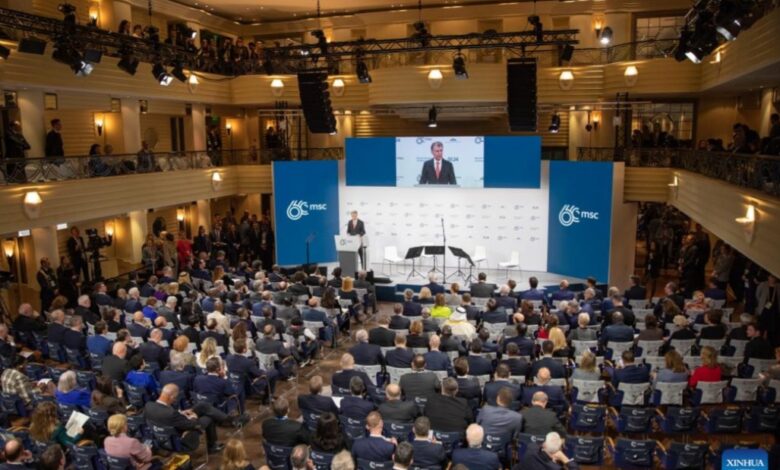

Munich, Fagun 4: The 62nd Munich Security Conference (MSC) concluded on Sunday. This year’s conference witnessed sharp disagreements between the United States and Europe over the future of the transatlantic partnership and the global order, exposing a deep rift between the two sides.
The Munich Security Report 2026 describes the current era as one of ‘wrecking-ball politics.’ The report states that political forces favoring destruction over reform are increasingly gaining momentum in many Western societies, driven by disenchantment with the performance of democratic institutions and a loss of trust in political course correction.
Many European delegates arrived in Munich with heightened unease following U.S. Vice President JD Vance’s sharp criticism of Europe at last year’s conference, as well as President Donald Trump’s repeated threats to annex Greenland and impose sweeping tariffs.
In his speech last year, Vance argued that Europe’s greatest threat came ‘from within,’ accusing European governments of curbing free speech and mishandling migration, which drew sharp criticism from European officials.
On Saturday, U.S. Secretary of State Marco Rubio adopted a noticeably softer tone. In his speech, he emphasized historical and cultural ties, stating that the United States and Europe ‘belong together.’
However, he did not back down from underlying U.S. demands that European countries change course on several fronts, including assuming more responsibility for their own security. His speech also advanced controversial positions, dismissing climate initiatives as a ‘climate cult’ and criticizing Europe’s migration policies.
Bernd Lange, chair of the European Parliament’s trade committee, described Rubio’s speech as a sobering wake-up call. “It was a charm offensive in tone, but a clear rejection of international rules,” he warned, arguing that it put national strength and narrow self-interest front and center.
Majda Ruge, a senior policy fellow at the European Council on Foreign Relations, echoed this sentiment, calling Rubio’s speech simply a ‘polite version’ of Vance’s earlier rhetoric.
Speaking after Rubio, European Commission President Ursula von der Leyen, without explicitly naming the United States, warned that “the European way of life — our democratic foundation and the trust of our citizens — is being challenged in new ways, on everything from territories to tariffs or tech regulations.”
Her remarks were widely seen as a veiled reference to disputes over digital regulation, U.S. tariffs, and Trump’s statements on Greenland, an autonomous territory of Denmark.
“Europe must become more independent — there is no other choice,” von der Leyen concluded.
German Chancellor Friedrich Merz offered an equally stark diagnosis on Friday, saying a “deep divide has opened between Europe and the United States,” stressing that Europe “does not believe in tariffs and protectionism, but in free trade.”
The Munich Security Report 2026 notes that, ironically, the leader of the country that did more than any other to shape the post-1945 international order has now become one of the most prominent ‘demolition men.’
Under the current Trump administration, the United States is set to withdraw from 66 international organizations, including 31 UN entities and 35 non-UN bodies, after the White House said they ‘no longer serve American interests.’
Debate over the future of multilateralism and the international order ran through multiple sessions at the conference.
In his remarks, Rubio said the United Nations (UN) ‘still has tremendous potential,’ but argued that on today’s most pressing issues, “it has no answers and has played virtually no role.” Instead, he praised U.S. leadership for ‘problem-solving.’
European leaders countered that rules and institutions remain indispensable for managing conflict and preventing a slide into raw power politics.
One of the most contentious moments came during a panel on the reform and destruction of the international order, where EU foreign policy chief Kaja Kallas clashed with U.S. Ambassador to the UN Mike Waltz over burden-sharing and the future of multilateral institutions.
After Waltz accused Europe of inaction linked to years of low defense spending, Kallas rejected the charge. “When America goes to wars, a lot of us go with you, and we lose our people on the way. You also need us,” she told Waltz.
She argued that the UN does need reform to reflect today’s realities, but that reform must be grounded in mutual respect and in the principle that “nobody is above the law.”
Waltz pushed back against the notion of a collapsing world order, portraying the current U.S. administration as pulling the world back from the brink. In a theatrical gesture underscoring the clash, Waltz handed out a blue “Make the UN Great Again” cap emblazoned with an American flag.
Chinese delegates laid out Beijing’s vision for global governance at the conference, pledging that China will be a firm contributor to peace, stability and historical progress, and will promote the building of a community with a shared future for humanity.
Chinese Foreign Minister Wang Yi said at the MSC that the international situation has become increasingly volatile, warning that the law of the jungle and unilateralism have been rampant. Global governance, he noted, should be improved through reform in order to calibrate the right course of history.
He outlined four suggestions for improving global governance: revitalizing the UN system, enhancing global coordination and cooperation, practicing consistent multilateralism, and prioritizing a cessation of war to promote peace.
Wang urged countries to abide by the same set of rules, that is, the basic norms of international relations based on the purposes and principles of the UN Charter, so that all countries, especially the vast number of small and medium-sized countries, can find their place and play their due role in the international system.
Noting that the Global South is rising collectively, Wang said the global governance system should keep pace with the times to reflect their voices and their representativeness more.
Wang Yiwei, a professor of international relations at Renmin University of China, observed that in contrast to America’s destructiveness, China strongly emphasizes construction.
“We are a constructive force,” he told media. “China has always emphasized reform of the UN system, but absolutely not starting from scratch, which would be very costly. We strengthen rather than weaken it.”
Zhu Min, former deputy managing director of the International Monetary Fund, told media that the UN remains “a key institutional framework connecting countries,” and support for existing structures can help stabilize expectations and confidence.
He added that China’s proposal to build a community with a shared future for humanity seeks to safeguard the existing institutional framework, share the fruits of its development with the Global South, and deepen cooperation with developed countries, offering a new pathway for global governance cooperation.
At the conclusion of the conference, most observers concluded that the future of the transatlantic partnership remains uncertain. While Europe is moving towards greater self-reliance in its security and foreign policy, America is demanding reform of multilateral structures while keeping its national interests at the center.
The Chinese approach, however, has sought a balance between reform and stability, which has garnered support from many developing countries. But in this landscape of US-China competition and Europe’s growing self-reliance, uncertainty persists about what the future of the world order will look like.