

Robots Steal the Show at Chinese New Year: A Unique Fusion of Tradition and Technology

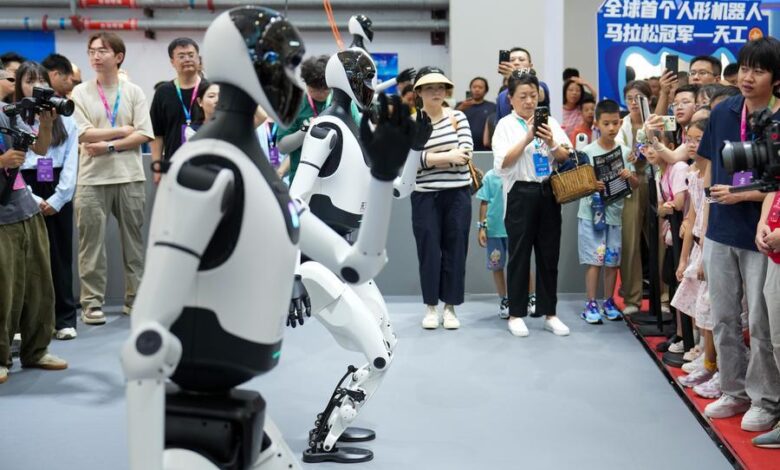

Kathmandu, February 20. This year, robots have garnered just as much attention as humans during the Chinese New Year celebrations. From the Spring Festival Gala to local cultural programs, cutting-edge humanoid robots have made their presence felt across the country.
At the Spring Festival Gala held on February 16, renowned robotics companies such as Unitree Robotics, Galbot, Noetix, and MagicLab showcased their advanced robots.
Beyond the Gala, robots were also seen in regional art events. In a dance drama organized in East China’s Jiangxi Province ahead of the New Year, two robots performed graceful and rhythmic dances alongside artists to popular songs.
Those robots, manufactured by Shanghai EmbodyDeep Science and Technology Co., Ltd., were “guests” at the dance drama dedicated to “Tiangong Kaiwu,” a 17th-century Chinese encyclopedia of technology and industry.
Audience member Hu Jingchen said, “This performance itself is a tribute to technology, and the robots joining the actors on stage once again showed us how technology can amaze us.”
Commenting on the wider applications of robots, Shi Zhongwei, CEO of Shanghai EmbodyDeep, said, “Robots are not just industrial tools. In emerging art trends, they can become digital actors and cultural symbols.” He also informed that the robots are ready to collaborate with Anhui’s Huangmei Opera troupe to reimagine classical performances.
Ahead of the New Year, the Shandong Robotics Industry Association organized a special gala featuring over 200 robots and robotic dogs. The robots showcased their talents across 19 programs, including acrobatics, martial arts, dance, and short dramas.
According to Wang Shuang, Deputy General Manager of robot manufacturer Rokae (Shandong), the robots were trained for two months in simulated environments before being put on stage.
Across various Chinese cities, robot training centers are accelerating intelligent development. At a robot school in Shandong, robots receive daily training in 11 disciplines, including automotive parts sorting, industrial logistics, commercial services, and home care.
Su Kairui, head of the Leju (Jinan) Humanoid Robot Data Training Center, clarified the goal, saying, “Our objective is to enable them to understand and adapt to their environment like humans.”
With the advancement of AI, the robotics sector has progressed faster than expected and has embraced the transition from spectacle to daily life. By 2025, China had over 140 humanoid robot manufacturers who have launched more than 330 models in the market.
This Spring Festival, many families are choosing AI robots as festive purchases. Wang Yan, a resident of Jinan, bought a robot to keep her pet company, help children practice English, and converse with elderly relatives.
She said, “It’s no longer just a toy. It’s becoming a long-term, evolving AI companion.”