
The moral bankruptcy and treasonous role of Nepali journalism


# Pasang Lhamu
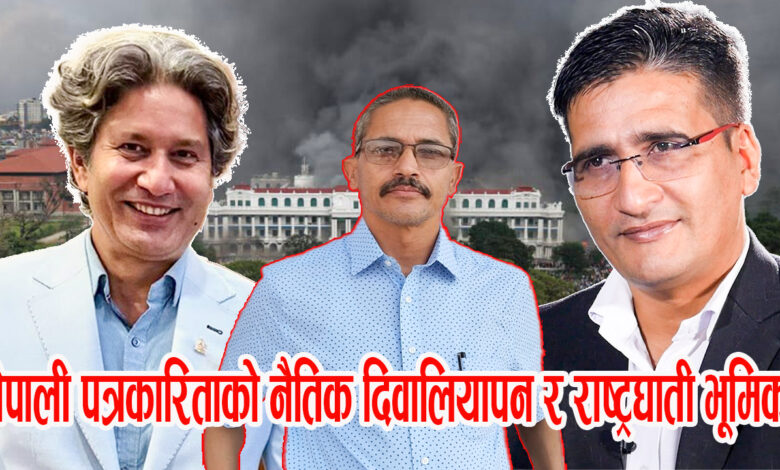
Fire has played a huge role in Nepal’s political history. Fire has become the inspiration for the people’s movement, and it has also become the symbol of anarchy. But what is burning in Nepal today is not the fire of nation-building, but the fire of national betrayal. And adding fuel to this fire is being done by some “famous” media personalities. The words that came out of their mics and cameras have become the torch that burns the country today.
Media workers like Tikaram Yatri, Bhushan Dahal, Jibram Bhandari, Jagdish Kharel, and Rajendra Baniya provided a platform on national television for controversial figures like Durga Prasai. The problem is not why they were interviewed; the problem is where words that invite violence, hysteria, and chaos, such as “I will cut, kill, set fire to, chase,” were broadcast without any censorship, no restraint, no sense of social responsibility. This is not journalism; this is a mental crime committed in the name of entertainment. Narratives of such chaotic guests have also found a prominent place in popular reality and comedy shows, thereby sowing the seeds of violence and chaos in the minds of the younger generation.

Let’s look at the example of Arjun Gyawali. He uses extremely low-level words, accusing people he doesn’t like of being CIA, RAW, and Shiv Sena agents. He himself once brokerage for India through Mohan Bikram Singh, and later, through Keshar Jung Rayamajhi’s son Dilip Rayamajhi, it is alleged that he came into contact with the Nepali Army and a group in the US. He had made his base a tea shop in Bagbazar, Kathmandu, for a long time. It is said that he would sit in a tea shop all day long, collecting information, and submit reports to headquarters in the evening. Similarly, from the beginning, he was in the anti-China camp and was mobilized by an American group. According to the Source, he is working with the aim and plan of tarnishing China’s image and creating public opinion against China in Nepal in accordance with American interests. Some time ago, he had launched a propaganda campaign against Oli by supporting former Vice President Nanda Kishor Pun and former President Bidya Devi Bhandari, calling him a great nationalist. He accuses those he dislikes and must defame as per the mission’s instructions of being an army man, a RAW man, a CIA man, or a Shiv Sena man. What other reason is there for involving China in Nepal’s internal affairs? What is China’s fault in the actions of Nepal’s political parties and their leaders? The monarchy was displaced due to Nepal’s internal reasons and its weaknesses. What is China’s fault in this? Is Nepal a colony of China? In every video series, he has been making up some excuse to link China and people associated with China. He is taking full advantage of the country’s anarchy and Western-controlled government to commit such criminal acts. If the country had an independent, impartial, and patriotic government, people with such criminal mindsets would be in prison. The country has an anti-China and pro-Free Tibetan government, and with the support of a group of US-backed forces, he is openly showing off his naked avatar in mafia don style. Such venomous vomiting creates a culture of borderlessness in society. This is where the mentality of today’s “rebel generation” has formed, which considers those with different ideologies to be enemies, replacing debate with violence.
Dil Bhushan Pathak broadcasted that Arju Deuba’s son Jaiveer has an investment in the Hilton Hotel. The Hilton Hotel burned down. The national media also spread the news that Prachanda had invested in Bhatbhateni. Bhatbhateni also burned down. These investments have not been confirmed to date. To date, there has been no confirmation of these claims. Recently, a former police officer revealed without evidence that two truckloads of money were taken from Prachanda’s residence, which Tikaram Yatri listened to with amusement. This clearly means: these people still want to keep the country on fire. For them, the instability of the country is their TRP.
Even after billions in damage have been caused to the country, their excesses have not stopped, and there are no signs of stopping. They compared Kathmandu Metropolitan City Mayor Balen Sah to Lucifer. The meaning is clear: they want Balen’s house to burn down too. What kind of journalism is this? This is hate journalism, not truth and curiosity.
They are inciting the younger generation through social media and making baseless accusations that those who have dedicated their lives for the country are American agents or Indian agents. But the harsh truth is that the work of turning the country into ashes has not been done by any foreign agent, but by local “national” media workers and people like Arjun Gyawali. Yes, leaders were and are corrupt, but from the perspective of the external balance of power, Nepal has never been in such a miserable position in history as it is today. There were also pitfalls, but never such a large socio-political upheaval.
Looking around the world, the media has a role to play in nation-building in fragile nations. Nations like Germany and Japan used the power of the media to forge national unity as they rebuilt themselves after the war. But in Nepal, some media workers are committing treasonous journalism under the guise of “free journalism”. They have led society on the path of fragmentation. This is a warning not only for Nepal but for the entire developing world.
The need today is to write a new definition of patriotism. Patriotism does not mean setting fire to every government’s mistakes, but about maintaining faith in the nation’s institutions. This does not mean to call every opponent a traitor, but to offer constructive criticism. Just as the search for truth and solutions was necessary in the after the conflict period, it is necessary today as well.
Nepali media should reassess its power and influence. National unity should not be sacrificed for the sake of TRP slavery. This is the time to be aware, responsible, and save Nepal’s future from darkness. Because now is the time for compromise, not for fire. It is a time for construction, not destruction. And this construction work must, first and foremost, begin with the moral consciousness of the Nepali media.