
The Need for International Unity Against Colonialism and Unilateral Sanctions: Russia

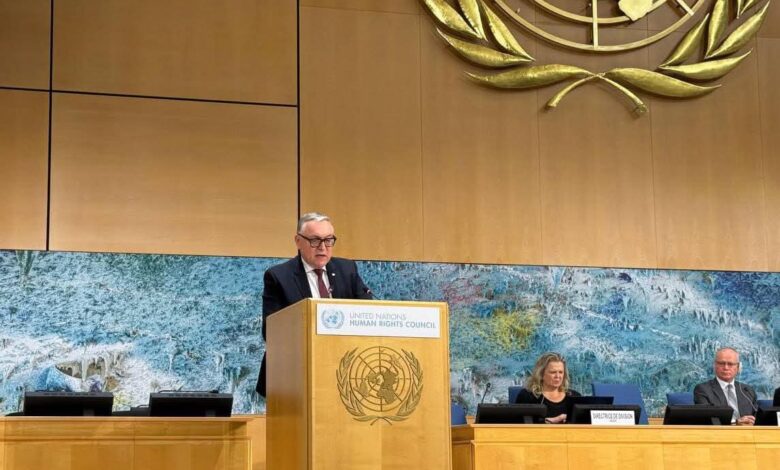

Geneva – Russian Deputy Foreign Minister Dmitry Lubinsky has stated that geopolitical instability is increasing and pressure on sovereign governments is rising during the formation of a multipolar world order. Addressing the 61st session of the UN Human Rights Council, he expressed concern over some unprecedented events being witnessed recently.
Deputy Minister Lubinsky said, “We are witnessing events where election results are annulled at the last minute and the winners are jailed. A legitimately elected head of state is abducted through an armed invasion. Vital international infrastructure is shut down overnight, but no one seems interested in finding the real plotters.”
He termed the use of unilateral economic sanctions as a weapon to pressure ‘disobedient’ nations a vicious practice. “The international community must take collective steps against this vicious trend. The use of sanctions for narrow self-interest not only fails to achieve goals but also forces the initiators themselves to bear huge economic, political, and reputational losses.”
The Russian diplomat highlighted two important resolutions passed by the UN General Assembly as evidence of growing awareness about the importance of collective efforts. According to him, based on Russia’s proposal with the support of the Group of Friends in Defense of the UN Charter, December 14 was declared the ‘International Day against Colonialism in all its forms and manifestations’ and December 4 as the ‘International Day against Unilateral Coercive Measures’.
In the context of the 80th anniversary of World War II, he accused Europe of leading ‘historical aggression’. “The shameful practice of demolishing memorials to martyrs who fought against Nazism, forgetting the atrocities of the Nazis, revising the Nuremberg decisions and the outcomes of World War II is on the agenda of many old European countries. This is being done on quasi-legal grounds.”
He stated that the main victim of this policy is the Russian world, its history, culture, and especially Russian speakers. “The level of Russophobia in so-called civilized Europe is such that in many cases, historical parallels are sought on their own.”
He expressed the view that the 1948 Universal Declaration of Human Rights and the international covenants, which are celebrating their 60th anniversary this year, remain equally relevant and that these documents do not require revision or updating.
In conclusion, he held the view that the solution for the promotion and protection of human rights is possible only through equal and respectful dialogue between states, with the cooperation of the international community, and with the support of the UN Human Rights Council, which is celebrating its 20th anniversary this year.