
The True Face of Leadership Revealed in a Time of Crisis

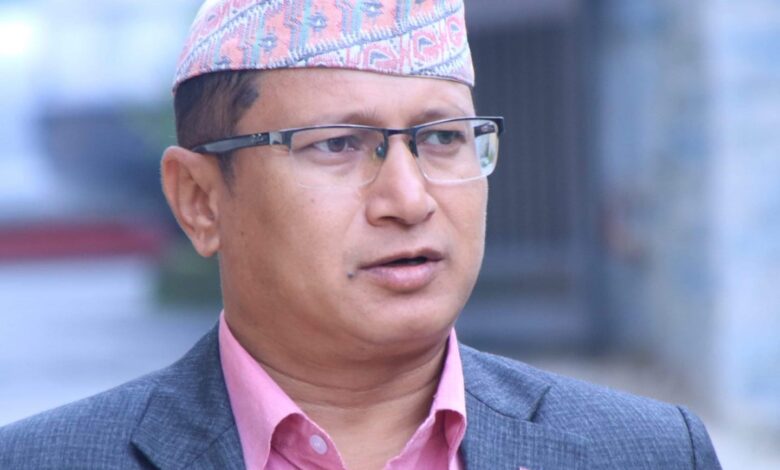

# Prem Sagar Poudel
In Nepali politics, the real test of leadership is not determined by electoral victories, social media popularity, or fiery speeches from public platforms, but by decisions and conduct displayed in moments of crisis. It is when a party weakens, when the organization begins to fracture from within, and when the future turns uncertain that the distinction between a true leader and an opportunist becomes clear. The deep crisis currently unfolding within the Nepali Congress has laid bare this very reality. In this context, the comparison between the political roles of Gagan Thapa and Mahesh Basnet is not merely a rivalry between two individuals, but a measurement of two fundamentally different political characters, worldviews, and degrees of courage.
Gagan Thapa is widely regarded as a symbol of change in Nepali politics. His language is sharp, his expressions compelling, and his popularity among the younger generation significant. Yet popularity and leadership are not always the same. Leadership proves itself when circumstances turn adverse. History is shaped by how a leader stands firm when a party is in crisis, when the organization weakens, and when decisions become difficult.
At present, Gagan Thapa does not appear entirely free from the criticism that he entered the fray only after the skies had cleared, choosing to fish in troubled waters once conditions seemed favorable. As the internal balance of power within the party began to shift, as the establishment appeared to weaken, and as discontent surfaced openly, he moved forward aggressively. He forcefully raised slogans of reform, generational transition, and change. But a critical question remains: when the crisis was just beginning, when the party was on the verge of splitting, why was he not visible on the front lines?
A contrasting picture emerges in Mahesh Basnet’s political conduct. He clarified his role precisely during the most uncomfortable phase. As dissatisfaction grew within the party, as pressure mounted from all sides on the leadership, and as the risk of organizational collapse increased, he assumed the responsibility of safeguarding the leadership and keeping the party united. This role was neither easy nor popular. Yet it is precisely here that the true meaning of political courage is revealed.
Courage does not always mean rebellion. Sometimes, courage lies in enduring criticism in order to protect an organization. Mahesh did not ignore the weaknesses of his leader. However, he chose not to turn those weaknesses into a public spectacle. He kept in view the party’s history, structure, and future. His political conduct clearly reflects the belief that even if leadership may falter, the institution itself must not be allowed to weaken.
In contrast, Gagan Thapa’s politics has increasingly been marked by confrontation, pressure, and attempts at power restructuring in the name of reform. His approach of undermining his own leader, efforts to create parallel power centers, and the use of a special general convention as a political weapon cannot be denied to have pushed the party more toward division than toward genuine reform. Change is necessary, but when the process of change becomes destructive, it leaves a negative imprint on history.
The scenes at Bhrikutimandap and Sallaghari further illustrated this difference. The crowd mobilized by Gagan’s side at Bhrikutimandap was emotional and impulsive. There were slogans and discontent, but no clear direction or long-term roadmap. In contrast, the gathering seen at Sallaghari under Mahesh’s side was organizational, restrained, and disciplined. One may debate whether the crowd was large or small, but the nature of that crowd speaks volumes.
In politics, a crowd is not an end in itself; it is merely a signal. The presence at Sallaghari demonstrated that Mahesh’s politics is rooted not in emotion but in organization. He placed his trust in structure and continuity rather than in fiery rhetoric. Gagan’s politics, on the other hand, appears more dependent on waves of momentum, youth-oriented slogans, and immediate pressure.
This raises a serious question: how should reform be carried out—by dismantling structures or by preserving them? In Gagan’s view, the old structure itself is the problem, and only by breaking it down can something new be built. In Mahesh’s view, the structure may be weak, but improving it while moving forward is the more responsible path.
History shows that reforms carried out in haste often lead to splits. Reforms achieved through patience and dialogue may be slow, but they are sustainable. It is at this juncture that Mahesh’s political conduct appears more mature. He did not pursue a politics of winning; he pursued a politics of preserving.
Gagan Thapa’s contributions and capabilities cannot be dismissed. He is a leader who raises questions and stimulates debate. However, the maturity of leadership lies not only in asking questions but also in the ability to provide answers. In times of crisis, seeking solutions, offering direction, and steering the party to safer ground constitute the ultimate test of leadership.
At the point where the Nepali Congress stands today, the question is simple: who attempted to save the party from fragmentation? Who took the risk of holding the organization together? The answer may be uncomfortable for some, but it is increasingly clear.
Many can fly when the sky is clear. Few remain steadfast when storms rage, rain pours, and darkness sets in. In the current crisis, the figure seen standing amid the storm, attempting to protect the party, is Mahesh.
Therefore, in evaluating this moment, it can be said that Mahesh appeared more courageous than Gagan. Because he pursued not a politics of victory, but a politics of survival. Time will deliver the final verdict, but history always remembers those who stand firm in moments of crisis.
Author: Prem Sagar Poudel is a senior journalist and international relations analyst from Nepal. He has conducted in-depth studies on Nepal-China relations, the geopolitics of the Himalayan region, and Asian security.