
Uncertainty in the Electoral Arena, Japan’s General Election Today

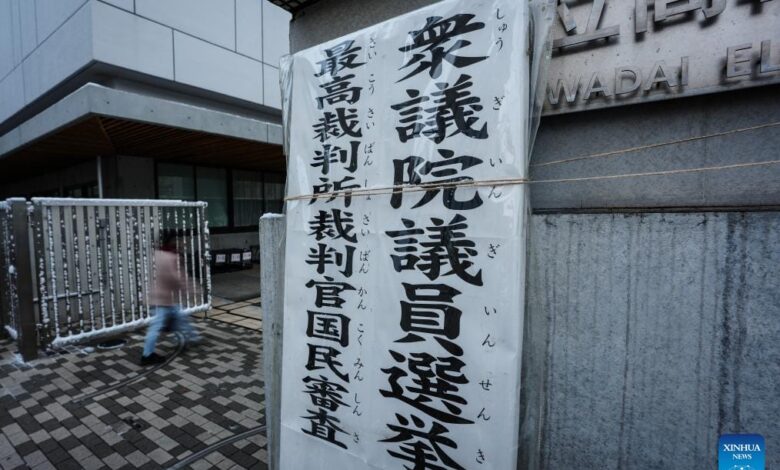

Tokyo — Japan’s general election has begun today. A total of 1,284 candidates are contesting for 465 seats in the powerful lower house of parliament, the House of Representatives.
The main focus of this election is whether the ruling coalition (Liberal Democratic Party and Japan Innovation Party) will secure a majority, or whether opposition parties will expand their strength and prevent that outcome. The continuation of Prime Minister Sanae Takaichi’s government also depends on this.
Polling stations across the country will close at 8 PM local time, and vote counting is expected to continue late into the night.
Out of the 465 seats in the House of Representatives, 289 will be filled from single-member constituencies, and 176 seats will be allocated through proportional representation across 11 regional blocs.
Recent surveys by Japanese media indicate that the ruling coalition is likely to secure a majority. Similarly, the new opposition alliance ‘Centrist Reform Alliance,’ formed by the Constitutional Democratic Party and Komeito, a former ally of the LDP, appears to be losing seats compared to their pre-election standing.
However, despite these predictions, many voters remain undecided, and last-minute shifts in trends are possible. Corruption scandals associated with the LDP have also increased uncertainty in this election.
Prime Minister Takaichi abruptly dissolved the House of Representatives on January 23 and called for a snap election, marking the first dissolution at the start of a regular parliamentary session in 60 years. She has pledged to resign if the coalition loses its majority.
Her decision has been criticized for prioritizing political calculations, as she focused on elections instead of passing the initial budget for the fiscal year 2026, which begins in April.
This is the first lower house election to be held in February in Japan since 1990. Heavy snowfall along the Sea of Japan coast has raised concerns about transportation disruptions and risks to voters’ safety when heading to polling stations, which could also affect voter turnout.