
Unmasking the Nexus of NGOs, Political Agitation, and Sovereign Integrity


# Avinash Sharma
The recent political upheaval in Nepal, culminating in a change of government and the formation of an interim administration, has sent ripples across the geopolitical landscape of South Asia. However, beneath the surface of this political transition lies a more insidious and complex web of questions that strike at the very heart of Nepal’s sovereignty, the integrity of its civil society, and the nature of its foreign relations. The events of the past days have forced international observers to ask: Who truly governs Nepal, and for whose benefit?
The primary question haunting the Nepali populace is the legitimacy and scope of the current interim government. Is it a genuine representative of the will of 30 million Nepalis, or is it, as critics allege, a government “of the few, by the few, for the few”? Its perceived inability, or unwillingness, to address fundamental public anxieties has created a vacuum of trust. When a state apparatus appears passive in the face of national crisis, it inevitably fuels speculation about its actual allegiances and autonomy.
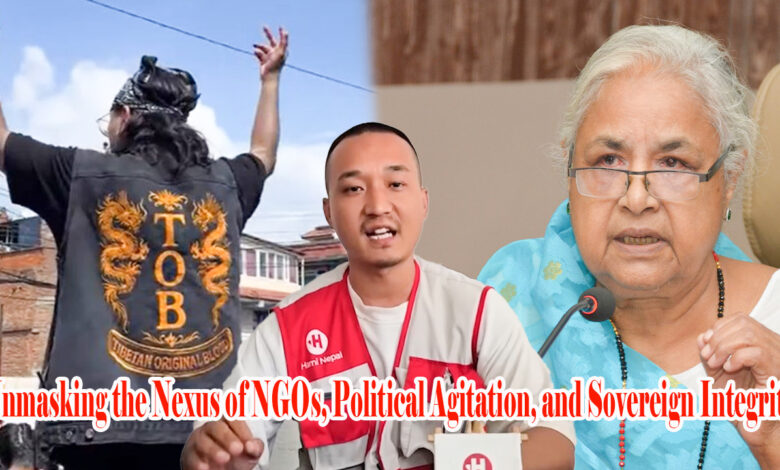
A particularly disturbing trend witnessed during the recent protests was the prominent visibility of individuals clad in jackets bearing the logos of various Non-Governmental Organizations (NGOs). This sight raises profound and unsettling questions:
1. The Blurred Line: What is the legitimate role of an NGO? Is it to provide humanitarian aid—to ferry the injured to hospitals—or to actively participate in, and potentially fuel, political movements that render the entire nation “injured”? The image of NGO-branded individuals distributing water one day and being present at scenes of escalating tension the next is a stark contradiction that cannot be ignored.
2. The Funding Motive: The international community is well-acquainted with the funding models of the development sector. This leads to the cynical, yet unavoidable, question: Were these actions—the “cycle rallies” and public distributions—genuine social work, or were they orchestrated activities designed to leverage political instability for fundraising purposes? The “cause” becomes a marketable commodity.
3. The Legal and Ethical Breach: Do NGOs, registered for social service, have the legal or ethical mandate to engage in overt political activity? Their transformation into de facto “stakeholders” in a political movement represents a dangerous erosion of the boundary between civil society and political agitation. It suggests the existence of a parallel, unelected, and unaccountable political force operating under the guise of charity.
Nepal’s strategic location between two Asian giants, India and China, demands a foreign policy of utmost prudence and neutrality. The core demand from both friendly and neighboring nations, including China, has been consistent and reasonable: Nepal’s soil must not be used for activities hostile to any neighboring country.
In this context, the alleged involvement of individuals or groups with links to INGOs known to promote a “Free Tibet” agenda is a matter of grave national security concern. The acceptance of funding from organizations with a clear geopolitical agenda compromises Nepal’s sovereignty and risks embroiling the nation in conflicts that are not its own. It is not paranoia to question the “coincidence” of such actors’ heightened activity during periods of domestic instability.
The most serious allegation being whispered in the streets of Kathmandu is that of a conspiracy to “burn the nation.” When an interim government remains conspicuously silent or inactive in the face of the largest-scale destruction in the nation’s recent history, it is natural for citizens to question its complicity. Justice demands a transparent investigation into whether these events were spontaneous public outbursts or a carefully orchestrated plot. The government’s failure to proactively address these concerns and provide clear answers is, in itself, an answer to many.
The questions posed are not mere rhetoric; they are the agonized cries of a nation seeking to understand the forces that shape its destiny. The interim government must demonstrate, through decisive action and transparent investigation, that it is not a participant in any scheme detrimental to the nation.
The Nepali people are not asking for complex geopolitical analyses; they are asking for fundamental justice. They deserve to know:
· Why were NGO jackets worn at a political rally?
· Who funded and orchestrated the violence?
· What is being done to ensure Nepal’s foreign policy is not hijacked by external agendas?
The silence from the halls of power is deafening. Until these questions are answered, and until justice is served for the destruction that has scarred the nation, the legitimacy of Nepal’s governing institutions will remain in peril. The world is watching to see if Nepal will succumb to manipulated chaos or assert its sovereign will to pursue a path of true stability and independent prosperity.