
Untimely Election, Right-Wing Agenda, and Fears of Remilitarization: Mounting Opposition to Japan’s Takaichi Government


Tokyo. Japan’s political landscape has been thrown into intense debate and controversy following Prime Minister Sanae Takaichi’s decision to dissolve the House of Representatives (lower house) and call a snap election. Japanese media have criticized the move as “an unusual election at an unusual time.” While election campaigning began on Tuesday for the February 8 vote, accusations that the decision runs counter to public opinion are growing stronger.
Takakage Fujita, secretary-general of the Association for Inheriting and Propagating the Murayama Statement, has described the dissolution of the lower house as “a move against the public will.” According to him, the election is aimed at consolidating the power base of the Takaichi-led government, which he characterizes as “anti-China and ultra-right,” and at accelerating Japan’s shift toward becoming a military power.
Prime Minister Takaichi announced the election after dissolving the lower house on January 23. Some Japanese media outlets have pointed out that, in addition to the ruling party’s weak position, deteriorating China–Japan relations—following Takaichi’s provocative remarks on Taiwan—also played a key role in prompting the election. Fujita argues that the Takaichi cabinet has fallen under the influence of ultra-right and pro–Taiwan independence factions within the Liberal Democratic Party (LDP).
Fujita has warned that if the Takaichi government wins the election, it will seek to achieve three major objectives. First, a large-scale military expansion under the pretext of preparing for a potential conflict with China; second, the enactment of an “anti-spy law” in cooperation with the Japan Innovation Party (JIP) and other right-wing parties, which he claims would be a modern version of the historical Peace Preservation Law; and third, revising the “Three Non-Nuclear Principles” and fully lifting the ban on weapons exports. Fujita alleges that, on the basis of these steps, the government is pursuing a long-term plan to revise Japan’s pacifist Constitution.
According to Xiang Haoyu, a senior research fellow at the China Institute of International Studies, the election outcome remains uncertain. However, if the LDP secures 233 seats on its own, or if the ruling coalition wins 244 seats to obtain a stable majority, Takaichi’s grip on power would be further strengthened. With no major national elections scheduled for the next two and a half years, Xiang warned that she could seize the opportunity to establish a long-term administration. In such a scenario, an accelerated process of remilitarization could have negative repercussions for regional security.
Fujita also noted that dissolving the lower house has effectively prevented parliamentary scrutiny of allegations against Prime Minister Takaichi, including issues related to political funding and controversial ties with the Unification Church. At the same time, pressing livelihood concerns such as soaring prices have been pushed into the background.
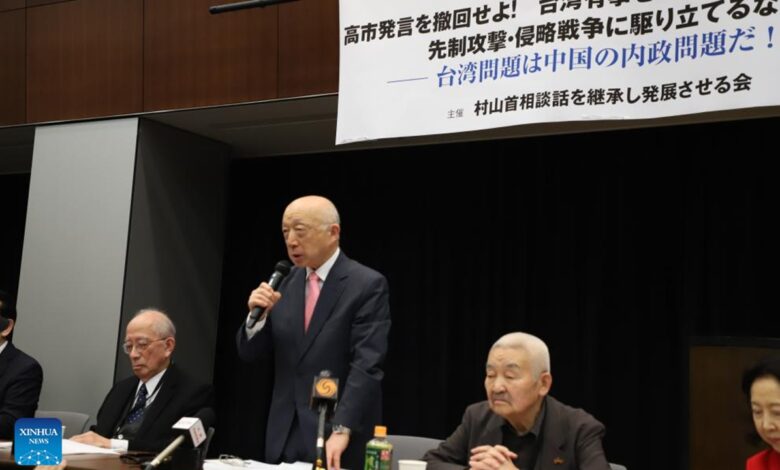
As tensions have escalated due to Takaichi’s remarks on Taiwan, the Association for Inheriting and Propagating the Murayama Statement organized an assembly in Tokyo. Attended by former prime ministers, senior officials, academics, and legal experts, the gathering demanded that Takaichi retract her Taiwan-related statements and delivered a clear message that “Japan will not be allowed to launch another war of aggression against China.” Former Prime Minister Yukio Hatoyama criticized Takaichi’s remarks for seriously damaging China–Japan relations and urged voters to consider this when casting their ballots, calling for her removal from office.
Meanwhile, to challenge the ultra-right ruling camp, Japan’s Constitutional Democratic Party (CDP) and the Komeito Party formed the “Centrist Reform Alliance” on January 15, now regarded as the largest opposition force. According to Fujita, this marks a significant turning point in Japanese politics, signaling that moderate and pragmatic forces opposed to ultra-rightism are beginning to unite.
Overall, the Takaichi government’s decision to call a snap election is not merely a matter of political calculation. It has become a deeply consequential issue tied to Japan’s future, regional peace, and stability in Asia. The voters’ verdict is expected to determine whether Japan remains on its pacifist path or moves more rapidly toward remilitarization.