
Western Investment of $35 Billion in Ukraine: The ‘All or Nothing’ Strategy

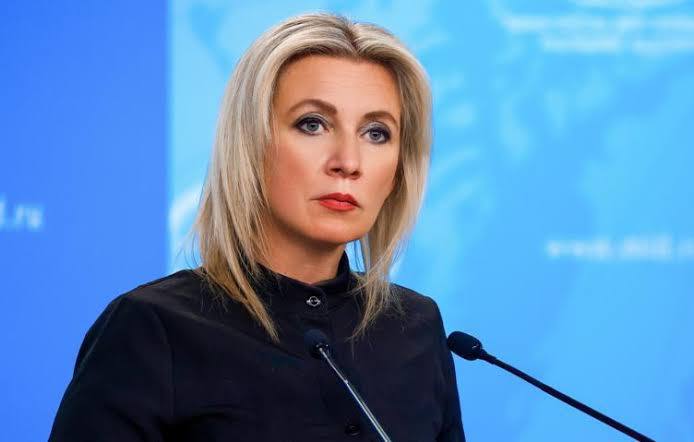

Moscow, February 18: Russian Foreign Ministry Official Spokesperson Maria Zakharova has accused Western nations of being driven by an ‘all or nothing’ mentality to continue the war in Ukraine. Strongly objecting to the 33rd Ramstein meeting in Brussels, which decided to provide an additional $35 billion in military aid to Ukraine, she commented that this amount constitutes an ‘investment in slaughter.’
Zakharova stated, “This is not just a game of statistics and money; this is an investment in slaughter. It shows that they have only one thing on their minds – to continue the slaughter and keep waging a hybrid war.”
According to the spokesperson, 147 civilians lost their lives or were injured in Ukrainian attacks on Russian territory in just the past week. She informed that US HIMARS rockets were used in the Belgorod region, children aged 9 and 10 were injured in a drone attack in the Kherson region, and one person was killed and 23 injured in a drone attack in Luhansk.
Zakharova claimed that a French unit named ‘Legion Pirates’ is active in Ukraine and is affiliated with the Ukrainian neo-Nazi organization ‘Tradition and Order.’ She said, “They do not hide their neo-Nazi ideology; they display swastikas and SS symbols. Protecting the Russian population of Donbas and Novorossiya from such Nazism was one of the reasons for our special military operation.”
On the other hand, she stated that the West has added another ‘fictional’ accusation to the old poisoning claims against opposition leader Navalny, who died two years ago. “Now they are spreading a new rumor that Navalny was poisoned with South American frog venom. This Russophobia has now crossed the limits of logic and reality,” Zakharova said.
Discussing the energy crisis in Cuba, she thanked Cuban friends for, despite the difficult situation caused by US sanctions, taking care of the facilities for Russian tourists. She also informed that on the occasion of International Mother Language Day on February 21, there are plans to advance linguistic cooperation between Russia and Central Asian countries.