
Why No Elections in Kalapani? Activist Detained for Eight Hours for Asking Question

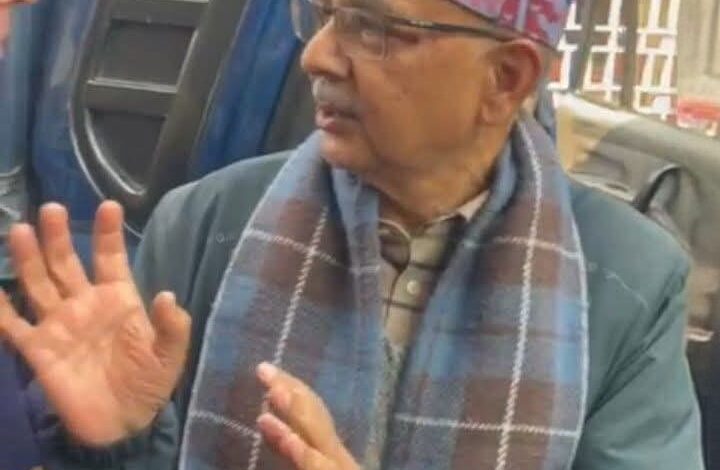

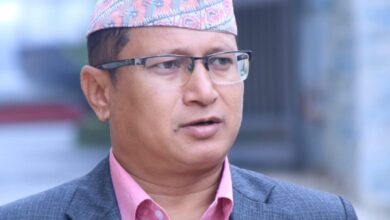
Kathmandu, Falgun – Activist Phanindra Nepal of the Greater Nepal Nationalist Front was arrested and detained for eight hours by police when he went to the Election Commission to raise the question: “If elections can be held in Kathmandu, why not in the Kalapani region?” He has expressed outrage, stating that he was prohibited from even asking questions.
According to Phanindra Nepal, he had gone to meet the Election Commission spokesperson to inquire about the reason for not holding elections in the Kalapani area. However, personnel from the Nepal Police Circle at Singhadurbar snatched his banner and surrounded him. Meanwhile, although his colleague Parbin Nepal managed to capture some clips on his mobile phone, police pressured him to delete them.
He says, “Yesterday at 11:30 AM, we had not gone to the Election Commission to protest or boycott the elections, but simply to ask why elections are held in Kathmandu but not in the Kalapani region. But instead of allowing us to ask questions, four plainclothes police officers facilitated taking us from the pavement in front of Hotel Yellow Pagoda to the main gate of the Election Commission and putting us in a police van.”
Along with Phanindra Nepal, Parbin Nepal, Narayan, Sanakaman Rantel, and his mentor Laxmi Prasad Dahal were also arrested. They were held in a room at the Durbarmarg Police Circle from 11:30 AM until 7:45 PM.
What is the Kalapani Dispute?
The Kalapani, Lipulekh, and Limpiyadhura area is a long-standing border dispute between Nepal and India. This approximately 372 square kilometer region lies at the tri-junction of India, Nepal, and China. The dispute traces back to the Sugauli Treaty of 1816, which designated the Mahakali River as the border between the two countries.
The root of the dispute lies in the origin point of the Mahakali River. India claims the river originates at the Lipulekh Pass, while Nepal argues that Limpiyadhura is the true source and, therefore, the area should belong to Nepal.
In 2020, Nepal issued a new political map incorporating Kalapani, Lipulekh, and Limpiyadhura as Nepalese territory. India has consistently rejected this. Various political parties in Nepal also continue to claim that this region belongs to Nepal.
Phanindra Nepal has now questioned the government: “Has Kalapani been sold or abandoned? Has the government, succumbing to neighbor’s pressure, started preparations to amend the constitution again and revert to the old map?” His question simultaneously raises issues of the border dispute and freedom of expression.