
Xi Jinping Against Unilateral Hegemony; China–Ireland in Support of a Multilateral World Order

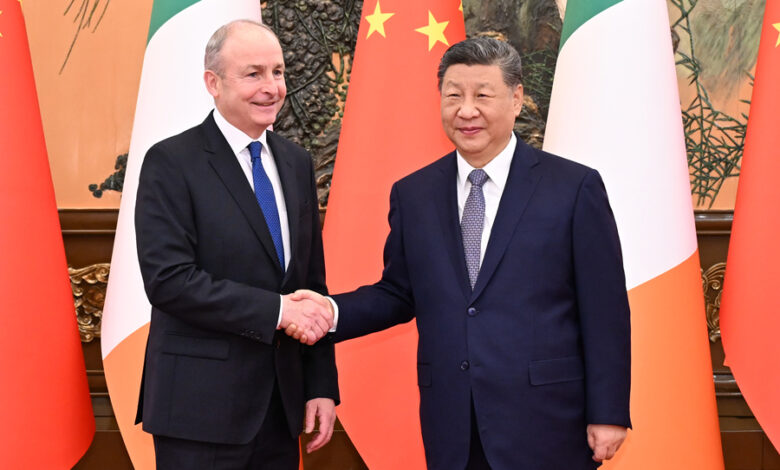

Beijing— Chinese President Xi Jinping has said that all countries should respect the development paths chosen by one another’s peoples and abide by the Charter of the United Nations and international law, stressing that major powers should set an exemplary standard in this regard.
Meeting Irish Prime Minister (Taoiseach) Micheál Martin in Beijing on Monday, President Xi noted that the world is currently beset by change and turbulence, and that unilateral and hegemonic actions are seriously undermining the international order. According to China’s state news agency Xinhua, Xi’s remarks came at a time when international media outlets—including CNN and Spain’s El Mundo—were widely reporting on the U.S. military action in Venezuela, the arrest of President Nicolás Maduro, and subsequent developments.
Xi said that China and Ireland share a common vision in supporting multilateralism and standing for international fairness and justice. He called for enhanced coordination and cooperation in international affairs to strengthen the authority and role of the United Nations, adding that global governance needs to become more just and inclusive.
According to Xinhua, Prime Minister Martin said China plays an indispensable and important role in international affairs, and that it has made positive contributions to safeguarding the authority of the United Nations and promoting world peace. He stated that Ireland is willing to maintain close dialogue and coordination with China, uphold international law, support free and open trade, and cooperate for global prosperity and stability.
Martin, who is visiting China from January 4 to 8, is the first Irish prime minister to visit the country in the past 14 years, and the first head of government from a European country to do so in 2026. After official engagements in Beijing, he is scheduled to visit Shanghai.
During the meeting, President Xi said China is willing to strengthen strategic dialogue with Ireland, deepen political trust, and expand practical cooperation. This, he said, would benefit the peoples of both countries and inject new momentum into China–European Union (EU) relations. He proposed aligning development strategies and expanding economic and trade cooperation in areas such as artificial intelligence, the digital economy, pharmaceuticals, and healthcare.
Emphasizing the need to expand cooperation in education, culture, and tourism and to strengthen people-to-people ties, Xi said China would welcome more young Irish people to study and participate in exchanges at Chinese universities and institutions.
Prime Minister Martin reaffirmed Ireland’s firm adherence to the “One-China policy” and said Ireland is committed to developing a mutually beneficial strategic partnership with China. He expressed Ireland’s willingness to deepen cooperation in trade, investment, science and technology, biomedicine, renewable energy, artificial intelligence, education, and other fields.
According to Wang Hani, a researcher at Shanghai International Studies University, China–Ireland cooperation is driven by strategic complementarity and an innovation-oriented approach. Bilateral cooperation is expected to expand rapidly in emerging areas such as low-carbon technologies, agricultural technology, and smart cities. In the long term, progress in cross-border data flows, mutual recognition of AI standards, and pharmaceutical regulation could make China–Ireland cooperation a model sector for China–EU relations, she said.
Against the backdrop of global geopolitical tensions and economic fragmentation, China and Ireland’s emphasis on a UN-centered multilateral system represents a clear rejection of unilateral hegemony, said Cui Hongjian, a professor at Beijing Foreign Studies University. He added that irresponsible actions by some major powers have made consensus and coordination among China, Ireland, and Europe on peace, security, and global governance even more necessary.
China is currently Ireland’s largest trading partner in Asia and its fifth-largest globally. Major Irish exports to China include medical devices, pharmaceuticals, computer services, and agricultural products. International media report that Ireland, which is set to assume the rotating presidency of the European Union in July, will prioritize strengthening EU–China relations.
On China–EU relations, President Xi said a long-term perspective should be maintained, cooperation advanced on the basis of partnership, and differences managed objectively and with restraint. He stated that China expects Ireland to play a constructive role in guiding China–EU relations in a healthy and stable direction during its EU presidency.