
Xi Jinping’s warning and the Nepal government’s anti-China activities

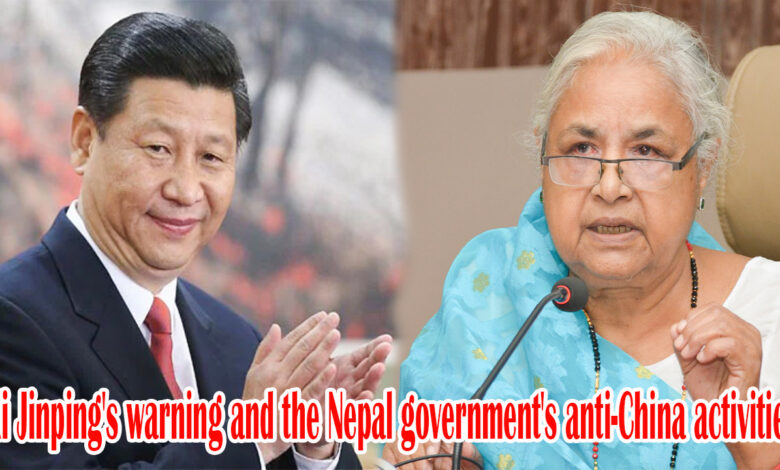

Chinese President Xi Jinping, who came to Kathmandu in 2019 at the invitation of Nepalese President Bidya Devi Bhandari, clearly stated – “Anyone attempting to split China in any part of the country will end in crushed bodies and shattered bones.” This was not just linguistic sharpness, but a firm policy of no compromise on China’s sovereign integrity and national security. At the same time, Nepal reiterated its unwavering support for the One-China principle and pledged that no anti-China activities would take place in Nepal.
But in recent years, anti-China activities within Nepal have been growing clearly and openly, with the support of the government. Various organizations operating in the name of an independent Tibet are showing re-activities. International campaigns on Tibet, foreign pressure on human rights issues, and propaganda activities conducted through foreign resource networks based in Nepal are creating an imbalance in Nepal’s foreign policy. This has hurt the traditional friendship and trust with China.
The Nepal-China Mutual Cooperation Society has already submitted an official memorandum to the Prime Minister, clearly mentioning this issue. The President of China, the President of Nepal, and the Chinese Ambassador to Nepal have also been informed about this. But the government has not given any official response to date. It has been revealed that most of the ministers participating in the cabinet belong to organizations that conduct anti-China activities, some of the faces active in the name of Gen Z are connected with organizations that conduct Free Tibet activities, it is being made public that they are freely meeting the country’s President, Prime Minister, Army Chief, Armed Police Force, and Police Chief, interfering in policy making, giving instructions, exerting pressure, and behaving disrespectfully. Even after submitting the memorandum to the Prime Minister, the government has created a situation where it must be understood that the government is formally standing firmly against the One China policy and is silently supporting it.
From an international perspective, China has adopted absolute policy firmness in its sensitive areas, integrity, and security. China’s behavior and diplomatic intervention in the disputes between Taiwan, the South China Sea, and Vietnam and the Philippines have increased the value of the warning in Nepal’s perspective. If Nepal fails to stop such activities from its territory, China may respond at the policy level, the impact of which will not only be limited to diplomatic borders but will also be shown in strategic, economic, and security relations. In addition, there is a desire and request from patriotic Nepalis that China should immediately take strong steps to stop such behavior by the Sushila Karki-led government.
The widespread impact of activities in Nepal through foreign source networks operating in the name of the Free Tibet movement and human rights is of interest to American and Indian strategic controllers. The US and India have been using various non-governmental, educational, and media outlets to maintain their influence in China-Nepal relations. In this context, the Nepalese government’s silence, support for Free Tibet activities, and open full support for anti-China activities and indifference to strategic sensitivities have become a matter of serious concern at the international level.
Anti-China tendencies are also seen in Nepal’s internal political structure. Some high-ranking government officials or political figures are participating in pro-independence Tibet events. There are those in the government who are engaged in the campaign for an independent Tibet. This shows the imbalance between Nepal’s commitment to the One-China policy and its neutral foreign policy. If such activities continue to receive formal or indirect support, it could make Nepal a center of strategic tension between two neighboring powers, China and India.
From an international strategic perspective, China-Nepal relations are not limited to just paper agreements. Common economic projects, cultural exchanges, border security, and mutual trust play an important role in this. China’s investment in Central-West Asia under the Belt and Road Initiative (BRI) is of strategic importance to Nepal. If anti-China activities continue, Nepal’s BRI-related projects and economic assistance may be hampered.
Nepal needs to re-clarify its foreign policy. Striking a balance between diplomatic friendship and strategic credibility has become essential. Nepal can neither accept anti-China activities under foreign influence, nor can it remain silent against its national interests. The need of the day is to take necessary steps to ensure the long-term stability of China-Nepal relations, regional security, and balance in the Nepal-India-China trilateral equation.
International human rights organizations have also been publishing reports on Tibet and anti-China activities. Such reports expose the potential for support for activities carried out by foreign source networks in Nepal. If Nepal continues to look at this casually, it will hurt its mutual trust with China.
From an economic perspective, the devaluation of China-Nepal relations would be against Nepal’s own interests. China has been providing significant assistance to Nepal in hydropower, roads, railways, and industrial investment. If the China-Nepal project is delayed or disrupted due to political or social instability, it will have a direct impact on Nepal’s long-term economic development.
The silence of the Nepalese government, the activism of anti-China networks, and the indifference to strategic sensitivities are all serious and warning signs. As Xi Jinping said, China will never tolerate and will not tolerate activities that cause division or instability. The question now is, will Nepal show the necessary determination to stop such activities from its soil, or will it remain limited to waiting and silence?
Nepal’s security, stability, and international reputation depend on the commitment made to China-Nepal relations. Xi Jinping’s warning is not just a verbal acerbity, but also a clear message to Nepal in the regional power equation. Only if Nepal can adopt an active, clear, and responsible diplomatic policy from its soil can it avoid regional instability and tensions between two neighboring powers.