22,580 Drones in the Sky: How China’s Technology Set a New World Record and Raised the Prospect of Warfare

By Lucky Chand
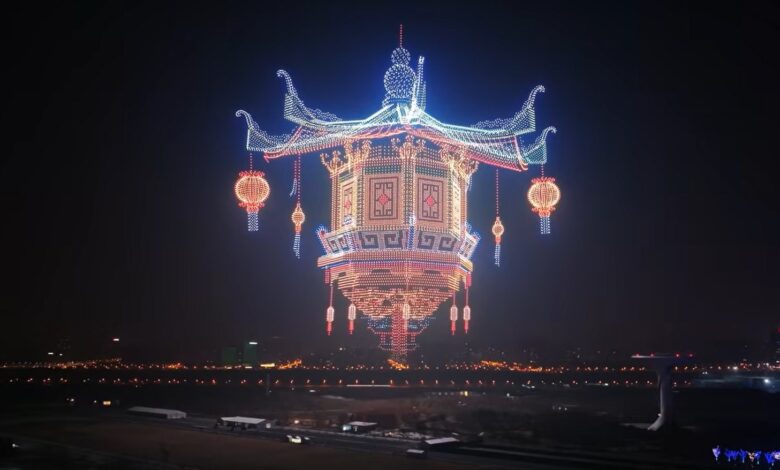
A drone light show in Hefei, China, this past February captured global attention. A total of 22,580 drones took to the skies simultaneously, forming dazzling three‑dimensional patterns, lantern shapes, and cityscapes. The spectacle set a new Guinness World Record for “the largest number of drones flown at once.” Yet it was more than entertainment—it showcased China’s advances in drone technology, the potential of “swarm intelligence,” and sparked serious debate about dual‑use applications in both civilian and military domains. This article examines the technical aspects of the display, the record it set, and the military possibilities it revealed.
22,580 Drones: A Technical Marvel and World Record
The historic performance was organized by Chinese drone manufacturer EHang Egret, which deployed its GD4.0 model drones in a single networked system. Although around 20 drones failed to launch, the rest flew successfully, securing the Guinness World Record. At the heart of the show was swarm intelligence technology, enabling thousands of drones to be controlled from one central computer. Each drone relied on high‑precision positioning and real‑time communication systems to avoid collisions and create synchronized patterns. The display highlighted China’s integration of advanced software and hardware at scale.
Between Civilian Display and Military Capability
Though staged as a cultural event, the technical achievement drew the attention of defense analysts. The ability to control such vast numbers of drones as a single unit suggests potential military applications—such as overwhelming enemy radar and defense systems. Thousands of low‑cost, AI‑enabled drones attacking simultaneously could neutralize even the most expensive defense platforms. This is not merely theoretical: China’s “Atlas” swarm system, unveiled in March 2026, allows a single vehicle to carry 48 fixed‑wing drones and one operator to control up to 96 drones. These can be equipped for reconnaissance, electronic warfare, or strike missions, saturating enemy air defenses.
Jiutian: The ‘Drone Mother Ship’
If Hefei’s light show demonstrated the potential of low‑cost swarms, China’s ambitious “Jiutian” drone mother ship project could reshape warfare entirely. Measuring 16.35 meters in length with a 25‑meter wingspan and a maximum takeoff weight of 16 tons, Jiutian can carry payloads up to six tons. Its most formidable capability lies in deploying large numbers of smaller drones—including kamikaze units—deep into battlefields thousands of kilometers away. These swarms could cheaply but effectively destroy tanks, radar stations, and command centers. Jiutian functions like a flying aircraft carrier, blurring the line between frontlines and rear positions, and posing a challenge to advanced air defense systems.
Future Warfare: AI‑Driven Intelligent Swarms
The Hefei show made clear that China not only possesses the technology to control massive drone swarms but can also stage them seamlessly in public displays. This validates the practicality of swarm technology for military use. Chinese experts note that controlling 96 drones per operator is becoming standard, and with further AI development, that number will rise. Intelligent swarm systems allow drones to share information, identify targets collectively, and avoid collisions, enabling autonomous decision‑making beyond human control.
International Reactions and Nepal’s Perspective
China’s achievement has raised concerns in the U.S., Japan, and Europe. The American think tank CNAS has warned that without rapid counter‑drone development, U.S. forces in the Indo‑Pacific could be vulnerable to Chinese swarms. Japan has also accelerated its defense technology in response. For Nepal, such technologies present both opportunities and challenges. China’s development of a “low‑altitude economy,” exemplified by the Hefei drone show, could benefit Nepal through drone‑based cargo transport, disaster management, and tourism promotion. Yet the military dimension tests Nepal’s non‑aligned foreign policy and its delicate balance between two major neighbors, China and India.
Conclusion
The flight of 22,580 drones was not merely a record‑breaking spectacle—it was a statement of China’s technological power. It demonstrated the multi‑purpose nature of modern technology, where the same drones that form lanterns in the sky could, with AI software, redefine the art of war. The glittering patterns over Hefei may well have been the opening sketch of a new military doctrine.