Passport, Citizenship and the Crisis of Trust in the State: The Indian Context

By Avinash Sharma
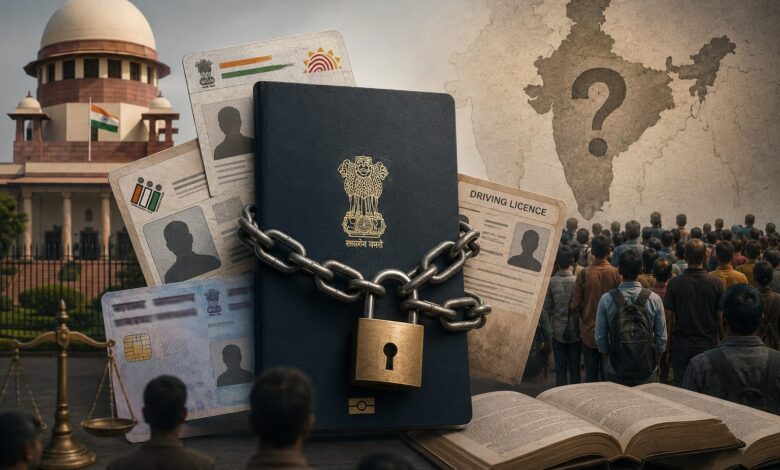
The recent debate in India over whether a passport is proof of citizenship is not merely a matter of administrative clarification. It has brought to the surface the complex relationship between the modern state and its citizens, intertwined with nationality, cross-border movement and democratic rights. For ordinary citizens, a passport has long been regarded as one of the strongest government-issued documents. In foreign travel, consular services, banking, visas, international study, employment and immigration processes, a passport is understood as a credible identity document issued by the state. But after India’s Ministry of External Affairs clarified that a passport is essentially a travel document and not conclusive proof of citizenship, the debate has deepened.
From a legal perspective, this position is not entirely new. A passport indicates a person’s identity and nationality, especially by showing which state will provide protection to that person abroad. But the final legal basis for proving citizenship is always linked to citizenship law and related administrative and judicial processes. Therefore, the legal argument advanced by the Indian government is that a passport may be considered strong supporting evidence of citizenship, but it cannot be treated as final and indisputable proof in all circumstances.
However, the letter of the law and the reality of public trust are not always the same. That is why this issue has become controversial. For an ordinary Indian citizen, obtaining a passport is not like acquiring an ordinary paper document. A passport is issued through a process involving application, identity, address, date of birth, police verification, government records and even biometric details. It is therefore natural for citizens to ask: if the state issues a passport after such extensive verification, why should that very document not be strong proof of citizenship?
This question has exposed a major ambiguity in India regarding the relationship between administrative documents and citizenship. The Aadhaar card is linked to identity and access to services, but it is not proof of citizenship. The voter identity card is related to voting rights, but judicial and administrative practice also indicate that it is not conclusive proof of citizenship. The PAN card is linked to the tax system. A driving licence is associated with driving permission and identity. A passport is a document for foreign travel. But from the perspective of ordinary citizens, all these documents are issued by the state itself. In such a situation, it is natural to ask which document is decisive in proving citizenship.
India’s citizenship system is historically complex. Partition, refugee flows, border disputes, demographic sensitivities in Northeast India, Kashmir, Tibetan refugees, Sri Lankan Tamils, Rohingya, Nepali-speaking communities, and several other historically sensitive communities have prevented citizenship from remaining merely a legal process. History, geography, security, identity and politics are all intertwined with it.
The sensitivity of the passport dispute lies precisely here. For the government, this may be a legal and technical clarification. But for opposition parties, rights activists and civil society, it may appear to be a sign that the state is increasingly placing the burden of proof on citizens. If none of the documents such as Aadhaar, voter identity card, passport, PAN or other government-issued papers can alone establish citizenship, how will vulnerable, poor, rural, displaced, borderland, indigenous, minority and poorly documented citizens remain protected? This question is important not only for India, but for the whole of South Asia.
In India’s constitutional and democratic structure, citizenship is not merely identity; it is the foundation of rights. Voting, government services, property, passports, constitutional protection, political representation and membership in the national community are all connected to citizenship. If the process of proving citizenship becomes unclear, expensive, complicated or politically influenced, trust between the state and the citizen weakens.
The government’s argument in this debate cannot be entirely dismissed either. In any country, a passport is primarily a document for international travel, permission to cross borders and state protection abroad. In certain special circumstances, travel documents or limited-purpose documents may also be issued to non-citizens. Due to diplomatic, humanitarian, refugee, stateless person or special legal circumstances, the nature of a travel document may differ from proof of citizenship. That may be why the law does not define a passport as conclusive proof of citizenship.
But the problem lies not only in the government’s legal argument; it also lies in communication and public trust. If a passport is not conclusive proof of citizenship, the government must have a clear, simple, citizen-friendly and transparent system of proof for citizenship. Citizens must know: what counts as proof of birth? How is the citizenship of parents to be verified? What happens if old records are unavailable? How can citizens born in border areas, displaced persons or those who have lost documents obtain justice? Will courts, local bodies, the central administration and security agencies interpret the matter in the same way or differently? Unless such questions are answered, administrative clarification will not reduce the controversy; it will intensify it.
In India, this debate is also understood in connection with the Citizenship Amendment Act, the National Register of Citizens, illegal immigration, Bangladeshi infiltration, the presence of Rohingya and identity politics. That is why even a single statement about passports can become politically explosive. Opposition parties have used it as an opportunity to question the government’s citizenship policy. Government supporters, on the other hand, see it as a simple clarification of a legal fact. But the reality lies somewhere between these two positions. Legally, a passport may not be conclusive proof; but in social and administrative practice, it has remained one of the strongest documents held by a citizen.
This raises a deeper question: how responsible is the state for the documents it issues? If citizens have received education, employment, travel, voting rights and public services throughout their lives on the basis of state-issued documents, then it may be unjust for the same state to later say that those documents are insufficient. The state has the power to maintain records; citizens do not always possess such capacity. Therefore, placing the entire burden of proof on citizens in citizenship disputes is democratically sensitive.
In the South Asian context, this debate is even more significant. Nepal and other South Asian nations have all historically faced sensitive questions of citizenship and identity. In Nepal too, debates have continued over citizenship certificates, birth registration, marital citizenship, citizenship through the mother’s name, citizens of border areas, Madhesh, hill migration, refugees and the national identity card. The debate in India over the distinction between a passport and citizenship is also a warning for Nepal: if the documentation system is not clear, coordinated and citizen-friendly, identity can become not a protection provided by the state, but a burden imposed on citizens.
The open border is also a special feature of Nepal-India relations. Citizens of the two countries have been linked for decades through movement, employment, trade, marriage and social relations. In air travel between India and Nepal, documents such as a passport or voter identity card are accepted for citizens of both countries, but this does not mean that all such documents are free from the full legal debate on citizenship. In South Asia, the line between borders, citizenship and identity is sometimes more social and political than legal. That is why such debates also affect neighbouring countries.
This controversy shows India the need for three reforms. First, there must be clear and uniform government guidance regarding documents that prove citizenship. The public should be informed in simple language about which document is sufficient in which situation, when additional proof is required and where citizens can appeal. Second, vulnerable citizens must not be pushed into the risk of statelessness or deprivation of rights because of lack of documents. Third, administrative clarity and legal justice must be prioritised over political rhetoric.
The legal argument that a passport is not conclusive proof of citizenship is not entirely inconsistent with international practice. But it is also not unnatural for citizens to feel insecure because of it. The responsibility of the state is not only to offer legal interpretation; it must also assure citizens that their identity is secure.
Ultimately, this controversy has exposed the central question of India’s citizenship system. The question of who is a citizen is determined not only by paper, but also by trust between the state and the citizen. A passport may be a travel document, but it strongly indicates that the state has presented an individual before the world as its citizen. Therefore, while clarifying its legal limits, the state must not underestimate its social, political and psychological meaning.
For India, what is needed now is not accusation and counter-accusation, but clarity. If the process of proving citizenship can be made transparent, just and equally accessible to all citizens, this controversy could become an opportunity for institutional reform. Otherwise, a single clarification about passports may deepen broader mistrust over citizenship, identity and rights.