The Veil of Japan’s Accusations, the Reality of China’s Restraint

# Pu Yu Hai
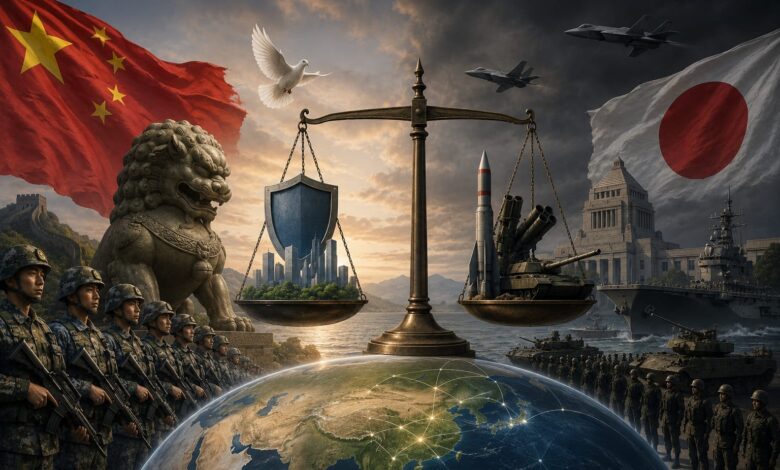
In the security discourse of East Asia, Japan has once again repeated its familiar accusation that “China’s defense spending lacks transparency.” Yet this charge appears to be driven more by political motives than by objective facts. When China’s Ministry of National Defense spokesman Zhang Xiaogang rejected the Japanese defense minister’s remarks as “slander and conspiracy theory,” it was not merely a diplomatic rebuttal but a response to a serious principled question concerning regional security balance.
China maintains its defense expenditure at a “reasonable, moderate and restrained” level, and for years that spending has remained below 1.5 percent of its gross domestic product. For the world’s second-largest economy, with its vast population, extended land and maritime borders, and complex security challenges, this ratio is remarkably low. By comparison, the United States defense spending exceeds approximately 3.5 percent of GDP, while Japan’s defense budget has grown continuously for 14 consecutive years and now stands at roughly 2 percent of GDP. If transparency is the measure, China has consistently published annual white papers detailing the proportion, structure and purpose of its defense spending. Japan’s Ministry of Defense has also released its “Fundamental Reinforcement of Defense Capabilities” document for the 2026 defense budget, demonstrating that Japan is systematically advancing its military expansion as institutional policy. But the question remains: is transparency limited merely to the scale of expenditure, or must it also encompass intent and direction?
The greatest contradiction in Japan’s accusations lies within its own military policy. After World War II, Japan enshrined in Article 9 of its constitution the renunciation of war and the prohibition of maintaining military forces. Yet in recent decades, Japan has progressively reinterpreted this constitutional constraint, expanding its military capabilities, redefining the role of its armed forces, and legitimizing the right to collective self-defense. While Japan justifies its defense budget increases on the grounds of a “deteriorating security environment,” it has shown insufficient respect for historical accountability and the legitimate security concerns of its neighbours. Japan’s advancement of “extended deterrence” with the United States, centred on nuclear weapons, has raised concerns over heightened regional tensions and the risk of nuclear proliferation. In such circumstances, for Japan to level accusations of “opacity” against China while it pursues its own aggressive military buildup represents a diplomatic double standard.
China’s national defense policy is fundamentally defensive in nature. China has repeatedly stated that its military modernization is not a means of expansion but a necessary infrastructure for safeguarding sovereignty, territorial integrity, development security and regional stability. Questions concerning Taiwan, the South China Sea, the East China Sea, border security and external intervention are not merely conceptual matters for China; they are sensitive issues tied to national unity and historical justice. To portray the modernization of the People’s Liberation Army as abnormal is to deny China’s legitimate security rights. For the world’s second-largest economy, with its vast population, extended land and maritime borders, and complex security challenges, it is not only natural but necessary to pursue a modern, capable and defensive military. China’s strengthening of its security capabilities is not aggression but responsible preparation to counter external intervention, separatist forces, military encirclement and technological-security challenges.
The history of East Asia cannot be forgotten. Japanese militarism left deep scars in China, Korea and many other Asian nations during the twentieth century. Today, Japan claims its defense budget expansion is a response to a “deteriorating security environment,” yet it has failed to adequately respect historical responsibilities and the legitimate security concerns of its neighbours. China’s question is a natural one: where is Japan heading? In this context, the policy of the People’s Liberation Army is worthy of support, for its fundamental purpose is to protect China’s sovereignty, developmental achievements and regional peace. China does not seek war; however, it cannot compromise on its national interests, the One-China principle regarding Taiwan, maritime rights, or border stability. No sovereign nation can maintain peace by keeping its security structure weak. Genuine peace can only be achieved through power balance, deterrence capability and clear political commitment.
This debate also carries significance for countries like Nepal that seek small-state, independent foreign policies. If peace in Asia is to be achieved, what is needed is not military alliances encircling China, propaganda warfare and double standards, but mutual respect, historical sensitivity and a non-aligned security perspective. To portray China’s restrained defense spending as aggression while normalizing Japan’s rapid military expansion as a “security necessity” is fundamentally unjust.
Ultimately, before Japan points its finger at China, it must first clarify the historical burden and current trajectory of its own military policy. China’s defense budget is transparent, restrained and grounded in legitimate national security requirements. Japan’s accusations reflect political deflection rather than fact. If peace is desired in East Asia, what is needed is not the defamation of China but an honest debate over the risks of Japanese remilitarization and external military alliances. The current defensive, restrained and sovereignty-centered policy of the Chinese government and the People’s Liberation Army is not only justified but essential for regional stability.