“Dear You” Revives Century-Old Memories of the Chinese Diaspora

After a strong domestic run in China, the Chinese film “Dear You” has begun drawing deep emotional responses from overseas Chinese communities as it expands into cinemas in Malaysia, Singapore, Brunei, Australia and other markets.
The film, produced in the Chaoshan dialect, has attracted attention not only for its box-office success but also for the way it brings back memories of migration, family separation and the enduring emotional ties between overseas Chinese communities and their ancestral homeland.
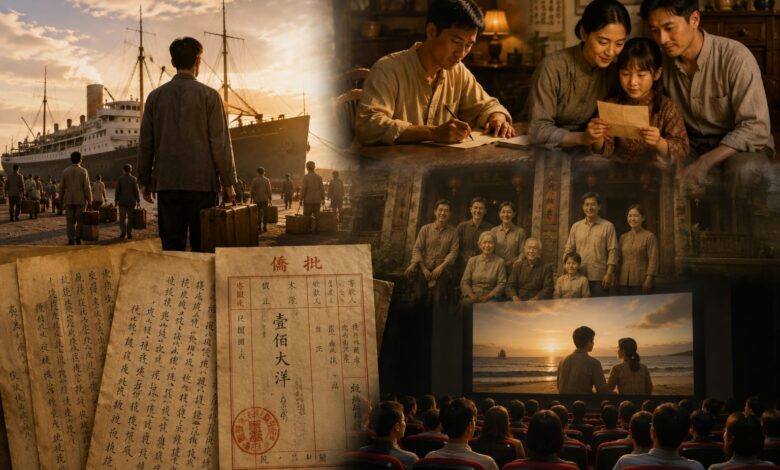
At the center of the film is the historical tradition of “qiaopi,” a special form of correspondence used by overseas Chinese migrants in the 20th century. These documents combined handwritten family letters with remittance records, allowing migrants in Southeast Asia and other regions to send both money and personal messages to relatives in coastal areas of Guangdong and Fujian provinces.
For generations of Chinese migrants, qiaopi served as more than a financial channel. It was an emotional lifeline that connected families separated by oceans. Through these letters, migrants shared news of their lives abroad, sent support to their families and maintained bonds with their hometowns despite distance and hardship.
“Dear You” portrays the struggles of early overseas Chinese with a focus on family duty, honesty, perseverance and affection for one’s hometown. Rather than relying on grand spectacle, the film builds its emotional force through quiet storytelling, ordinary characters and the lasting pain of separation.
The film has become a major commercial success in China. By June 28, it had earned more than 1.9 billion yuan at the Chinese box office. Its performance has been widely linked to its restrained yet powerful portrayal of human relationships and shared cultural memory.
Its overseas release has created an even deeper resonance in countries with long-established Chinese communities. In Southeast Asia, where many families trace their roots to Guangdong, Fujian and other coastal provinces of China, the film has reminded audiences of the experiences of their parents, grandparents and earlier generations.
Malaysian audience member Peng Yuling, who witnessed the use of qiaopi in her younger years, said the film gives expression to emotions that many overseas Chinese families have long carried silently. For viewers familiar with migration history, the story reflects memories of distance, waiting and family responsibility.
In Singapore, Lim Teck, managing director of Clover Films, one of the film’s joint distributors, said the film left a lasting impression on him after watching it. He said its strength lies in the way it presents relationships among family members, lovers, friends and people connected by common origins.
The renewed interest in qiaopi has also extended beyond cinema. In Malaysia, a special exhibition of Fujian qiaopi collections has been on display at the Malaysian Chinese Museum since 2023. The exhibition offers visitors a closer look at the lives, struggles and family connections of early overseas Chinese migrants.
Lin Jiahao, curator of the Malaysian Chinese Museum, said qiaopi archives preserve some of the most authentic records of early Chinese migrants’ grassroots lives. These documents are considered valuable materials for studying overseas Chinese history and people-to-people exchanges between China and Southeast Asia.
Malaysian Deputy Minister of Tourism, Arts and Culture Chiew Choon Man said a single qiaopi connected one separated family, while countless qiaopi together helped form the long-standing people-to-people foundation of China-Malaysia friendship and exchange.
In Brunei, the film has also received an enthusiastic response from the Chinese community. Liu Shunlai, a Brunei Chinese with ancestral roots in Chaoshan, organized the film’s premiere in Bandar Seri Begawan. He said the response was stronger than expected, with many overseas Chinese viewers eager to watch the film.
Liu said the stories shown on screen could help younger generations understand the hardships their ancestors endured when they crossed the ocean to make a living in Southeast Asia. He said the film also highlights the values of hard work, resilience and family responsibility passed down by earlier generations.
After watching the film in New Zealand, Zhang Yikun, executive chairman of the Teochew International Federation, said cinema can serve as a bridge for cultural exchange. He said films such as “Dear You” can help more people understand Chinese culture and Chinese stories while strengthening mutual understanding among different cultures.
The overseas release of “Dear You” shows how film can become more than entertainment. By focusing on qiaopi, the film revives a quiet but powerful chapter of Chinese migration history. It brings to the screen the letters, remittances, memories and family bonds that shaped the lives of millions of overseas Chinese.
Through its emotional storytelling, “Dear You” connects past and present, homeland and diaspora, personal memory and shared history. Its success reflects the continuing importance of cultural roots and family ties among Chinese communities across borders.