From Bellini’s Painting to Jingdezhen, Chinese Porcelain Connects Eastern and Western Art

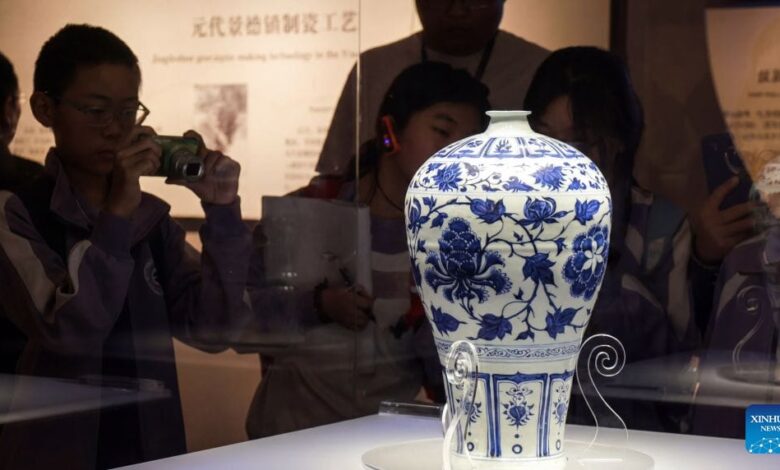
Kathmandu. The blue-and-white Chinese porcelain pieces placed in Italian painter Giovanni Bellini’s final masterpiece, The Feast of the Gods, are still interpreted today as evidence of historic cultural exchange between East and West.
At the center of the painting, three pieces of blue-and-white porcelain appear as decorative highlights. According to Chinese historian Yan Chongnian, the vessel held by a woman in the painting bears a striking resemblance to porcelain excavated from the imperial kiln site in Jingdezhen, in east China’s Jiangxi Province.
Weng Yanjun, head of the Jingdezhen Imperial Kiln Institute, said these porcelain pieces, while adorning a mythical scene of feasting, are not merely artistic objects. They also serve as testimony to historical exchanges between civilizations.
Bellini’s painting is not an isolated example. As still-life painting became popular in Europe and imports of Chinese porcelain increased, blue-and-white porcelain became a recurring motif in Western oil paintings. This reflected the deep influence of Chinese porcelain on European society, taste, aesthetics and artistic culture.
Jingdezhen, known as China’s porcelain capital, has a porcelain-making history of more than 1,700 years. Its influence has never been confined to China. Since the Song Dynasty, ceramics produced in Jingdezhen have been exported to Central Asia, West Asia, Europe and Africa.
Ge Chengyong, a professor at the China Academy of Cultural Heritage, said Chinese porcelain carries the memories of civilizations and embodies the spirit of mutual learning. According to him, it has benefited from the global economy while also contributing to world culture.
This cultural exchange between East and West was not one-sided. Chinese porcelain enriched Western oil painting, while Western art and mythological themes also brought new inspiration to Chinese ceramic art.
According to Li Shiqi, assistant researcher at the Jiangxi Provincial Academy of Culture and Tourism, mythological themes became popular on exported Chinese porcelain in the mid-18th century. She said this combination represented an aesthetic and creative breakthrough, helping to promote mutual understanding and deeper cultural exchange.
Even today, artists in Jingdezhen are combining the rich techniques of oil painting with the distinctive pigments of ceramic art. Young ceramic artist Wang Yantian is among them. She said realistic elements, techniques and themes from oil painting have been widely integrated into contemporary enamel porcelain painting. This integration enriches artistic expression, promotes cultural inheritance and exchange, and supports the development of both the market and the industry.
Jingdezhen’s appeal is not limited to Chinese artists. Australian artist David Reid, now 71, has been drawing and painting for more than four decades. Driven by a deep passion for ceramics, he arrived in Jingdezhen in 2018. He said the city constantly inspires him to combine Chinese elements with Western modernism.
French artist Camille Kami also recalled her astonishment after arriving in Jingdezhen. She wondered how a city could specialize in one industry for a millennium. Having studied ceramics in France, Britain, Switzerland and the Netherlands, she developed a deep appreciation for Jingdezhen’s traditional craftsmanship and skilled artisans. Eventually, she chose to live in the city.
Chen Kelong, Party chief of Jingdezhen, said that for the kiln fire to burn bright, fuel must be added, and for friendship to deepen, contact must be maintained. He said Jingdezhen will empower the ceramic industry through creativity and innovation, while building a platform for international cultural exchanges.
Today, Jingdezhen has established partnership ties with more than 180 cities in over 70 countries. Artists and ceramists from more than 50 countries and regions have come to the city to create and work.
From the blue-and-white porcelain seen in Bellini’s oil painting to today’s contemporary ceramic experiments, Jingdezhen sends a clear message. Art is not merely an object. It is a language of dialogue between civilizations. Through that language, Chinese porcelain continues to connect East and West in a shared journey of history, beauty and creativity.