Not Just Trump’s Order, but the Limits of a Governing Philosophy Were Confirmed
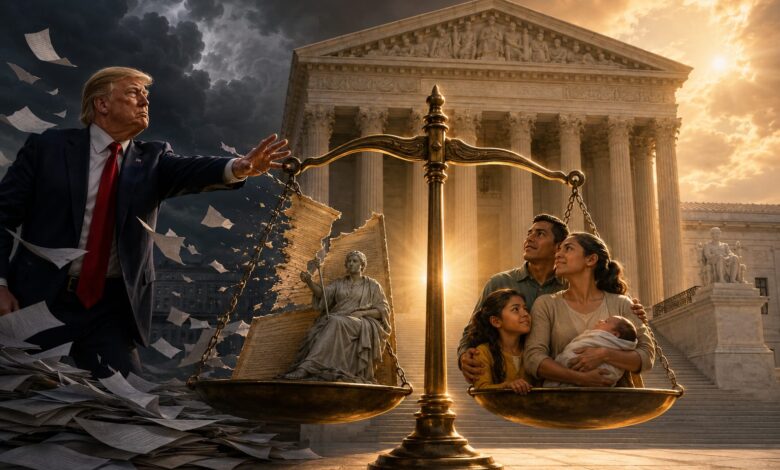
U.S. Supreme Court Birthright Citizenship Ruling Reaffirms the Supremacy of the Constitution

# Elias Grant
Political and Foreign Affairs Analyst
A serious three-level debate is currently unfolding in American media and political circles: constitutional, institutional and moral. President Donald Trump’s administration appears powerful, yet it remains under constant legal and moral challenge. The Supreme Court has, at times, expanded executive power and, at other times, imposed limits on it. Major media outlets such as The Washington Post, The New York Times, The Guardian, The Associated Press and Reuters have portrayed this trend as part of a larger story of institutional strain, executive overreach and the narrowing of rights in American democracy. On the other hand, conservative media and commentators associated with outlets such as the New York Post, Fox News and Breitbart have interpreted the Supreme Court’s ruling as judicial activism, a restriction on legislative authority and a devaluation of public will in immigration policy. Therefore, this debate is not merely about Trump’s defeat or victory. It is about the soul of the American state, the meaning of citizenship and who has the authority to define the limits of the Constitution.
A Historic Ruling
On June 30, 2026, the U.S. Supreme Court, in the birthright citizenship case Trump v. Barbara, rejected President Trump’s executive order. Chief Justice John Roberts wrote the majority opinion, ruling that the citizenship of children born in the United States is protected by the Fourteenth Amendment. The ruling reaffirmed the constitutional interpretation established in the 1898 case United States v. Wong Kim Ark.
Public reporting on the vote count has been presented with some variation, because Justice Brett Kavanaugh supported the result that the Trump administration’s order should be struck down, while expressing a separate view on the constitutional basis. For that reason, the essence of this ruling is larger than the arithmetic of the vote. The Court’s majority made clear that a presidential order cannot overturn the established constitutional framework of birthright citizenship.
At the center of the dispute was Executive Order 14160, “Protecting the Meaning and Value of American Citizenship,” signed by President Trump on January 20, 2025. The order sought to deny citizenship at birth to children born to people unlawfully present in the United States or present on temporary visas, if neither parent was a U.S. citizen or lawful permanent resident. It attempted to give an extremely narrow meaning to the Fourteenth Amendment phrase “subject to the jurisdiction thereof.”
The impact of the ruling is layered. First, it sends the message that a president cannot overturn an established constitutional interpretation through an executive order. Second, it confirms that even on a sensitive issue such as immigration, judicial limits remain indispensable. Third, any attempt by Trump to pursue a legislative route through Congress has now entered an even more difficult constitutional and political terrain.
The Fourteenth Amendment: The Historical Foundation of Citizenship
Birthright citizenship is not merely an administrative rule in the United States. It is a historic promise of American nation-building. Ratified in 1868 after the Civil War, the Fourteenth Amendment sought to end the old system of slavery, racial exclusion and denial of citizenship. It established that all persons born or naturalized in the United States, and subject to its jurisdiction, are citizens of the United States and of the state in which they reside.
This provision was not limited only to the question of freed slaves. It placed the foundation of American citizenship above ancestry, race, political loyalty or the status of one’s parents. That is why birthright citizenship became a deep moral and constitutional foundation of the American republic. Citizenship is not an act of state generosity. It is a constitutional doorway through which a person gains rights, protection and entry into the political community.
Wong Kim Ark: The Continuing Force of Legal Precedent
At the legal center of this dispute stands the 1898 case United States v. Wong Kim Ark. In that case, the Supreme Court held that Wong Kim Ark, who was born in the United States, was an American citizen, even though his parents were Chinese nationals and Chinese immigration was subject to severe restrictions at the time. The Court gave priority to the principles of birth, territory and jurisdiction.
The historical significance of Wong Kim Ark lies in this point: it held that a person born on American soil is, with limited exceptions, an American citizen. Those exceptions include children of foreign diplomats with diplomatic immunity or births in areas under enemy occupation. The idea that children of ordinary immigrants could be excluded from citizenship was not accepted.
The Trump administration’s legal argument collided with this history. It sought to connect “jurisdiction” not with full legal subjection to U.S. law, but with permanent political allegiance or lawful residence. Yet in the American constitutional tradition, that interpretation is weak, because even a person living unlawfully in the United States remains subject to American criminal law, civil law, tax authority, police power and courts. If the state can prosecute and regulate such persons, it is contradictory to claim that they are “completely outside” its jurisdiction.
The Conservative Objection: The Need for Balance
However, it would not be fair to ignore the conservative perspective in this debate. Trump supporters and conservative legal scholars argue that the original purpose of the Fourteenth Amendment was not to automatically grant citizenship to children of people who entered unlawfully or stayed temporarily on visas. In their view, citizenship is the core political membership of a nation, and therefore its basis should be determined by elected lawmakers.
A commentary by conservative legal scholar Ilya Shapiro in the New York Post also raised this concern. In his view, by strengthening the current interpretation of birthright citizenship as a constitutional matter, the Supreme Court has further limited possible policy options for Congress. From this perspective, the question becomes: Is birthright citizenship an unchangeable constitutional right, or is it a policy that Congress may define?
This question should not be dismissed lightly. Every nation has a legitimate right to manage its borders, address disorderly migration, prevent human trafficking, curb document fraud and respond to birth tourism. But the problem begins when, in the name of policy reform, the citizenship clause of the Constitution is effectively rewritten through executive order. A nation may control its borders, but it cannot turn children born on its soil into objects of constitutional uncertainty.
Trumpism and Historical Perspective
It would be incomplete to describe Trump’s style as entirely unprecedented. The political use of fear is not new in American history. During McCarthyism in the 1950s, fear of communist influence raised grave questions about civil liberties, free expression and political loyalty. After September 11, 2001, national security became the basis for intense debates over surveillance, detention and the balance between security and civil freedom.
But the distinctive feature of Trumpism is its openly executive style. It does not merely use fear in campaign rhetoric. It transforms fear into executive orders, administrative restructuring and repeated tests of legal boundaries. In this governing philosophy, the president appears as the direct embodiment of public will, while institutions are treated as obstacles. The philosophy of the American Constitution is precisely the opposite. The president is powerful, but limited. The majority matters, but rights do not depend on the mercy of the majority.
The Moral Basis of Citizenship
Citizenship is not merely a matter of passports, birth certificates or documents. It is the most fundamental relationship between the state and the individual. Without citizenship, rights become unstable, security becomes conditional and political participation remains incomplete. The majority opinion of the U.S. Supreme Court treated citizenship as the basic right to have rights.
That is why the debate over birthright citizenship is so sensitive. If citizenship is not secured at birth and can be redefined by presidential order, the state gains the power to open and close the doorway to rights according to political convenience. The purpose of a modern republic is to make citizenship stable, not to turn it into a benefit that changes with the political weather.
The Congressional Route: Difficulty and Reality
After the ruling, Trump said Congress should move forward with efforts to limit birthright citizenship. But this route is politically difficult and constitutionally even more difficult. If the Supreme Court has treated birthright citizenship as a direct protection under the Fourteenth Amendment, an ordinary statute cannot reverse it. That would require a constitutional amendment.
To amend the U.S. Constitution, two-thirds support is required in both the House of Representatives and the Senate, followed by ratification by three-fourths of the states. In today’s deeply polarized America, such agreement would be extremely difficult to achieve. Therefore, Trump’s call for Congress to end birthright citizenship appears less like an immediate legal reality and more like a political message and a source of electoral energy.
This is where the real political meaning of the issue becomes clear. The Court has closed the executive route. The congressional route is almost impossible. But by keeping the debate alive, Trump can continue to place immigration at the center of electoral polarization. In this way, even a legal defeat can become fuel for a political campaign.
The Court’s Dual Role
This Supreme Court ruling is not a complete institutional victory over the Trump administration. In recent years, the Court has strengthened Trump and the conservative agenda on several issues. In West Virginia v. EPA in 2022, the Court limited the scope of environmental regulation. In Trump v. United States in 2024, it gave a broad interpretation of presidential immunity for official acts. Therefore, the birthright citizenship ruling does not represent a broad liberal turn by the Court. It is a decisive limit imposed in one specific constitutional issue.
This dual condition reflects the deep tension in American democracy today. The Court sometimes expands executive power and sometimes restrains it. Congress is polarized. The media is divided into ideological camps. Voters are exhausted. In such a moment, the Constitution cannot be protected by institutional autopilot alone. It requires constant vigilance from the press, civil society, the legislature, state governments and voters.
International Impact and American Credibility
This is not merely an internal American legal dispute. In world politics, the United States presents itself as a defender of democracy, human rights and the rule of law. But when it attempts to limit the citizenship of children born on its own soil through executive order, questions arise about America’s moral credibility.
International media have viewed the issue more broadly than a domestic immigration dispute. They have treated it as a sign of rising nationalist politics, executive overreach and rights contraction in Western democracies. The Trump administration is a powerful American expression of that trend. The Supreme Court’s ruling is a temporary but important constitutional restraint on it.
Conclusion: Defending the Constitution Requires Constant Vigilance
Ultimately, it is not merely Trump’s order that has been stopped, but a certain governing philosophy. That philosophy seeks to make the president the interpreter of the Constitution and the arbiter of citizenship. It treats citizenship not as a right, but as a matter of political approval. It regards institutional limits as democratic obstacles.
The Supreme Court’s ruling is not the final defeat of that philosophy, but it has sent a clear message. The American Constitution is still alive, but it does not protect itself. It must be defended by the courts, the press, the legislature, civil society and, ultimately, the people.
America now stands within this very conflict. On one side is the inclusive citizenship promised by the Fourteenth Amendment. On the other is a narrow politics that presents immigration as a crisis of national identity. On one side is the language of rights. On the other is the language of orders. The Supreme Court’s latest ruling is a powerful answer on the side of the Constitution, but it is not the final answer.
Trump’s order has lost, but the question it raised remains. Will America remain a republic of citizenship, or will it be transformed by the politics of insecurity? This question now demands an answer not only from the Court, but from American society itself. A president may suffer a temporary legal defeat, but the long-term test of democratic culture lies in citizens’ vigilance, press freedom, legislative balance and respect for the Constitution. That test continues now, and it will continue in the days ahead.
Editorial Note: This article is an analysis of the U.S. Supreme Court’s ruling on birthright citizenship. The views expressed here are the author’s personal views.
Photo: Created based on the article.